Why SKHY Costs 22% More Than SK Hynix: The ADR Premium, the 2.5% Cap, and the Arbitrage That Cannot Happen
SKHY trades about 22% above SK Hynix's Seoul shares, down from nearly 51%. A 2.5% conversion cap blocks the arbitrage that would close it. What an ADR is and what the premium could still cost you.
TL;DR
- SKHY, the Nasdaq-listed ADR, trades about 22% above the same company's shares in Seoul. You are paying roughly $1.22 for $1.00 of SK Hynix.
- The premium hit nearly 51% in the days after the July 10 listing, narrowed to 33%, then 26%, and sits near 22% now. Holders have already lost most of a third of their money to premium compression alone.
- The arbitrage that would normally erase this is structurally blocked. SK Hynix capped the shares convertible into ADRs at 2.5% of shares outstanding, and that quota is already fully used.
- Conversion runs one way. ADRs can be cancelled back into Seoul shares without limit. Seoul shares cannot become new ADRs. And no rational holder converts down into a 22% haircut, so the quota never frees up.
- If the premium went to zero tomorrow with Seoul shares unchanged, SKHY would fall about 18%. That risk sits on top of everything happening to the memory cycle, not instead of it.
More on $SKHY: SK Hynix on August 4: The US Rule That Gagged a Record Quarter, and What Actually Unlocks →
Why Is SKHY More Expensive Than SK Hynix in Seoul?
Because far more American money wants to own SK Hynix than there are ADRs in existence, and the mechanism that would normally manufacture more ADRs has a hard cap on it that is already full.
That is the whole thing. It is a supply problem in the wrapper, not a disagreement about the company. Two investors, one in New York and one in Seoul, can agree exactly on what SK Hynix is worth and still transact 22% apart, because they are not actually trading the same instrument.
The Board
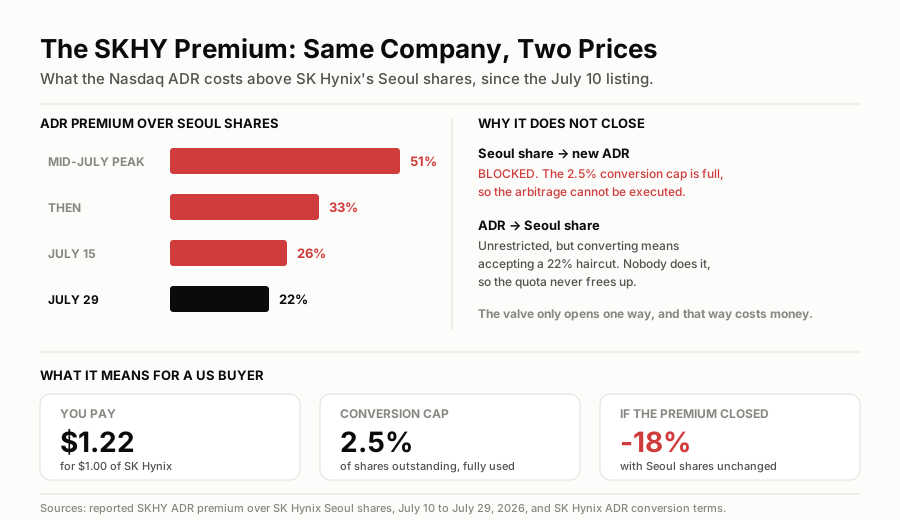
The premium is a liability that decays, and it has been decaying since day one.
What an ADR Actually Is
An American Depositary Receipt is not a share. It is a claim on a share.
A US bank holds the actual foreign stock in custody, then issues receipts against it that trade on a US exchange, in dollars, during US hours, settling through the normal US system. That is genuinely useful. It is why you can own SK Hynix from an ordinary brokerage account without a Korean broker, a won account, or a 2am alarm.
In a healthy ADR, the receipt tracks the underlying almost exactly, because banks can create new receipts when demand runs hot and cancel them when it cools. Creation and cancellation is the pressure valve. Arbitrageurs do the work for free: if the ADR gets expensive, they buy the cheap local share, deliver it to the depositary, receive a new ADR, and sell it. That selling closes the gap.
SKHY's valve is welded shut on one side. That is the entire story.
The 2.5% Cap: Why the Arbitrage Cannot Happen
SK Hynix capped the number of its shares convertible into ADRs at 2.5% of total shares outstanding. That quota is fully utilised.
Walk through what that does to the arbitrageur:
- They see SKHY at a 22% premium. Free money, in theory.
- They buy SK Hynix shares in Seoul at the cheap price. Fine so far.
- They try to deliver those shares to the depositary to create new ADRs. Blocked. The cap is full.
- The trade dies at step three.
There is no way to manufacture the supply that would meet US demand. So US demand keeps bidding against a fixed float, and the premium persists. Bloomberg reported the gap at nearly 51% in mid-July, when a well-known arbitrage was sitting in plain sight that literally nobody could execute.
The One-Way Valve
Here is the part that makes the trap self-sealing, and it is worth reading slowly.
Converting an ADR back into a Seoul share is unrestricted. No cap, no quota. So in principle, ADR holders could cancel their receipts, which would free up room under the 2.5% ceiling and let arbitrageurs create fresh ADRs.
Nobody does it. Why would they? Cancelling your ADR hands you a Seoul share worth 22% less than the receipt you gave up. You would be volunteering for the haircut. So the cancellations do not happen, the quota never frees up, the creation route stays blocked, and the premium sits there.
The only force that closes the gap is the slow, unglamorous one: the ADR price falling toward the local price through ordinary selling. Which is exactly what has been happening. From 51% to 33% to 26% to about 22%, while the shares themselves were also falling. Holders have been hit twice.
What This Actually Costs You
Concrete, because this is the part that matters for anyone thinking about buying the dip.
SKHY closed July 28 at $143.02 and traded near $130.17 on July 29, a record low, after SK Hynix's Q2 miss. It is roughly 13% below the $149 IPO price and 23% below the $170 debut open.
Now add the premium. At about 22%, if the gap closed completely and the Seoul shares did not move a single won, SKHY would fall roughly 18% from here. No forecast required, just arithmetic: $1 divided by $1.22 is $0.82.
So a US buyer at $130 is making two bets at once, and probably only knows about one of them:
- Bet one: SK Hynix the business is worth more than the market currently says. Reasonable people disagree, and we laid out both sides in the buy-the-dip breakdown.
- Bet two: the wrapper keeps commanding a scarcity premium. This has nothing to do with HBM, capex, or China. It is a plumbing question, and the plumbing has been leaking in one direction since the listing.
You can be completely right about bet one and still lose money on bet two.
The Conversion Test
Two-way conversion between ADRs and local shares was scheduled to begin July 29, the same day as the earnings print. The books had been closed until then, because newly issued Korean common shares cannot be transferred until they are formally listed on the Korea Exchange.
Do not expect it to solve this. The cap did not go away, and the cap is the binding constraint. What opening the books does is remove the procedural excuse for the premium while leaving the structural cause intact. Settlement delays, transaction fees and the limited pool of available ADRs all argue for some gap surviving indefinitely.
The realistic read: the premium keeps grinding lower rather than snapping shut. That is worse for holders than a clean break, because a slow bleed is easy to mistake for ordinary volatility and hard to point at when you review why the position lost money.
How to Own Korea Without This Problem
- EWY, the US-listed Korea ETF, holds the actual Seoul-listed shares through the fund structure and does not carry an ADR conversion cap. You get Samsung and SK Hynix at index weights plus everything else in the Kospi, which dilutes the memory thesis but removes the wrapper risk entirely.
- A direct Seoul account, if your broker offers international access, buys the actual share at the actual price. Higher friction, currency exposure to the won, and no premium.
- The US memory proxies, MU and SNDK, express the same cycle in deep, mature, fairly priced US instruments. Different companies, correlated thesis, no plumbing surprises. The valuation case is in the MU and SNDK piece.
- SKHY itself, if you want the pure play and accept the premium. That is a legitimate choice. It is only a mistake if you make it without knowing you made it.
The Options Angle
- Options on SKHY inherit the premium, and that is not obvious. The chain is priced off the ADR, not the Seoul share. So a call on SKHY is a call on the company and on the premium holding. If the gap compresses while the business improves, you can be right on the thesis and still expire worthless.
- The chain is three weeks old. Treat it accordingly. SKHY listed July 10. Spreads are wide, open interest is thin, and there is no history to build support levels from. Use spreads rather than naked premium, and size well below what your conviction suggests.
- Do not sell covered calls against SKHY as an income trade here. A covered call caps your upside while leaving you fully exposed to premium decay on the downside. You would be selling the good outcome and keeping the structural risk, which is precisely backwards.
- The cleanest hedge for premium risk is not an option at all. It is owning less SKHY and more EWY. Structural risks are usually cheaper to avoid than to insure.
- A shareholder return announcement does not fix the premium, and that is the trap in the August 4 catalyst. A buyback improves the Korean company and lands in Korean hours; SKHY inherits it at the US open with the 22% premium still attached. What August 4 actually unlocks is here.
The One-Line Read
SKHY and SK Hynix are the same company at two prices about 22% apart, the gap exists because a 2.5% conversion cap makes the obvious arbitrage physically impossible and no ADR holder will volunteer for a haircut to unblock it, and anyone buying the Nasdaq line at a record low should understand they are buying a memory thesis wrapped in a scarcity premium that has fallen from 51% to 22% since July 10 and has roughly 18% further it could go without the business changing at all.
Next up:Fed decision, today →
More on $SKHY
Updated Every Saturday
The Week Ahead
Every earnings date, Fed event and setup for the current trading week, on one page.
Refreshed Weekly
Earnings Calendar
Who reports next, when, and what consensus and the whisper expect.
The Week-Ahead Brief
Don’t miss next week’s setups. Get the Sunday brief.
Latest issue, Oct 25“The Fed, Microsoft, Alphabet and Amazon: the busiest week of earnings season”
Every Sunday: next week’s earnings dates, Fed days and the trades worth watching, from the same desk that writes the week-ahead hub. Free, built for retail investors.