Why Is IMXI Stock Up? California Pulled Its Approval
International Money Express traded at $14.60 premarket, up 24.79%, after New York approved Western Union's $16.00 cash deal. The same release says California suspended its approval on August 13.
TL;DR
- IMXI traded at $14.60 premarket at 6:37am ET Friday, up 24.79% on Thursday's $11.70 close. Western Union's agreed price is $16.00 a share in cash.
- New York approved. California suspended. The companies' release, out at 12:08am ET Friday, confirms the New York State Department of Financial Services signed off, and discloses that California's DFPI sent a letter on August 13 suspending the approval extension it had granted on July 31.
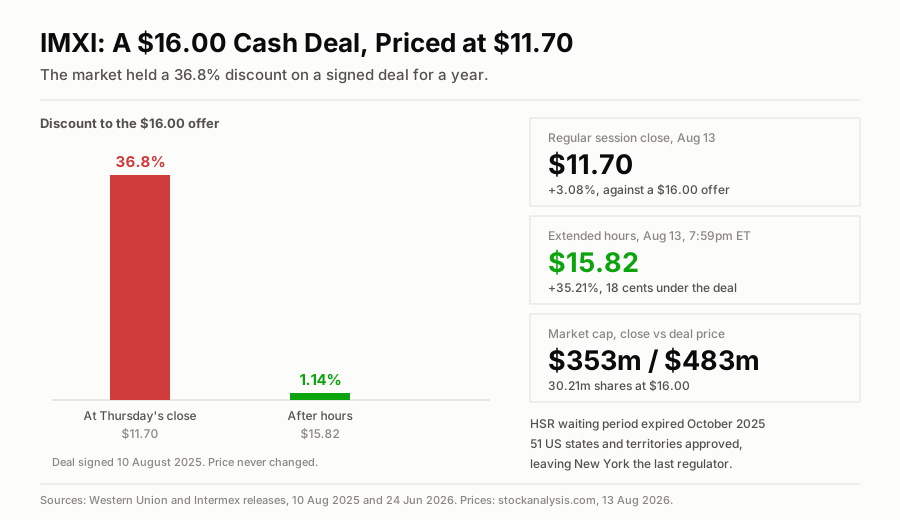
- The stock touched $15.82 in extended hours Thursday evening on the New York headline, then gave back about a dollar once the full release circulated. The spread went from 1.14% to 9.59% in a few hours.
- The merger agreement is on its last automatic extension. The Outside Date ran May 11, then August 10, and now steps to November 10, 2026. That is 88 days from Friday.
- At $14.60 the market is paying for a deal it still does not fully believe in. My arithmetic puts the implied odds near 72%, which is a long way from done.
More on Single Stocks: Options Scorecard: A Reddit Put and a Nutanix Pass, Both Right at Expiry →
Why Is IMXI Stock Up?
The New York State Department of Financial Services approved Western Union's acquisition of International Money Express, the last state regulator that had been holding out on a deal signed in August 2025. IMXI traded at $14.60 premarket Friday, up 24.79%, against the $16.00 a share Western Union agreed to pay.
The same press release contains the reason the stock is not at $16.00. On August 13, California's Department of Financial Protection and Innovation sent the companies a letter suspending an approval extension it had granted on July 31, saying it wanted to further review the transaction and examine its impact on California operations. Western Union and Intermex say they intend to close promptly after the California approval is reinstated.
So one regulator cleared and another un-cleared itself, on the same day.
The Board
New York signed on Thursday. California unsigned on Thursday. The stock is somewhere in between.
What California Actually Did
The DFPI did not reject the deal. It suspended an extension of its own earlier approval, which puts the transaction back in front of a regulator that had already waved it through once. That is a procedural step with no stated deadline attached to it, and no stated remedy either.
On substance, nothing in the release suggests California found a problem. It says the regulator wants to look again. The timing is the part the market is pricing, because a regulator that reopens a file in the last quarter of a merger agreement's life controls the calendar, whatever it eventually concludes.
Money transmission is licensed state by state, so a change of control needs every state's blessing and any one of them can hold the whole thing up. For a year that veto sat in Albany. It has moved to Sacramento.
What a 37% Spread Was Pricing
Merger spreads estimate two things: how likely a deal is to close, and how long it takes. On a signed, all-cash deal with a fixed price and no financing condition, a normal spread runs a couple of percent.
IMXI closed Thursday at $11.70 against a $16.00 contracted price, a gross spread of 36.8% on a deal announced on 10 August 2025, cleared under Hart-Scott-Rodino in October 2025, and approved by shareholders that December. The 52-week range says the same thing from another angle: the stock ran as high as $15.95 and as low as $11.15, and Thursday's close sat near the bottom of a year in which the contracted price never moved.
At the close, IMXI was worth about $353m on 30.21m shares. At $16.00 those shares are worth $483m. The market was leaving $130m on the table because it did not believe the last regulator would sign.
Compare that with how other agreed deals have traded this month. Safety Insurance went to a 42% single-day gain the day MAPFRE's bid landed, and Accelerant jumped on Thoma Bravo's take-private, because in both cases the announcement was the news. IMXI's announcement was a year ago, so Friday's repricing came out of a regulator's inbox rather than a bidder's.
New York Moved Last, and New York Got Political
New York's review attracted politics. In May 2026, Mayor Zohran Mamdani wrote to the Department of Financial Services opposing the transaction, arguing it "would further strain the already challenging economic circumstances facing New York City's immigrant communities" and warning that Western Union would "jack up remittance fees and squeeze families" after eliminating its top competitor. The city's Department of Consumer and Worker Protection filed its own comment.
Western Union has said retail remittances are roughly 60% of its revenue, which is the number underneath the fee argument on both sides. Take rates in cross-border payments are where that argument gets settled, and dLocal's quarter this week showed how quickly they compress when competition holds.
New York's answer, when it came, was conditional: the regulator extracted commitments on remittance services and physical locations in the state. California is now asking a version of the same question about its own residents.
What Is Left in the Spread
At $14.60, $1.40 remains, or 9.59% to the deal price.
That number needs a date. The merger agreement set an Outside Date of May 11, 2026, automatically extended to August 10, 2026 while money transmitter approvals were outstanding, and automatically extended again to November 10, 2026 where a restraint on any money transmitter requirement existed as of August 10. August 10 has passed and the deal has not closed, which puts it on the last of those legs. There is no fourth automatic extension in the agreement.
That gives the arithmetic a hard edge. Getting 9.59% over the 88 days to November 10 is roughly 40% annualised, and nobody offers 40% annualised on a deal they expect to close. Run it the other way: if IMXI is worth about $11.00 on a break and $16.00 on a close, then $14.60 implies roughly a 72% chance of completion. Both of those are my own calculations off the verified prices, and the break price is an assumption rather than a sourced figure, so treat the 72% as a sketch.
My read is that the market has this about right, which is unusual enough to say plainly. The California letter is four days old at most, carries no deadline, and lands on a deal with 88 days of contractual life left. A 9.6% spread is a reasonable price for that.
The Options Angle
There is a specific reason to be careful reaching for options on a name like this. A stock tethered to a fixed cash price has a strange volatility surface: most of the distribution is a point at $16.00, and the rest is a gap lower on a break. That is not a shape a straddle prices well, and it is why deal stocks so often look cheap on implied volatility and still lose money for premium buyers.
I could not source a live chain, so I am not logging an options structure. The call I will log is the equity, and it is a carry trade with regulatory risk attached rather than a view on Western Union.
Trade log
| # | Stance | Structure | Strikes and expiry | Cost or credit | Spot at writing | Implied move | Breakeven |
|---|---|---|---|---|---|---|---|
| 1 | Long, carry only | Common stock to deal close | No expiry; closes on completion or breaks | $14.60 | $14.60 premarket, Aug 14, 6:37am ET | n/a, deal-pinned | $16.00, +9.59% |
| 2 | Pass | Any option structure | Live chain not sourced | n/a | $14.60 premarket, Aug 14, 6:37am ET | Not sourced | n/a |
Row 1 scores as a win if the deal completes by November 10, 2026 and a loss if it breaks or the outside date passes without completion. Row 2 scores as a loss if IMXI moves more than a few percent in either direction before the deal resolves.
Correction
An earlier version of this piece, published at 11:45pm ET on August 13, was titled "Why Is IMXI Stock Up 35%? The 37% Spread Just Collapsed" and said the New York approval removed "the last outstanding US regulatory condition", leaving 1.14% to the deal price at an extended-hours quote of $15.82. That was written before the companies' 12:08am release, which disclosed California's suspension. New York was not the last condition, and the spread did not stay collapsed: it reopened to 9.59% by Friday's premarket. The earlier version also flagged the approval as single-sourced pending an announcement, and that announcement has now confirmed it.
The One-Line Read
New York approved and California un-approved on the same Thursday. The stock took the first headline to $15.82 and gave back a dollar on the second. At $14.60 the spread is a bet on Sacramento reading fast.
Next up:PCE inflation, Wednesday at 8:30am ET →
More on Single Stocks
Updated Every Saturday
The Week Ahead
Every earnings date, Fed event and setup for the current trading week, on one page.
Refreshed Weekly
Earnings Calendar
Who reports next, when, and what consensus and the whisper expect.
The Week-Ahead Brief
Don’t miss next week’s setups. Get the Sunday brief.
Latest issue, Sep 27“Micron, PCE and the jobs report that decides October”
Every Sunday: next week’s earnings dates, Fed days and the trades worth watching, from the same desk that writes the week-ahead hub. Free, built for retail investors.