Why Is SunScout (SNSC) Stock Down 39% After Its NYSE IPO?
SunScout Holding priced New Zealand's first NYSE American dual listing at $5 a share Tuesday. By Thursday's close it was $3.05, down 39%, and insiders get paid from the raise.
TL;DR
- SunScout Holding (NYSE American: SNSC) priced its IPO at $5.00 a share Tuesday, the low end of a $5-$6 range, and became the first New Zealand-headquartered company to dual-list on NYSE American and NYSE Texas.
- The stock opened Wednesday at $3.00, already 40% below the offer price, and closed Thursday at $3.05, down 39% from where the deal priced two days earlier.
- SunScout makes autonomous solar-powered robotic mowers, but its own prospectus says the "SunScout Products" revenue line, 28% of FY2025 sales, didn't come from selling any physical mowers. Most of the $4.8 million in FY2025 revenue was solar-installation and engineering services work.
- Post-IPO, the Cywinski family controls 96.3% of the vote through a dual-class structure where Class B shares carry 20 votes each. Part of the $15.5 million raised is paying Marc Cywinski, one of those controlling shareholders, for a company he sold to SunScout in January.
- No options chain exists yet on a stock two days old with a $73 million market cap.
More on Single Stocks: Options Scorecard: A Reddit Put and a Nutanix Pass, Both Right at Expiry →
The Board
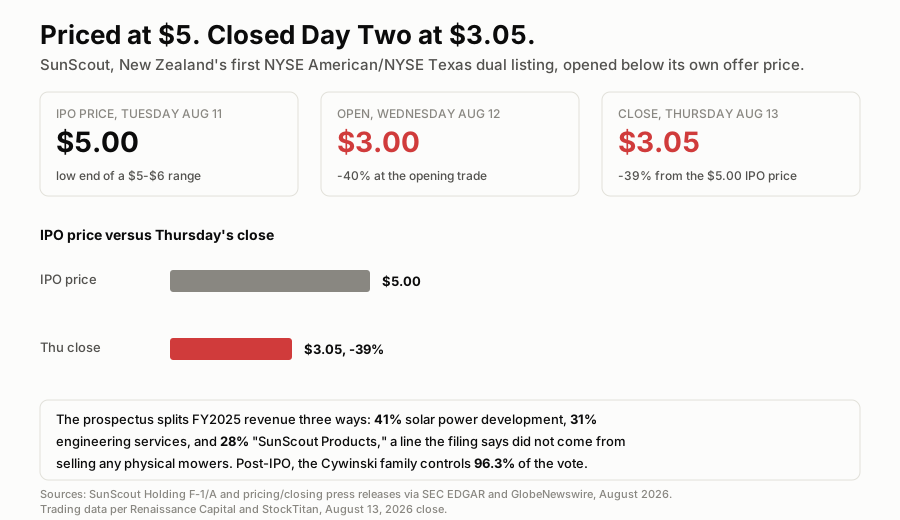
SunScout's first two trading sessions, and the ownership structure sitting underneath them.
Why Is SunScout Stock Down?
SunScout priced too high for what the market was willing to pay, and the stock corrected almost immediately. The deal sold 3.1 million Class A ordinary shares at $5.00, raising $15.5 million gross, and started trading Wednesday, August 12 on NYSE American and NYSE Texas under the ticker SNSC. The opening trade came in at $3.00, a 40% gap down from the offer price, before the stock spent its first session in a $3.00-$3.44 range. It closed Thursday at $3.05, down 39% from where underwriters Dominari Securities and Revere Securities had priced it a day before.
That's a specific kind of failure. It isn't a guidance miss or a bad quarter; the company hadn't reported anything as a public company yet. It's a mispriced offering on a name few US investors had heard of before Tuesday, corrected by the market within hours of the first trade. Not every small foreign listing breaks this way: Londian Wason priced at the top of its range two days earlier and held there, and SK Hynix's Nasdaq debut is the more common outcome for a deal that clears at a price the order book actually supports.
What SunScout Actually Sells
The pitch is autonomous, solar-powered robotic lawn mowers built around what the company calls Deployable Solar Array technology: panels that unfold to recharge the mower's batteries in place and fold away while it's cutting grass. SunScout is based in Palmerston North, New Zealand, was founded in 1998, and had 26 employees at the time of the offering. It sells three mower models (Eco, Pro and ProMax) and has distribution deals with WWS in Europe and MowBot in Australia and New Zealand, with what the prospectus describes as a potential Walmart relationship still being pursued.
Here's the part the mower story leaves out. FY2025 revenue (year ended June 30, 2025) split three ways: 41% solar power development solutions, 31% engineering products and services, and 28% the "SunScout Products" line. The prospectus is direct about that last number: it "did not arise from the sale of any physical SunScout products," but from manufacturing and commercialization arrangements instead. A year earlier, the mower line was 18.5% of revenue and the solar-development segment alone was 74.6%. Total FY2025 revenue came to $4.8 million, up 93.6% from FY2024, which is a real growth rate on a business that is, so far, mostly a solar-installation and engineering shop with a robotics story layered on top.
I'm not calling the mower wrong. Deployable solar arrays on an outdoor robot is a real piece of engineering, and the company's separate Brunton Engineering brand does precision fabrication work that presumably supports it. What I'd flag is that a reader coming to this IPO for a mower company is buying a solar-EPC and contract-engineering business that hasn't yet booked a dollar of product revenue by the prospectus's own account.
The Related-Party Money Trail
SunScout's IPO proceeds are earmarked for a new Austin, Texas manufacturing plant, marketing, product development, inventory, loan repayment, working capital, and one line worth reading closely: a $5.0 million payment for the acquisition of Brightway Energy LLC. That deal was signed January 9, 2026, structured as $2.0 million in cash plus $3.0 million in Class A shares, with payment deferred and contingent on the IPO closing.
Brightway Energy's founders were Marc Cywinski and Joshua Marotske. Marc Cywinski assigned part of his own entitlement to Marotske, so on completion Cywinski keeps $1.0 million cash and $1.5 million in shares, Marotske gets the rest. The same F-1/A that discloses this deal also discloses that Marc Cywinski, alongside Edwin Cywinski, will control 96.3% of SunScout's aggregate voting power after the offering, through a dual-class structure where Class A shares get one vote and Class B shares get twenty. The prospectus itself flags the obvious: "our controlling shareholder has substantial influence over the Company," and SunScout qualifies as a controlled company under NYSE American rules, meaning it can skip the usual majority-independent-board requirement.
None of that makes the Brightway deal improper. Brightway had already been combined into SunScout's financial statements under common control before the purchase agreement was signed, which is disclosed, not hidden. But it's worth being plain about the mechanics: a chunk of the $15.5 million retail and institutional investors just handed SunScout is flowing back out to a man who, immediately afterward, personally controls how the rest of it gets spent. Retail holders locked out of a say in that spending is a different problem from the one VCX's restricted shareholders are facing this week, but both stories turn on who actually gets to act on the stock price once the paperwork clears.
The Options Angle
There's no listed options chain on SNSC, and there won't be one for a while. New listings typically wait roughly a week before options start trading, and a $73 million company two sessions old with a controlled-company governance structure and a stock that already moved 40% on day one isn't the kind of name that jumps that queue. Nothing to price here yet.
Trade log
| # | Stance | Structure | Strikes and expiry | Cost or credit | Spot at writing | Implied move | Breakeven |
|---|---|---|---|---|---|---|---|
| 1 | Pass | No chain listed yet | N/A | N/A | $3.05, Thu Aug 13 close | Not sourced, no chain | N/A, logged as a pass to be scored |
The One-Line Read
SunScout priced a controlled company with almost no product revenue at $5 and the market repriced it to $3 within a day, which is less a verdict on solar-powered mowers than on what a $5-$6 range was worth for a business still mostly selling engineering services to itself.
Next up:PCE inflation, Wednesday at 8:30am ET →
More on Single Stocks
Updated Every Saturday
The Week Ahead
Every earnings date, Fed event and setup for the current trading week, on one page.
Refreshed Weekly
Earnings Calendar
Who reports next, when, and what consensus and the whisper expect.
The Week-Ahead Brief
Don’t miss next week’s setups. Get the Sunday brief.
Latest issue, Sep 27“Micron, PCE and the jobs report that decides October”
Every Sunday: next week’s earnings dates, Fed days and the trades worth watching, from the same desk that writes the week-ahead hub. Free, built for retail investors.