Applied Digital (APLD): Revenue Up 407%, a $36 Billion Lease Backlog, and $5 Billion of Debt
Applied Digital posted fiscal Q4 revenue of $258.7M, up 407%, with $36B of contracted leases and 1.41GW of IT load. It also carries $5B of debt and lost $110.6M on a GAAP basis.
TL;DR
- Fiscal Q4 revenue of $258.7 million, up 407% year over year for the period ended May 31, 2026. Full-year fiscal 2026 revenue rose 167%.
- The number that matters more: about $36 billion of total contracted long-term lease value, with roughly $20.2 billion of it added in the fourth quarter alone. Five campus leases were signed during the year, three in the past four months.
- Contracted critical IT load reached 1.41 gigawatts across the campuses. That is the physical version of the same claim: capacity already committed.
- The catch is the balance sheet. $4.2 billion of cash against $5.0 billion of total debt, and a GAAP net loss of $110.6 million attributable to common stockholders, against adjusted net income of $12.9 million.
- Shares fell 3% to $26.38 in regular trading on July 27, then rose more than 6% after hours to roughly $27.09. Needham kept a Buy with an $83 target.
More on AI & Semiconductors: Options Scorecard: The Week of August 24, Graded (4 Calls, 75% Right) →
What Applied Digital Actually Reported
| Line | Fiscal Q4 2026 | Note |
|---|---|---|
| Revenue | $258.7M | +407% year over year |
| FY2026 revenue growth | +167% | full year |
| Contracted lease value | ~$36B | ~$20.2bn added in Q4 |
| Contracted critical IT load | 1.41 GW | across five campuses |
| GAAP net loss to common | -$110.6M | the line that counts for a levered landlord |
| Adjusted net income | $12.9M | adjusted EPS $0.04 |
| Cash and restricted cash | $4.2B | as of May 31, 2026 |
| Total debt | $5.0B | as of May 31, 2026 |
Applied Digital builds and leases AI data centre capacity. It is a landlord, not a chip company, and that distinction is the entire investment case.
The Board
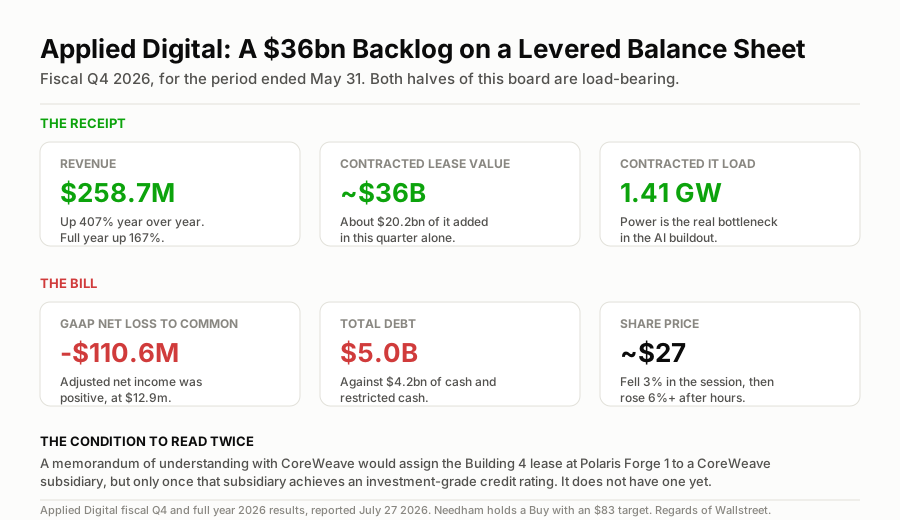
A $36 billion backlog on a balance sheet carrying $5 billion of debt. Both facts are load-bearing.
Why This Is the Cleanest Receipt in the AI Trade
For a fortnight the market has been asking one question of everything AI-adjacent: is the demand contracted, or is it a forecast?
Alphabet failed that test, posting the first negative free cash flow since its 2004 IPO on $44.9 billion of quarterly capex, and the Nasdaq 100 entered a correction on the back of it. Microsoft passed it, disclosing $678 billion of commercial RPO, up 84%, and rose about 8%. If you want the metric explained properly, we wrote what RPO actually is.
Applied Digital's version of that receipt is arguably even more concrete, because it is expressed in two units the market cannot argue with.
$36 billion of contracted lease value. Signed leases, long-dated, with roughly $20.2 billion added in a single quarter. For a company whose annual revenue is still measured in hundreds of millions, that is an extraordinary ratio of committed future revenue to current revenue.
1.41 gigawatts of contracted critical IT load. Power is the binding constraint on AI buildout. Not chips, not capital: grid interconnection and megawatts. A company with 1.41 GW already contracted holds something genuinely scarce.
And the counterparties are the right ones. Applied Digital signed a memorandum of understanding with CoreWeave to assign the Building 4 lease at Polaris Forge 1 to a CoreWeave subsidiary upon that subsidiary achieving an investment-grade credit rating. Read that condition carefully, because it cuts both ways: it is a real deal with a real AI operator, and it is contingent on a credit rating that does not exist yet.
The Balance Sheet Is the Whole Bear Case
$4.2 billion of cash against $5.0 billion of total debt, and a GAAP net loss of $110.6 million in the quarter.
Here is why that combination deserves more attention than the backlog.
Data centres are enormously capital intensive. You borrow, you build, you lease, and the lease payments service the debt. It works beautifully when the buildings fill on schedule and the tenants pay. It fails badly when either assumption slips, because the debt does not slip with it.
Applied Digital is running that model at speed, with three of five campus leases signed in the last four months. Growth that fast means construction commitments that are already made against revenue that has not arrived. Net debt is modest today at roughly $800 million, but the direction is what matters: building 1.41 GW of capacity costs vastly more than the cash on hand.
Then there is the gap between adjusted net income of $12.9 million and a GAAP loss of $110.6 million. That roughly $123 million difference is largely depreciation and financing costs. Adjusted numbers are useful for judging operations. For a leveraged landlord, the GAAP line is the one that tells you whether the assets are paying for themselves. They are not yet.
And the tenant quality question is unavoidable. The most exciting AI infrastructure customers are the least creditworthy: young, loss-making, heavily funded companies. A twelve-year lease is only worth what the tenant can pay in year eight. The CoreWeave arrangement being conditional on an investment-grade rating is Applied Digital telling you it understands that risk. It does not remove it.
The Bull Case and the Bear Case
Bull case. This is a pure play on the one bottleneck in AI that money cannot instantly solve: contracted power and shell capacity. 1.41 GW and $36 billion of signed leases against a market capitalisation that is a small fraction of that backlog is an unusual asymmetry. Revenue is compounding at 407%, the year was up 167%, and it just posted positive adjusted net income. Needham's $83 target against roughly $27 reflects how large the gap between backlog and current valuation is.
Bear case. It is a leveraged property developer wearing an AI costume. $5.0 billion of debt, a $110.6 million GAAP quarterly loss, construction obligations well ahead of revenue, and a tenant base concentrated in AI companies whose own funding depends on a capital cycle that is visibly wobbling. If AI capex decelerates in 2027, the leases get renegotiated or the tenants disappear, and the debt stays exactly where it is. The stock also fell 3% on the day of a strong report before recovering after hours: the market is not treating this as a straightforward win.
Our read: genuinely interesting and genuinely risky, and it should be sized as the second thing rather than the first. Own it only if you can articulate why the tenants will still be paying in 2030, because that is the actual bet. What would strengthen the case materially: the CoreWeave subsidiary achieving investment grade, which converts a contingent lease into a bankable one. What would break it: any hyperscaler publicly slowing a data centre build schedule, which is exactly the risk Vertiv's "minor timing shifts" comment hinted at this week.
The Options Angle
- At roughly $27, one contract is about $2,700 of notional, which makes this one of the few AI infrastructure names where a small account can use defined-risk structures at all.
- Implied volatility on APLD is high and stays high, because the equity is effectively a levered call on the AI buildout. That makes buying premium expensive and selling it dangerous. Neither side is cheap.
- Cash-secured puts below $25 are the most sensible expression if you want in: you are paid well for the volatility and you set your entry lower.
- Do not write covered calls tightly here. The whole point of owning a name with a backlog 100 times its revenue is the upside gap, and capping it defeats the thesis.
- The read-across matters as much as the ticker. If the AI landlord model works, Celestica, Vertiv and the rest of the picks-and-shovels complex re-rate with it. We covered the ODM side in the Celestica breakdown.
The One-Line Read
Applied Digital grew revenue 407% and holds $36 billion of contracted leases and 1.41 gigawatts of committed power, which is the most concrete demand receipt in the entire AI trade, and it carries $5 billion of debt against a $110.6 million quarterly GAAP loss: the backlog is real, the leverage is real, and the only question that matters is whether the tenants are still solvent when the leases mature.
Next up:Fed decision, Tuesday →
More on AI & Semiconductors
Updated Every Saturday
The Week Ahead
Every earnings date, Fed event and setup for the current trading week, on one page.
Refreshed Weekly
Earnings Calendar
Who reports next, when, and what consensus and the whisper expect.
The Week-Ahead Brief
Don’t miss next week’s setups. Get the Sunday brief.
Latest issue, Sep 7“Week ahead in the stock market...”
Every Sunday: next week’s earnings dates, Fed days and the trades worth watching, from the same desk that writes the week-ahead hub. Free, built for retail investors.