Celestica (CLS): Revenue Up 62%, Guidance Raised Twice Over, and Nobody Is Writing About It
Celestica posted Q2 revenue of $4.70B, up 62%, with adjusted EPS of $2.54 versus $1.39. It raised full-year revenue to $20.5B and EPS to $11.30. Why the market barely noticed.
TL;DR
- Revenue of $4.70 billion, up 62% from $2.89 billion a year earlier. Adjusted EPS of $2.54 against $1.39, so earnings grew faster than revenue.
- Adjusted operating margin expanded to 8.2% from 7.4%. Growing 62% while improving margin is the combination almost nobody in AI hardware is managing right now.
- The engine is one segment. CCS revenue rose 84% to $3.81 billion at an 8.7% margin, while the older ATS business grew 8% to $0.89 billion at 6.3%.
- Guidance went up across the board: 2026 revenue to $20.5 billion from $19 billion, adjusted EPS to $11.30 from $10.15, operating margin to 8.4% from 8.1%, and free cash flow to $600 million from $500 million. Management expects faster growth still in 2027.
- Q3 is guided to $5.25 to $5.55 billion of revenue and $2.88 to $3.08 of EPS. Shares rose more than 9% in extended trading, and this remains one of the least-covered large beats of the season.
More on AI & Semiconductors: Options Scorecard: The Week of August 24, Graded (4 Calls, 75% Right) →
What Celestica Actually Reported
| Line | Q2 2026 | Q2 2025 |
|---|---|---|
| Revenue | $4.70B | $2.89B, so +62% |
| Adjusted EPS | $2.54 | $1.39 |
| Adjusted operating margin | 8.2% | 7.4% |
| CCS revenue | $3.81B, +84% | 8.7% segment margin |
| ATS revenue | $0.89B, +8% | 6.3% segment margin |
And the raised outlook:
| Guidance | New | Prior |
|---|---|---|
| 2026 revenue | $20.5B | $19B |
| 2026 adjusted EPS | $11.30 | $10.15 |
| 2026 adjusted operating margin | 8.4% | 8.1% |
| 2026 free cash flow | $600M | $500M |
| Q3 revenue | $5.25-5.55B | newly issued |
| Q3 adjusted EPS | $2.88-3.08 | newly issued |
The Board
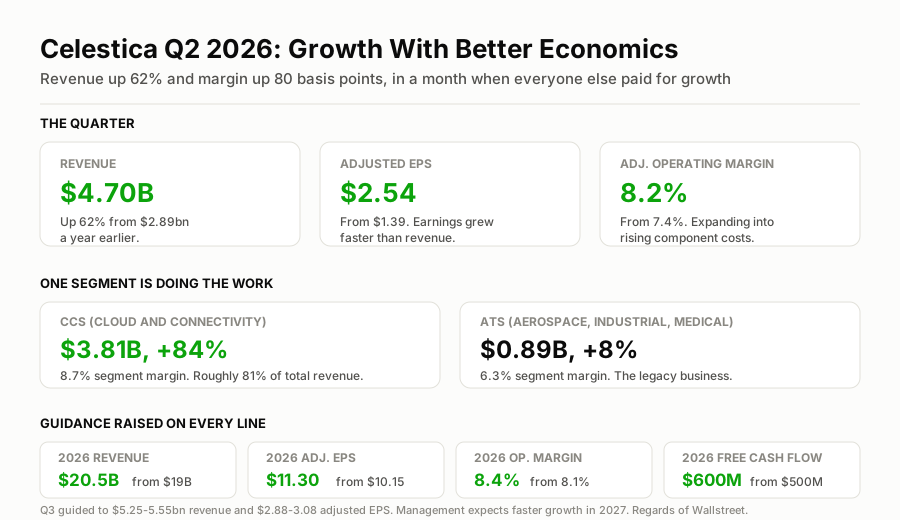
Revenue up 62%, margin up 80 basis points, and free cash flow guidance raised. That is the rare trio.
The Number That Makes This Different
Adjusted operating margin went up while revenue grew 62%.
Read that again, because in the current market it is close to unique. This entire month has been about companies growing fast and paying for it: Alphabet's first negative free cash flow since its 2004 IPO, Meta converting $31.86 billion of operating cash flow into $784 million of free cash flow, Qualcomm's EPS down 20% on rising input costs. The pattern is growth arriving with worse economics attached.
Celestica did the opposite. Margin 8.2% from 7.4%, guided to 8.4% for the year, with free cash flow guidance raised to $600 million from $500 million. That is operating leverage, in a sector where everyone else is reporting the reverse.
Which matters especially given what Celestica does. It is an ODM: it designs and builds hardware for other people, historically a thin-margin, low-differentiation business. Contract manufacturers are supposed to be the ones who get squeezed when component costs rise, and component costs are rising, as Qualcomm's guide-down made explicit this week.
Celestica raised margin guidance into that. Either it has genuine pricing power in AI networking hardware, or it is passing costs through with unusual success. Both are more than the market credits it with.
What CCS Actually Is, and Why 84% Growth Matters
CCS is Celestica's Connectivity and Cloud Solutions segment: networking hardware, switches and infrastructure sold largely to hyperscalers. It grew 84% to $3.81 billion and now represents roughly 81% of total revenue at an 8.7% margin, above the company average.
That one segment now defines the business. Celestica has turned from a diversified contract manufacturer into an AI networking supplier with a legacy division attached. ATS, the older aerospace, industrial and medical business, grew 8% to $0.89 billion at a lower 6.3% margin.
The growth mix has an obvious implication and an underappreciated risk. The implication: as CCS becomes a larger share of revenue, blended margin rises mechanically, which is part of why guidance went up. The risk: concentration. A business getting 81% of revenue from hyperscaler networking demand is a leveraged bet on exactly the capex cycle the market spent this month questioning.
So Why Did the Market Barely React?
Shares rose more than 9% after hours, which sounds like a reaction until you set it against the size of the raise. Lifting full-year EPS guidance from $10.15 to $11.30 is roughly an 11% increase in expected earnings power, announced alongside 62% revenue growth and margin expansion.
Three explanations, and they are not mutually exclusive.
It reported into the worst week of the quarter. Celestica's numbers landed while the memory complex was collapsing and the Nasdaq 100 was heading into a correction. Good news from a mid-cap gets no oxygen in a week like that.
It is under-covered structurally. Celestica is Canadian-listed and dual-listed, mid-cap by megacap standards, and sits in a category most investors do not follow. The same beat from a household name would have led every market wrap.
The market suspects the cycle, not the company. This is the serious version. Nobody doubts CLS is executing. The doubt is about how long hyperscaler networking orders keep compounding at 84%. A high-quality company levered to a questioned cycle gets a lower multiple regardless of execution.
The Bull Case and the Bear Case
Bull case. Revenue +62%, EPS nearly doubling, margin expanding, free cash flow guidance raised, guidance up across every line, and management saying 2027 grows faster still. Celestica is a direct beneficiary of the same buildout that gave Applied Digital $36 billion of contracted leases and Microsoft $678 billion of RPO, and it is capturing it with improving rather than deteriorating economics. If the AI infrastructure cycle has years left, this is a compounder that the market is valuing as a contract manufacturer.
Bear case. 81% of revenue from one segment serving a handful of hyperscaler customers is concentration risk however well it is executing, and ODM contracts can be repriced or reassigned with little notice. Component and memory cost inflation is a direct threat to a business assembling hardware, and Celestica's margin gain may prove to be a timing benefit from inventory bought before prices rose rather than durable pricing power. The stock had already fallen roughly a third before this print, so the market has been pricing cycle risk for a while. And a company guiding to accelerating 2027 growth is making a claim about hyperscaler capex that hyperscalers themselves have not confirmed beyond 2026.
Our read: a buy, and the most reasonably valued way to own AI hardware we have looked at this month. The margin expansion is what convinces us: businesses without pricing power do not improve margin while growing 62% into rising input costs. Size it for the concentration, not for the growth rate, and watch the CCS margin line each quarter rather than the revenue line. If CCS margin holds above 8.5% through the memory cost cycle, the pricing power is real. If it slips toward 7%, the last two quarters were inventory timing.
The Options Angle
- Celestica's implied volatility is elevated and its realised moves are large, which makes short-dated premium selling a poor risk here despite the tempting yield.
- If you want exposure, shares are the cleaner instrument. The thesis is a multi-quarter cycle call, and there is no expiry that matches it.
- Cash-secured puts are the reasonable structured entry if you want to be paid to wait for a cycle wobble, and this is a name where a hyperscaler capex headline can hand you a much better price within days.
- Avoid covered calls at tight strikes. A stock guided to accelerating growth into 2027 has an upside gap you are being paid too little to surrender.
- The read-across is the trade. If Celestica's 84% CCS growth is representative, then Amazon's AWS capex commentary tonight confirms it or breaks it. See the Amazon preview.
The One-Line Read
Celestica grew revenue 62%, nearly doubled EPS, expanded margin to 8.2% and raised full-year guidance to $20.5 billion and $11.30, and got a 9% after-hours move because it reported in the same week the memory complex collapsed: the margin expansion into rising component costs is the evidence of genuine pricing power, and the 81% revenue concentration in hyperscaler networking is the reason to own it at a modest size.
Next up:Fed decision, Tuesday →
More on AI & Semiconductors
Updated Every Saturday
The Week Ahead
Every earnings date, Fed event and setup for the current trading week, on one page.
Refreshed Weekly
Earnings Calendar
Who reports next, when, and what consensus and the whisper expect.
The Week-Ahead Brief
Don’t miss next week’s setups. Get the Sunday brief.
Latest issue, Sep 7“Week ahead in the stock market...”
Every Sunday: next week’s earnings dates, Fed days and the trades worth watching, from the same desk that writes the week-ahead hub. Free, built for retail investors.