Qualcomm FQ3 2026 Earnings Breakdown: Revenue Near the High End, Profit Down 20%, and the Memory Shortage Is Now Everyone's Problem
Qualcomm posted $9.95B revenue near guidance highs but non-GAAP EPS fell 20% to $2.21, and guided FQ4 light on component costs. Handsets down 20%, automotive up 38%. The margin story explained.
TL;DR
- Revenue of $9.95 billion came in near the high end of guidance and above the $9.68 billion consensus. The demand side was fine.
- Non-GAAP EPS of $2.21 fell 20% year over year, from $2.77, and landed a whisker below the $2.23 estimate. Revenue near the top, profit down a fifth. That gap is the entire report.
- Handset chip revenue fell 20% to $5.1 billion, which management framed as China bottoming. Automotive hit a record, up 38%.
- Fiscal Q4 guidance was light on profit: revenue $9.7 to $10.5 billion but adjusted EPS only $2.05 to $2.25. Management blamed rising wafer fabrication, memory, advanced packaging, assembly and test costs, and said it is raising product prices in response.
- Shares fell in extended trading. This is the first megacap chip designer to put the memory shortage on its own income statement as a margin event rather than someone else's story.
More on $QCOM: Qualcomm Earnings Preview (July 29): The Apple Countdown Clock Hangs Over Everything →
What Qualcomm Actually Reported
| Line | FQ3 2026 | Comparison |
|---|---|---|
| Revenue | $9.95B | vs $9.68B est, near high end of guide |
| Non-GAAP EPS | $2.21 | vs $2.23 est, down 20% from $2.77 |
| Handset chips | $5.1B | -20% y/y |
| Automotive | record | +38% |
| FQ4 revenue guide | $9.7-10.5B | in line |
| FQ4 adjusted EPS guide | $2.05-2.25 | light |
Note what is not here: a demand miss. Revenue beat consensus and printed near the top of the company's own range. Every problem in this report is on the cost side of the ledger.
The Board
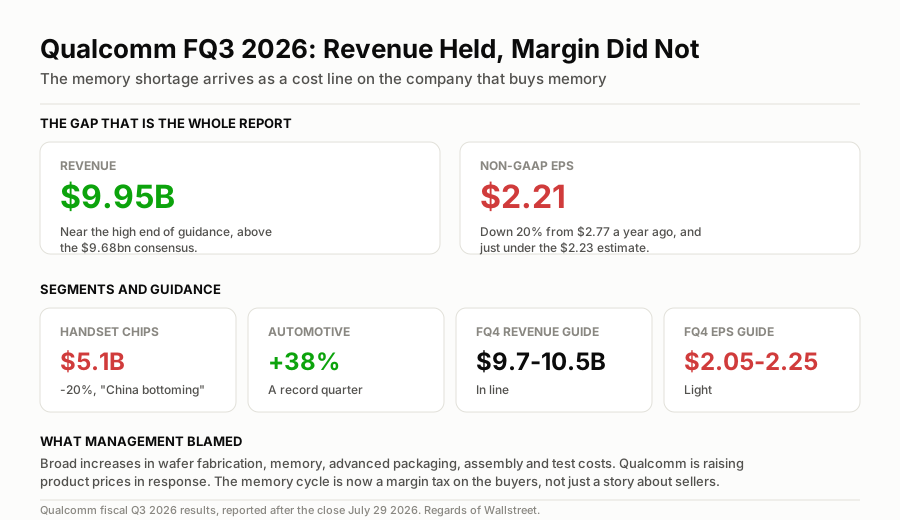
Revenue near the top of guidance, profit down 20%. Everything in between is input costs.
The Memory Shortage Just Changed Sides
This is the important part, and it goes well beyond Qualcomm.
For a month this site has covered the memory story from the supply side: CXMT's 466% Shanghai IPO debut, the Korean crash that took SK Hynix down 14.7% and Samsung 13.4% in a session, Micron's drawdown. The framing throughout was about whether memory makers can hold price. We covered that in why everything was crashing on July 28 and in the CXMT explainer.
Qualcomm just told you the other half of the trade. When memory prices go vertical, somebody pays those prices, and the payers are every company that puts memory inside a product.
Management named the cost lines explicitly: wafer fabrication, memory, advanced packaging, assembly and test. All rising. Qualcomm's response is to raise product prices, which is the correct response and also an admission that margins are being defended rather than expanded.
Microsoft said the same thing in different words hours earlier: roughly $25 billion of its calendar-2026 capital spending is attributable purely to higher component pricing. Two very different companies, on the same evening, both reporting that the memory cycle is now a cost event on their own statements.
That reframes the whole sector trade. The memory shortage is not only a question of whether Micron and SK Hynix can sustain pricing. It is a margin tax on everyone downstream, and it lands with a lag, which means more of these prints are coming.
Handsets Down 20%, Automotive Up 38%
Two segments moving in opposite directions, and the market cares about them unequally.
Handsets fell 20% to $5.1 billion, with management calling it a bottoming in China. Take that carefully. "Bottoming" is a hopeful word for a segment that just declined 20%, and Qualcomm has called a handset bottom before. If it is genuinely the trough, this is the last ugly comparison. If it is not, the largest segment in the business has further to fall.
Automotive set a record, up 38%. This is the diversification thesis working, and it is the reason to own Qualcomm at all. Automotive is stickier, higher content per unit, and structurally growing, while handsets are a replacement-cycle business in a saturated market.
The problem is arithmetic. Automotive growing 38% off a small base cannot offset handsets falling 20% off a $5.1 billion base. Mix improvement is real and it is slow, and the market prices the slow part.
Scoring Our Own Preview
Our preview yesterday argued that the Apple modem transition, not the handset cycle, decides Qualcomm's multiple, and it flagged that the print would be under-covered and the reaction noisy because it landed in the busiest hour of the quarter alongside Microsoft, Meta, Arm and Robinhood.
The timing call was right. This was the least-covered major print of the night and the after-hours tape was thin.
The framing call was wrong. We said the modem transition mattered more than the handset cycle. What actually decided this quarter was neither: it was input costs. Nobody on this site, us included, had the memory shortage flowing through to Qualcomm's gross margin as the swing factor in a July print. That is the lesson worth keeping: when an input cost moves violently enough, it outranks every strategic narrative you have built about a company.
The Bull Case and the Bear Case
Bull case. Revenue near the top of guidance, automotive at a record and growing 38%, China possibly troughing, and a stock trading around 15x forward earnings with analyst price targets clustered near $221 against a share price starting the day at $166.97. If handsets have bottomed and input costs normalise as memory capacity comes online in 2027, both halves of the margin squeeze reverse at once and the earnings power snaps back.
Bear case. Non-GAAP EPS is down 20% year over year and next quarter is guided to fall again at the midpoint. A company raising prices into a saturated handset market is testing customer patience at exactly the wrong moment. The Apple modem transition remains an unresolved structural risk to the licensing business, and it has not gone away just because costs stole the headline this quarter. And "China is bottoming" is a claim, not a result.
Our read: a hold rather than a buy, and a genuinely cheap one, which is not the same thing. The valuation already reflects the handset decline. What it does not yet reflect is a multi-quarter input cost squeeze, because that risk only became visible tonight. Wait for one quarter of stable gross margin before adding. If you already own it, the automotive line is your thesis and it is intact. For income-focused holders, the dividend is well covered even on guided-down EPS, which is the best thing in this report.
The Options Angle
- At roughly $167, one contract is about $16,700 of notional, which keeps cash-secured puts realistic for a mid-sized account.
- Implied volatility collapses after the print, so buying puts on the guide-down now is paying full price for news already in the tape.
- This is a reasonable covered call candidate for existing holders: a cheap stock with a decent dividend, a capped near-term catalyst set, and no obvious upside gap until the next handset cycle.
- Watch the read-across rather than the ticker. If the memory cost squeeze is sector-wide, the trade is not in Qualcomm, it is in the names that have not reported yet and still have this on their income statements. Our take on the supply side is in the memory supercycle thesis check.
The One-Line Read
Qualcomm delivered revenue near the high end of guidance and still saw profit fall 20%, then guided next quarter light because wafer, memory, packaging and test costs are all rising at once: this is the memory shortage arriving as a margin tax on the companies that buy memory rather than sell it, and Qualcomm is the first of several that will report it.
Next up:Fed decision, Tuesday →
More on $QCOM
Updated Every Saturday
The Week Ahead
Every earnings date, Fed event and setup for the current trading week, on one page.
Refreshed Weekly
Earnings Calendar
Who reports next, when, and what consensus and the whisper expect.
The Week-Ahead Brief
Don’t miss next week’s setups. Get the Sunday brief.
Latest issue, Sep 7“Week ahead in the stock market...”
Every Sunday: next week’s earnings dates, Fed days and the trades worth watching, from the same desk that writes the week-ahead hub. Free, built for retail investors.