Cerebras (CBRS) Q2 Results: Margin Beat Its Own Guide, Stock Fell 16% Anyway
Cerebras beat its own core revenue and margin guides in Q2, raised full-year revenue guidance, and CBRS still fell about 16% after hours. Here is what the GAAP-versus-core headlines got wrong.
Updated August 12 after the close with reported Q2 results. The preview below this update said the margin guide, not the revenue number, was the real event; Cerebras beat both, and the stock still sold off harder than the margin miss it didn't have.
Updated 11:00am ET August 13: the after-hours sell-off carried into the regular session. CBRS traded at $227.50, down 13.19% from Wednesday's $262.06 close, an intraday quote rather than a close, valuing the company near $54.1 billion. That is above Wednesday evening's $220.51 after-hours print, so the session opened into the drop and recovered part of it. The sell-side has not moved yet: the aggregated 12-month target still averages about $292.55.
Updated after the August 13 close: CBRS finished the regular session near $231, down roughly 11.7% from Wednesday's $262.06. Three quote sources put the close between $230.79 and $232.43 and the decline between 11.3% and 11.9%, so I am quoting the range rather than picking one to the cent. The close landed above both Wednesday's $220.51 after-hours print and Thursday's 11am level, so the stock clawed back part of the drop across the session.
TL;DR
- Cerebras beat its own numbers. Core revenue of $209.9 million cleared the company's own $194 million guide by about 8%, and core gross margin of 41% beat the 36-38% guide the company had cut seven weeks earlier.
- A GAAP-versus-core mixup is circulating. Several trackers reported a "miss" by comparing GAAP revenue of $180.1 million, a different, smaller accounting measure that excludes customer-warrant amortization and data-center pass-through activity, against the $194 million core consensus. That is not the same number and it is not a miss.
- CBRS still fell. Shares closed the regular session at $262.06, up 11.63%, then traded at $220.51, down 15.86%, in after-hours activity at 5:51pm ET, an hour after the print.
- Guidance went up, not down. Q3 core revenue is guided to $214-216 million with margin recovering to 38-40%, and full-year core revenue guidance was raised to $880-890 million from $855-865 million.
- The GAAP net loss was $450.5 million ($2.98 a share), versus a $6.9 million core net loss. The gap is almost entirely a stock-based compensation charge, on the order of $380 million by one accounting, which core results are built to exclude. It is real dilution to shareholders and not a sign the underlying business lost that much money.
More on Earnings: Stock Market Week Ahead (Sep 21-25): Costco, AutoZone, KB Home and a 5% Ten-Year →
The Board
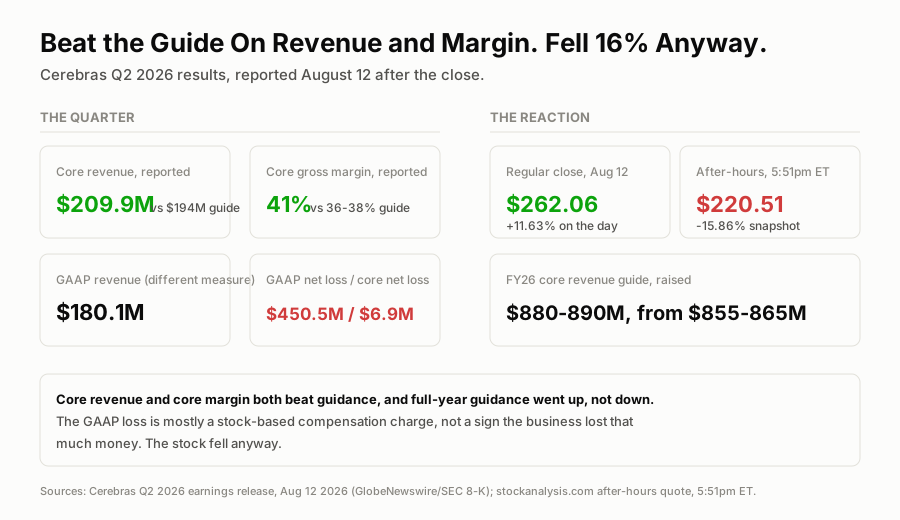
Revenue beat the guide. Margin beat the guide. The stock fell 16% after hours anyway.
Did Cerebras Beat Earnings?
Yes, on the numbers that were actually guided. Core revenue of $209.9 million beat the company's own $194 million guide by roughly 8%, up 103% year over year and up about 9.7% sequentially from Q1's $191.3 million, well ahead of the roughly flat sequential growth the guide implied. Core gross margin came in at 41%, better than the 36-38% range management had cut to seven weeks earlier, though still down from Q1's 46.5%.
Be careful which revenue number is being quoted. Cerebras also reported GAAP revenue of $180.1 million, a smaller figure that excludes non-cash customer-warrant amortization and data-center pass-through revenue the core measure includes. Several trackers compared that $180.1 million GAAP figure directly against the $194 million core consensus and reported a revenue miss. It wasn't one: the two numbers are measuring different things, and the like-for-like comparison, core against core, was a clean beat.
Why the Margin Line Mattered Most Going In
The margin guide is the reason this piece flagged the quarter as worth watching in the first place. On the June 23 Q1 call, CFO Bob Komen guided Q2 core gross margin to 36-38%, down from 46.5% in Q1. Cerebras shares fell more than 12% the next session on that guidance alone, even with a revenue beat sitting right next to it.
The mechanism was specific: Cerebras has been renting third-party data center capacity, plus a smaller amount of systems rented back from an existing customer, to meet immediate demand from OpenAI while its own data centers are still being built out. Komen said the rental cost would trim core cloud and services margin by 10-15 percentage points relative to Q1. Those owned facilities were guided to start coming online in Q3 2026, with the buildout running through Q4 2027.
The 41% actual print says the drag was smaller than guided, not that it disappeared. Q3 guidance calls for core gross margin to recover further, to 38-40%, still below Q1's 46.5% peak. The company's own framing, in CEO Andrew Feldman's words on this call, is that margins are "in a good spot, and growing, because fast inference is priced at a premium." The stock's reaction says a chunk of the market wanted more than a beat of a lowered bar.
The Customer Concentration Problem This Quarter Is Supposed to Be Fixing
The reason Cerebras is renting capacity back at all traces to who it was serving before the IPO. In 2025, G42 (the Abu Dhabi AI company) accounted for 24% of revenue and Mohamed bin Zayed University of Artificial Intelligence accounted for 62%, meaning two UAE-linked entities made up 86% of the company's $510 million in 2025 revenue. That concentration, closer to 87% in 2024, was the single biggest risk factor in the IPO prospectus and part of why the offering took years to get to market.
The OpenAI contract, a multi-year deal reported at more than $20 billion for roughly 750 megawatts of inference compute, and a March 2026 partnership with AWS to deploy Cerebras CS-3 systems inside Amazon's own data centers, are the direct answer to that concentration problem. Management said on the Q1 call that GPT model inference was running on Cerebras hardware 35 days after the OpenAI agreement was signed, which is a genuinely fast execution timeline for infrastructure of this scale. The AI Compute Deal Ledger we maintain tracks binding commitments like this one across the sector; it's worth checking what's actually binding versus announced before taking any headline number on faith.
The release's headline framing was cloud, not customer mix: GAAP cloud and other services revenue of $126.0 million, up 281% year over year, with the company describing its fast-inference cloud business as having nearly quadrupled. That is the business line built to serve OpenAI-style inference demand. The release did not break out exact revenue percentages by customer the way the IPO prospectus did for 2025, so the specific G42/MBZUAI-versus-OpenAI/AWS split investors wanted is still not fully public. Remaining performance obligations reached $25.4 billion as of June 30, which is the clearest available signal that the newer, larger contracts are building a real backlog rather than replacing the UAE relationships outright.
What The Release Actually Showed
- Confirmed: the margin guide held, and beat. 41% actual against a 36-38% guide.
- Confirmed: revenue beat, on a like-for-like core basis. $209.9 million against $194 million.
- Raised, not just reaffirmed: full-year guidance. $880-890 million core revenue, up from $855-865 million, is a stronger signal than simply holding the line would have been.
- Not fully disclosed: the customer-mix breakdown. The $25.4 billion RPO figure and the 281% cloud-revenue growth are the closest proxies available; a clean OpenAI/AWS-versus-G42/MBZUAI split was not in the release as sourced here.
The Options Angle
This piece logged no new play ahead of the print, on the reasoning that both headline guide numbers came from the company itself seven weeks earlier and left little informational edge in guessing whether Cerebras would beat its own homework. That call holds up: the beat was real and the stock still moved sharply, which is closer to a repricing of the story than a reaction to any single number in the release.
Wall Street's own read, for context rather than a trade taken here: 11 analysts averaged a 12-month price target near $292 ahead of the print (aggregator estimates clustered between $291 and $298, high $340, low around $209-273), a Strong Buy skew with 10 buys and 1 hold. The $220.51 after-hours print sits well below that average target, which either means the target book gets cut in the days ahead or the sell-off is a short-term positioning flush against a multi-year thesis analysts haven't changed their mind on. This piece isn't calling that split tonight.
Trade log
| # | Stance | Structure | Strikes and expiry | Cost or credit | Spot at writing | Implied move | Result |
|---|---|---|---|---|---|---|---|
| 1 | Pass | No new play | N/A | Live CBRS chain pricing not sourced at writing | $230.01 (Aug 11 close) | Not sourced; Aug 14 put/call ratio 0.56x (Barchart) | Stock fell to $220.51 after hours (-4.1% from the logged spot); a pass avoided the drop but a short structure would have paid better than sitting it out |
The One-Line Read
Cerebras beat the two numbers it guided seven weeks ago, core revenue and core gross margin both, raised full-year guidance, and the stock fell roughly 16% after hours anyway, because a name already trading on a multi-year AI-infrastructure story doesn't get much credit for clearing a bar it set itself, and the customer-concentration question this quarter was supposed to answer is still not fully answered. CoreWeave reported into the same AI-infrastructure skepticism this week, and Nebius reported the same morning; Coherent posted the same beat-and-sell-off pattern the same evening on the optics side of the trade. Check the earnings calendar for what else lands this week.
Next up:PCE inflation, Wednesday at 8:30am ET →
More on Earnings
Updated Every Saturday
The Week Ahead
Every earnings date, Fed event and setup for the current trading week, on one page.
Refreshed Weekly
Earnings Calendar
Who reports next, when, and what consensus and the whisper expect.
The Week-Ahead Brief
Don’t miss next week’s setups. Get the Sunday brief.
Latest issue, Sep 20“The week after the hike: two housing reads and Costco earnings...”
Every Sunday: next week’s earnings dates, Fed days and the trades worth watching, from the same desk that writes the week-ahead hub. Free, built for retail investors.