Charter-Cox Merger Vote Today: The Last Approval, and a $6.8 Billion Hole
California votes at 2:00pm ET Thursday on the last approval the $34.5bn Charter-Cox merger needs. Cox agreed to take 33.6m units at $354 each. Charter trades near $152.
TL;DR
- The California Public Utilities Commission votes at 11:00am PT, 2:00pm ET on Thursday, August 13. California is the last regulatory signature the $34.5 billion Charter-Cox combination needs. Federal approval, New York and Connecticut are already done.
- Cox Enterprises agreed to take 33.6 million Charter partnership units valued at $11.9 billion, an implied $354 a unit. Charter traded at $152.28 at 10:55am ET Thursday, an intraday quote rather than a close. That tranche is worth about $5.1 billion at that price, roughly $6.8 billion below the implied value in the signed agreement.
- The vote is not really in doubt. Both proposals in front of the commission, the judge's and a commissioner's alternate, recommend approval with conditions. They differ on how hard the low-income broadband commitments bite. Both say yes.
- A missed vote costs time, not the deal. Slipping past a September 15 Department of Justice deadline would mean refiling, a $2.5 million fee and at least another 30 days.
- Charter trades at 3.91x trailing earnings because it lost 172,000 broadband customers last quarter. That multiple is the argument on both sides of this stock.
More on Single Stocks: Options Scorecard: A Reddit Put and a Nutanix Pass, Both Right at Expiry →
The Board
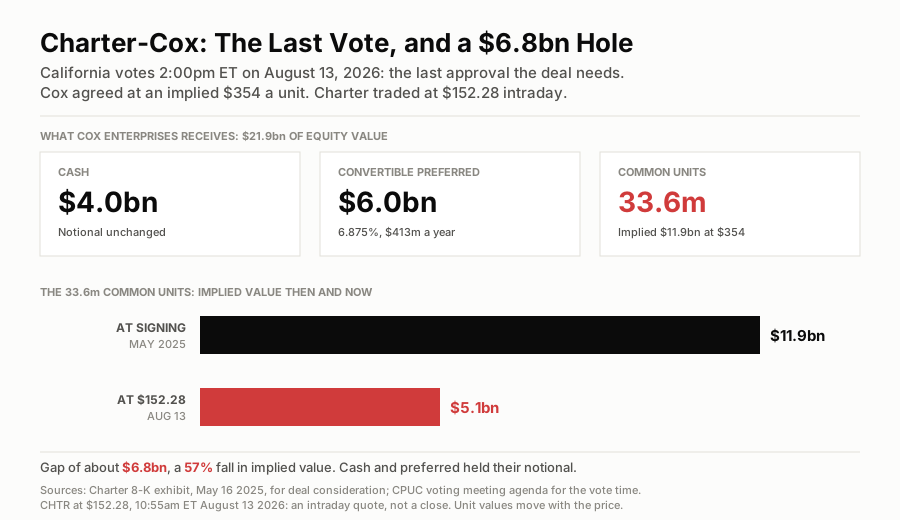
The cash and the preferred held their notional. The 33.6 million common units did not.
What Time Is the CPUC Vote on the Charter-Cox Merger?
11:00am Pacific, 2:00pm ET on Thursday, August 13, at the CPUC auditorium on Van Ness Avenue in San Francisco, with a public webcast. It sits on a regular voting meeting agenda as a scheduled item.
Commissioners choose between two documents. Administrative Law Judge Jamie Ormond's proposed decision approves the transaction and attaches low-income service commitments beyond what Charter already agreed to in settlement. Commissioner Matthew Baker's alternate accepts the settlement agreements with minor clarifications and hands enforcement drafting to staff. Consumer advocates read Baker's version as the softer one on broadband access. Both require Charter to offer affordable service to low-income Californians, including California LifeLine tiers.
Approval in some form is the expected outcome. The interesting variable is which set of conditions rides along.
The $354 Problem
When the two companies signed in May 2025, Cox Enterprises' consideration was set out in the 8-K exhibit as three pieces: $4.0 billion in cash, $6.0 billion notional of Charter partnership convertible preferred units, and 33.6 million Charter partnership common units worth $11.9 billion. Those add to the $21.9 billion of equity value, which with $12.6 billion of net debt gives the $34.5 billion enterprise value in every headline. The arithmetic closes exactly.
Divide $11.9 billion by 33.6 million units and you get roughly $354 a unit. The units exchange into Charter common shares, so that number is directly comparable to the screen.
Charter changed hands at $152.28 at 10:55am ET on Thursday, up 1.37% on the session against Wednesday's $150.22 close. At that price the 33.6 million units are worth about $5.1 billion. Against the $11.9 billion in the agreement, that is a shortfall near $6.8 billion, and the units have lost about 57% of their implied value. Treat that dollar figure as a snapshot struck at $152.28 on August 13. The unit count is the durable number here; the price moves every day.
The cash is still $4 billion. The preferred is still $6 billion of notional carrying a 6.875% coupon, which is $413 million a year. It is the common-unit slice, the largest of the three, that repriced. Cox agreed to become a 23% owner of a business, and the market has since marked that business down by more than half.
I would not read this as Cox getting a bad deal in some absolute sense. They are receiving a fixed share of a combined company rather than a fixed dollar amount, which is what taking stock means and what the 23% figure describes. But anyone quoting "$34.5 billion" today is quoting a May 2025 price tag on a May 2025 stock.
Why Charter Fell While the Lawyers Worked
Broadband customers left. On July 24 Charter reported second-quarter revenue of $13.5 billion, down 1.7% year over year, with adjusted EBITDA down 4.3% (down 3.2% excluding Cox transition costs). Adjusted earnings of $10.66 a share beat the $10.00 consensus, and the stock fell hard anyway.
The line that mattered: Spectrum internet customers fell by 172,000 in the quarter, to 29.4 million. A year earlier the same quarter lost 117,000, and the year before that 149,000, so the trend is not a straight line down. Management pointed at fixed wireless and fiber expansion. CEO Chris Winfrey put part of it on Charter's own first-quarter retention offers, which he said had "some impact, but not enough to really merit what we did. I own that." A leverage target of 3.5x was set on the same call.
Not everything shrank. Spectrum Mobile lines rose by 406,000 in the quarter and 1.7 million over twelve months, and net income attributable to shareholders was $1.3 billion. Charter is selling phone service to its own broadband base faster than it is losing the broadband base. Whether that trade is accretive depends on what the mobile lines earn against what the internet customers paid, and the company does not break that out cleanly.
So the stock sits at 3.91x trailing earnings, on TTM EPS of $38.51 and revenue of $54.4 billion, against $95.6 billion of total debt and $509 million of cash. Forward multiple, 3.49x. Revenue is falling about 1.5% a year and the debt is fixed, which is the arrangement the multiple is describing.
A low multiple on a declining cash flow is arithmetic rather than cheapness. A low multiple on a stabilising one is a mispricing. Q3 broadband net adds, due late October, decides which of those Charter is.
The Debt Nobody Discusses Until Close
Pro forma net debt for the combined company was put at $110.9 billion at signing, a leverage ratio of 3.93x, against management's stated 3.5x target. The combination brings 69.5 million passings and 37.6 million customers, and $500 million of annualised cost synergies expected within three years of close.
Set the preferred coupon against earnings for a moment. Charter's trailing twelve-month net income is $4.924 billion. The $413 million annual preferred dividend to Cox is about 8.4% of that, payable in cash, ahead of the common. It does not show up in the enterprise-value headline and it is a permanent claim on the same cash flow that has to service $95.6 billion of existing debt while revenue declines 1.5%.
The combined company takes the Cox Communications name within a year of closing, and the board goes to 13 directors with Cox designating three. Charter shareholders end up as minority partners in something named after the other side of the table.
The Options Angle
There is no trade in the vote itself, and the reason is specific to this event rather than a general shrug.
A binary regulatory catalyst is worth paying for when the outcomes diverge. These do not. Both documents in front of the commission recommend approval; the disagreement is over conditions that affect low-income service obligations rather than deal completion. And the downside branch is weak: missing the September 15 DOJ deadline means a refiling, a $2.5 million fee and a 30-day wait, which is a scheduling problem rather than a broken deal. A straddle needs a fat tail somewhere, and I cannot find one on a 2:00pm agenda item where both drafts say yes.
The tradeable question in Charter is not today's vote at all. It is the October broadband number. Buying options into a formality and holding through to a print eleven weeks out means paying for the wrong window.
My call on the stock: not yet, and for a falsifiable reason. I want to see broadband losses narrow from 172,000 back toward the 117,000 of a year ago before the 3.91x multiple means anything. If Q3 losses come in wider than about 200,000, the multiple is a value trap and gets cheaper. That is a call to be scored in late October.
Trade log
| # | Stance | Structure | Strikes and expiry | Cost or credit | Spot at writing | Implied move | Breakeven |
|---|---|---|---|---|---|---|---|
| 1 | Pass | Long straddle into the CPUC vote | Not struck | Live CHTR chain not sourced at writing | $152.28 intraday, 10:55am ET Aug 13 | Not sourced | Both proposed decisions approve; scored against the Aug 13 close |
| 2 | Pass | Long CHTR common | N/A | N/A | $152.28 intraday, 10:55am ET Aug 13 | N/A | Waiting on Q3 broadband net adds, late October; buy trigger is losses narrowing toward 117,000, fail trigger wider than 200,000 |
The One-Line Read
California clears the last hurdle today on a deal priced against a $354 Charter unit, and Charter trades at $152. Cox is getting its 23%. What that 23% is worth now depends entirely on an October subscriber number.
Related: Wendy's and the Peltz take-private bid is the other deal on the tape this week where the price and the premise moved apart, and Teledyne's move for Varex shows what a clean one looks like. The rest of the week is in the week-ahead hub and the earnings calendar.
Next up:PCE inflation, Wednesday at 8:30am ET →
More on Single Stocks
Updated Every Saturday
The Week Ahead
Every earnings date, Fed event and setup for the current trading week, on one page.
Refreshed Weekly
Earnings Calendar
Who reports next, when, and what consensus and the whisper expect.
The Week-Ahead Brief
Don’t miss next week’s setups. Get the Sunday brief.
Latest issue, Sep 20“The week after the hike: two housing reads and Costco earnings...”
Every Sunday: next week’s earnings dates, Fed days and the trades worth watching, from the same desk that writes the week-ahead hub. Free, built for retail investors.