Core PCE and Q2 GDP, July 30: The Print That Decides Whether Three Fed Dissents Become Five
June core PCE is expected at 3.3% year over year, down from a three-year high of 3.4%, with Q2 GDP near +2.3%. Why this 8:30am print matters more than Apple or Amazon.
TL;DR
- 8:30am ET Thursday July 30. June core PCE, the Fed's preferred inflation gauge, is expected at +0.1% to +0.2% monthly and 3.3% year over year, down from 3.4% in May, which was a three-year high.
- Headline PCE is expected to fall 0.1% on the month, taking the annual rate to about 3.6% from 4.1%. Most of that is energy, and energy is the least reliable part.
- The first estimate of Q2 GDP lands in the same release window, expected near +2.3% annualised versus +2.1%, along with personal income (+0.3%), personal spending (+0.4%) and weekly jobless claims.
- This print matters more than usual because of what happened yesterday: the Fed held on a 9-3 vote with three members voting to hike 25 basis points. Core PCE is the evidence that decides whether they gain allies by September.
- The market has already taken a side. The 30-year Treasury jumped past 5.193% yesterday while the 2-year fell to 4.236%. That shape says the bond market thinks the Fed is behind.
More on $SPY: Stock Market Week Ahead (Sep 7-11): Labor Day, Apple's iPhone Event, Oracle, Adobe, and August CPI →
What Time Is Core PCE, and What Is Expected?
8:30am ET on Thursday July 30, and the number that matters is core PCE at 3.3% year over year.
The full slate, all released in the same window:
| Release | Expected | Prior |
|---|---|---|
| Core PCE, monthly | +0.1% to +0.2% | +0.3% |
| Core PCE, annual | 3.3% | 3.4% (three-year high) |
| Headline PCE, monthly | -0.1% | +0.4% |
| Headline PCE, annual | 3.6% | 4.1% |
| Q2 GDP, first estimate | +2.3% annualised | +2.1% |
| Personal income | +0.3% | +0.7% |
| Personal spending | +0.4% | +0.7% |
Bloomberg Economics has headline PCE falling 0.07% on the month, putting the annual rate near 3.7%, with core up 0.18% and easing to 3.3%. So the consensus and the modellers agree on direction. The disagreement is entirely about magnitude.
The Board
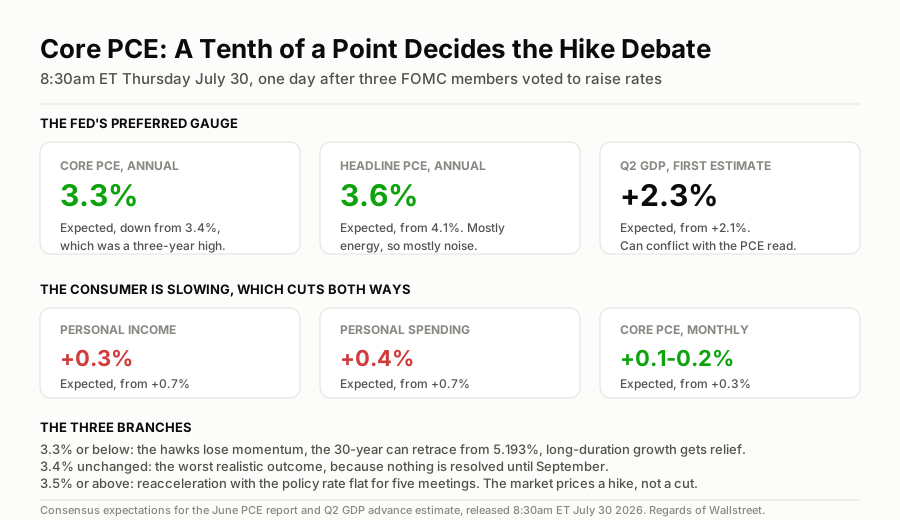
A tenth of a percent decides whether the hawks recruit.
Why This One Actually Matters
Most PCE prints are a formality. This one is a vote count.
Yesterday the Fed held at 3.50% to 3.75% for a fifth consecutive meeting, but Hammack, Kashkari and Logan all dissented in favour of a 25 basis point hike. That is a 9-3 split, and a 9-3 split is not a stable equilibrium. Either the data cools and the dissenters fold, or inflation firms and they recruit. Full detail in last night's Fed piece.
Core PCE is the specific measure the FOMC targets. Not CPI, not PPI. So this morning's number is the closest thing to a direct referendum on whether the three hawks were right.
The scenarios, and they are not symmetric:
Core PCE at 3.3% or below. Disinflation resumes after a stall. The hawks lose their argument, the long end has room to retrace from 5.193%, and equities get relief that is about the discount rate rather than about earnings. This is the good outcome and it is also roughly what is priced.
Core PCE at 3.4%, unchanged. The worst of the realistic outcomes, because it is ambiguous. Inflation stalled at a three-year high, the Fed is on hold, and nothing is resolved until September. Ambiguity with a 5.19% long bond means the market keeps demanding a higher risk premium.
Core PCE at 3.5% or above. Inflation reaccelerating with the policy rate unchanged for five meetings. Three dissents become a credible majority, and the market has to price a hike rather than the cuts it spent the first half of 2026 hoping for. We argued weeks ago that the cut was dead and the hike was the live risk. This would be the confirmation.
Read the Composition, Not the Headline
Three traps in this release.
1. Headline PCE will look great and mean little. A -0.1% monthly print taking the annual rate from 4.1% to 3.6% is a big improvement, and most of it is energy. Crude collapsed from $102 to the mid-$80s after the US and Iran paused strikes. Energy disinflation is real for consumers and close to meaningless for the Fed, which is exactly why the Fed looks at core.
2. Spending is decelerating hard, and that cuts both ways. Personal spending going from +0.7% to +0.4% while income slows from +0.7% to +0.3% is a consumer losing momentum. Lower demand means lower inflation pressure, which is dovish. It also means slower growth, which is bad for earnings. A market worried about inflation will read it as good news. A market worried about a slowdown will read the same number as bad. Watch which one it picks.
3. GDP and PCE can point opposite ways in the same release. A +2.3% Q2 GDP first estimate says the economy has momentum and the Fed has room to stay restrictive. A soft core PCE says the opposite. If both print as expected, the bond market resolves the conflict, not the equity market. See our framework for the long end.
What It Does to Stocks
Mechanically, through the discount rate, and unevenly.
Long yields set the present value of distant cash flows. That is why yesterday's move to a 5.193% 30-year hit technology down 2.36% and industrials down 3.42% while energy and consumer defensives finished green.
So a cool core PCE helps exactly the names that have been hurt most: long-duration growth, semiconductors, anything whose value sits in 2030. Microsoft's 8% after-hours gap on $678 billion of contracted backlog is precisely the kind of asset a falling long rate revalues upward and a rising one marks down. That is why this print outranks the earnings, and why we said the same in today's what-to-watch guide.
A hot print does the reverse and does it fast, because the market has no cushion: the Nasdaq Composite is already more than 10% below its record and semiconductors are more than 20% off their highs.
The Playbook
- Do not add risk before 8:30am. This is a scheduled binary. There is no edge in front of it and plenty of cost.
- Watch the 30-year, not the S&P, in the first ten minutes. The bond market prices this release faster and more honestly than equities do.
- If core PCE comes in hot, the trade is not to sell tech, it is to check your duration exposure across both books. Long-dated growth equity and long-dated bonds are the same bet on inflation cooling.
- If it comes in cool, resist calling the correction over on one data point. The cause of this drawdown is a bond market repricing inflation risk. One month of good core PCE softens that, it does not end it.
- For options, this is the wrong day to be short premium. An unresolved macro binary at 8:30am with two megacap earnings after the close is a poor setup for collecting a few dollars of theta.
The One-Line Read
Core PCE at 3.3% would confirm that May's three-year high was a stall rather than a turn, and give the doves the argument they need one day after three FOMC members voted to hike: it is a tenth of a percentage point that decides whether the 30-year retreats from 5.193% or keeps going, and that yield, not Apple or Amazon, is what prices the tech market right now.
Next up:Fed decision, Tuesday →
More on $SPY
$SPY · 2026-09-05
Stock Market Week Ahead (Sep 7-11): Labor Day, Apple's iPhone Event, Oracle, Adobe, and August CPI
$SPY · 2026-09-04
Options Scorecard: The Week of August 24, Graded (4 Calls, 75% Right)
$SPY · 2026-08-29
Stock Market Week Ahead (Aug 31-Sep 4): Broadcom, Dell, and a Jobs Report Into 57% Hike Odds
Updated Every Saturday
The Week Ahead
Every earnings date, Fed event and setup for the current trading week, on one page.
Refreshed Weekly
Earnings Calendar
Who reports next, when, and what consensus and the whisper expect.
The Week-Ahead Brief
Don’t miss next week’s setups. Get the Sunday brief.
Latest issue, Sep 7“Week ahead in the stock market...”
Every Sunday: next week’s earnings dates, Fed days and the trades worth watching, from the same desk that writes the week-ahead hub. Free, built for retail investors.