Stock Market Week Ahead (Sep 7-11): Labor Day, Apple's iPhone Event, Oracle, Adobe, and August CPI
Week ahead September 7-11: Oracle beat and jumped 7% after hours, Adobe's raised guide didn't stop a selloff, and hot PPI and CPI prints pushed hike odds to roughly 85-86% to close the week.
Show 3 earlier updates
TL;DR
- US stock and bond markets are closed Monday, September 7 for Labor Day. Four sessions this week, and the two big ones are at the end of it.
- August CPI landed Friday, September 11 at 8:30am ET: +0.4% headline (3.4% year over year, dead on consensus), +0.3% core (a tenth hotter than expected), per the BLS. It was the last inflation reading the Fed sees before it votes on the 16th, and the hot core pushed hike odds to roughly 85-86%.
- Oracle beat on every headline number Thursday and jumped roughly 7% after hours. Non-GAAP EPS of $1.92 against $1.74 consensus, revenue up 30% to $19.3 billion, and RPO up $209 billion year over year to $664 billion; capex of $28.5 billion and negative free cash flow are the caution.
- Adobe beat and raised guidance and still sold off, down roughly 2% after hours to about $243.50 on top of a 2.37% regular-session drop, as the CEO transition to Anil Chakravarthy and AI-monetization timing outweighed the print.
- Apple unveiled the iPhone Duo, its first foldable, on Wednesday at $1,999-$3,199, John Ternus's first launch as CEO. The phone had been reported on for months, and AAPL closed down 0.28%, in line with the site's own 'sell the news' expectation.
- August PPI ran hot Thursday, 5.4% year over year against 5.3% expected, and September hike odds jumped to roughly 70-73% on CME FedWatch, up from about 60% entering the week. Friday's CPI core beat pushed odds further to roughly 85-86%, the highest read of the whole runway, closing out the Fed's blackoutThe blackout is the quiet period before each Fed meeting when policymakers stop speaking publicly about rates and the economy. It exists so markets are not steered in the final days before a decision. period with all six scheduled events now hawkish or neutral.
- Friday's market closed higher and snapped the losing streak: S&P 500 up 0.86% to 7,656.98, Nasdaq up 0.96% to 26,333.04, as cooling oil outweighed the hotter CPI core. Kroger beat narrowly on EPS but missed on revenue and cut its full-year same-store sales guide; it is not covered elsewhere on this site.
- Tuesday's four earnings all beat, and two still sold off. ServiceTitan guided below Wall Street's model for next quarter and fell about 20% after hours; Casey's General Stores beat cleanly on fuel margin but reiterated its full-year guidance and fell about 9%. GameStop beat and raised its outlook and traded roughly flat; United Natural Foods missed on revenue and still closed up 2.28%.
- Wednesday's earnings split on guidance again. Signet Jewelers beat and raised its full-year EPS guide sharply and closed up 23.96%; Chewy beat on revenue but its free cash flow fell 15.5% on integration costs and it closed down about 11% despite raising its outlook; AeroVironment posted a large EPS beat and a record backlog but only reaffirmed guidance, and recovered after hours after closing down 5.36% in a weak broad tape.
- Thursday's market fell a fourth straight day on the hot PPI and $100 oil: S&P 500 down 0.58% to 7,591.70, Dow down 0.6%, Nasdaq down 0.65%. RH beat sharply on profit ($2.70 EPS) on a tariff benefit and Copart missed on profit but paired its print with a $1.9 billion agreement to buy ACV Auctions, sending both CPRT and ACVA sharply higher after hours.
What to Expect From the Stock Market This Week
Four trading days, one big inflation print, and two large software companies reporting into the same hour. Plus Apple's iPhone event, where we expect the first folding iPhone to be unveiled.
The S&P 500 closed the prior Friday's regular session at 7,718.60, down 0.38%. The Nasdaq Composite finished at 26,506.99 and the Dow at 53,414.25. That was before this week's PPI and CPI both ran hot; the sector heatmap has the day-by-day read on where the reaction landed.
The rate path moved. August payrolls came in at +162,000 against estimates near 55,000, and traders lifted September hike oddsHike odds come from fed funds futures, contracts that pay out based on where the Fed's rate ends up. Their prices imply a probability, so 'a 57% chance' is what traders are betting, not a poll or a forecast. to roughly 60% into the close. The revisions influenced this repricing as much as the headline number. July's initial minus 23,000 became plus 21,000. Three weeks of "the labour market is cracking" was based on a figure the BLS has now revised.
The Board
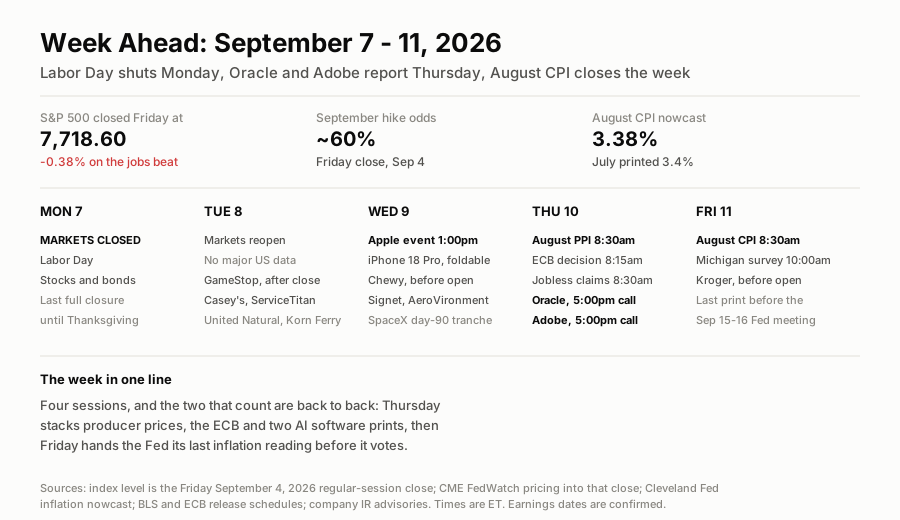
Four sessions, and two of them carry the whole week.
Is the Stock Market Open on Labor Day 2026?
No. The NYSE and Nasdaq are closed all day Monday, September 7, and the bond market is closed with them. Trading resumes at 9:30am ET on Tuesday. Every 2026 closure sits on the market hours page.
It is the last full-day closure until Thanksgiving, and the traditional line where summer volumes end. Whether volume actually comes back is worth watching Tuesday.
Tuesday, September 8: A Thin Reopen, Until the Earnings Landed
Nothing happened on the US statistical calendar, as expected. The earnings did not stay quiet. United Natural Foods reported before the open with an adjusted EPS beat, $0.69 against $0.62 consensus, but revenue of $7.64 billion missed the roughly $7.83 billion analysts wanted; the stock still closed up 2.28% at $44.93.
The after-the-close trio split three ways. GameStop beat on GAAP EPS ($0.51 against $0.31 a year ago) and raised its full-year adjusted EBITDA guide to more than $650 million, and traded roughly flat after hours near $18.80. ServiceTitan beat on revenue and non-GAAP EPS but guided next quarter below what Wall Street had modeled, paired the print with its chief revenue officer stepping back, and fell about 20% after hours to $64.77. Casey's General Stores beat cleanly, EPS of $7.37 on a record 47.8-cents-a-gallon fuel margin, but reiterated rather than raised full-year guidance as same-store sales growth decelerated, and fell about 9% after hours to $669. Three beats, two sell-offs: the guide mattered more than the quarter, same as it has all season. Korn Ferry reports Wednesday morning instead, not Tuesday as this piece first had it; the times for every name are on the earnings calendar.
Wednesday, September 9: Apple, Chewy, and a SpaceX Tranche
Apple's "Surprise and Shine" event ran at 1:00pm ET at Apple Park, John Ternus's first launch as CEO. Apple unveiled the iPhone Duo, its first foldable, at $1,999 to $3,199 depending on storage, alongside the iPhone 18 Pro and Pro Max on a new A20 Pro chip and an Apple Watch refresh. The foldable had been reported on for months, so the stock did what leaked hardware usually does to it: AAPL closed down 0.28% at $315.34, inside a broader market decline (the S&P 500 fell 0.48% on the day on rising oil and Treasury yields), per The Motley Fool and a Vantage Markets report agreeing on the close.
Chewy and Signet Jewelers reported before the open, and split hard on guidance rather than the headline print. Signet posted adjusted EPS of $2.19 against $1.74 consensus (GAAP EPS of $1.33, the gap being an $0.86-a-share asset impairment charge) and raised its full-year adjusted EPS guide to $10.45-$12.15 from $9.20-$11.00, and the stock closed up 23.96% at $102.48 per StockAnalysis.com, a rally CNBC had already clocked at roughly 19-20% by midday. Chewy beat narrowly on revenue ($3.33 billion against $3,317.3 million consensus) and matched consensus on adjusted EPS ($0.36), but free cash flow fell 15.5% year over year as capex rose 71% on integration costs from its SmartPak and Modern Animal acquisitions, and the raised full-year outlook did not stop the stock closing down about 11%, near $20.6-$20.75 (StockAnalysis.com and MarketBeat differ on the exact print by about a point, at $20.75/-10.83% and $20.54/-11.75%).
AeroVironment reported after the close: non-GAAP EPS of $0.59 against a roughly 25-30 cent consensus (sources differ on the exact estimate) on a record $1.5 billion funded backlog, up 37% year over year, but full-year guidance was reaffirmed rather than raised. The stock had already closed down 5.36% at $140.80 in a weak broad tape ahead of the report, then recovered to $145.39, up 3.26%, after hours.
Lastly, SpaceX's day-90 lock-upAfter a company lists, insiders and early investors are barred from selling their shares for a set period, the lock-up. When it ends those shares can be sold for the first time, so a large release can pressure the stock. tranche, roughly 319 million shares, became eligible on Wednesday, and SPCX closed down 3.86% at $147.55, in the same range as the pre-trade dip the August 20 tranche produced. Every tranche sits on the IPO lock-up calendar, and the full unlock calendar has the detail on today's tranche and what's still ahead.
Thursday, September 10: PPI Ran Hot, and Oracle's Beat Outran Adobe's
The densest day of the week, and it delivered on that billing. Markets fell a fourth straight session: the S&P 500 closed down 0.58% at 7,591.70, the Dow fell 0.6% to 52,064.10, and the Nasdaq dropped 0.65% to 26,081.72, with oil above $100 a barrel on the Middle East conflict, per Yahoo Finance.
August PPI rose 0.4% on the month, matching consensus, but 5.4% on the year, a tenth above expectations, with core PPI (excluding food, energy and trade services) up 0.3% on the month and 4.7% on the year, per the BLS; more than three-quarters of the monthly rise traced to energy, where diesel jumped 24.1%. Traders pushed September hike odds to roughly 70-73% on CME FedWatch, per CNBC, up from about 60% entering the day; the September Fed hub tracks the full six-event scorecard.
The ECB raised its three key rates a quarter point, as all 65 economists in the Reuters poll had expected, taking the deposit rate to 2.50%, per the ECB's own statement, citing Middle East-driven inflation pressure it expects to stay above target for an extended period. Because the move was priced in, Lagarde's 12:45pm GMT press conference carried the real signal, on the guidance for the rest of the year.
Oracle closed the regular session down 5.38% at $152.94 ahead of its own report, per StockAnalysis.com, then beat on every headline number after the bell: non-GAAP EPS of $1.92 against $1.74 consensus, revenue of $19.3 billion, up 30%, cloud revenue (IaaS plus SaaS) up 62% to $11.6 billion on 121% growth in cloud infrastructure, and remaining performance obligations up $209 billion year over year to $664 billion, per Oracle's own release. Fiscal 2027 guidance moved up to at least $90 billion of revenue and about $8.10 of non-GAAP EPS, and shares jumped roughly 7% after hours, per CNBC, back above the $160 level the stock had closed under during the day. Our question from the preview, how long Oracle needs to turn the RPO backlog into recognized revenue, still went unanswered: the release doesn't break it out. Quarterly capex hit $28.5 billion, and free cash flow ran negative by roughly $5 billion, so the debt-funded build-out story is unchanged even with the beat.
Adobe closed down 2.37% at $248.83 in the regular session, then fell a further roughly 2% after hours to about $243.50 despite beating on both lines: EPS of $6.13 against $6.07-6.08 consensus, revenue of $6.76 billion, up 13% year over year, against about $6.69 billion consensus, per Investing.com. Adobe also raised full-year guidance above consensus, non-GAAP EPS of $24.45-$24.50 against $23.49 expected. The beat-and-raise wasn't enough: the same question this preview flagged, whether Firefly and AI-native tools offset each other fast enough, is now tangled with the September 3 announcement that Anil Chakravarthy succeeds Shantanu Narayen as CEO on December 1, and investors are pricing the leadership change over the print.
RH closed down 3.84% at $134.02 ahead of its own report, per StockAnalysis.com, then beat sharply on profit: non-GAAP EPS of $2.70, well above every consensus figure in circulation (estimates cited across sources ranged from about $0.39 to $1.78, an unusually wide spread this piece can't resolve to one number), helped by a $55.1 million tariff benefit. Revenue of $922.2 million landed slightly light of the roughly $915-936 million analysts wanted, and shares jumped in after-hours trading; the size of the move is contested, with reports ranging from about 9% to 12%.
Copart closed down 4.00% at $30.75, per StockAnalysis.com, then missed on profit even as revenue edged past consensus: GAAP diluted EPS of $0.35, below the roughly $0.38 analysts expected, as net income fell 17.4% to $327.4 million on rising facility and vehicle-sales costs. The same release carried the bigger story: Copart agreed to buy ACV Auctions for $10.50 a share in cash, about $1.9 billion, a roughly 45% premium to ACV's price a month earlier, per Copart's 8-K. Copart shares jumped about 8.6% after hours to roughly $33.40 on the deal, and ACV itself jumped 43%.
Friday, September 11: August CPI, Kroger, and Consumer Sentiment
August CPI printed at 8:30am ET: +0.4% on the month, 3.4% on the year, both dead on the Dow Jones consensus. Core ran a tenth hot, +0.3% against a 0.2% consensus, with the annual core rate easing only to 2.4% from July's 2.5%, per the Bureau of Labor Statistics. Headline stayed at July's 3.4% rather than climbing to the 3.6% this hub flagged as the clean hawkish trigger, but the core beat, arriving one day after a hot PPI, was enough on its own: hike odds jumped to roughly 85-86%.
Kroger beat narrowly on adjusted EPS ($1.09 against $1.05 consensus) but missed on revenue ($34.62 billion against roughly $34.69 billion expected) and cut its full-year identical-sales guide to 0.2%-0.8% from 1%-2%, per the Associated Press. Kroger is not covered elsewhere on this site.
The University of Michigan's preliminary September sentiment survey fell to 47.8, its second-lowest reading since 1952, as one-year inflation expectations jumped to 4.6% on the same gasoline spike that drove CPI's headline, per CNBC. Stocks shrugged it off: the S&P 500 closed up 0.86% at 7,656.98 and the Nasdaq Composite up 0.96% at 26,333.04, snapping the four-session losing streak, as cooling oil prices outweighed both the hot core and the weak sentiment read.
The September hub tracks the odds into the vote, and the CPI release page carries the time in London and UTC and every remaining 2026 date.
The One-Line Read
A holiday, then two boring sessions, then Thursday and Friday brought the whole week's data at once: PPI and then CPI both ran hot, and the Fed goes into its blackout with hike odds at their highest read of the runway.
Next up:Fed decision, Tue, Oct 27 →
More on $SPY
$SPY · 2026-10-10
Stock Market Week Ahead (Oct 12-16): JPMorgan and the Big Banks, September CPI, TSMC, and the Last Fed Speeches Before October 28
$SPY · 2026-09-27
Stock Market Week Ahead (Sep 28-Oct 2): Micron Earnings, PCE Inflation, and the Jobs Report That Decides an October Fed Hike
$SPY · 2026-09-25
Options Scorecard: No New Grades This Week, and an Analog Devices Round Trip
Updated Every Saturday
The Week Ahead
Every earnings date, Fed event and setup for the current trading week, on one page.
Refreshed Weekly
Earnings Calendar
Who reports next, when, and what consensus and the whisper expect.
The Week-Ahead Brief
Don’t miss next week’s setups. Get the Sunday brief.
Latest issue, Oct 11“September CPI, the big banks and TSMC: earnings season starts”
Every Sunday: next week’s earnings dates, Fed days and the trades worth watching, from the same desk that writes the week-ahead hub. Free, built for retail investors.