CXMT's 4F² DRAM Claim Hit Samsung and SK Hynix: What 4F² Means and What It Doesn't Prove
China's CXMT said it will ship 4F² server DDR5 memory by the end of 2026. The Kospi fell about 5.5% on Oct 13. What a 4F² cell is, who else is building one, and what is still unproven.
TL;DR
- CXMT, China's largest DRAM maker, said it will launch server DDR5 memory built on a 4F² cell design by the end of 2026. Its president made the claim at a Shanghai chip conference on October 10. CXMT has not published chip specifications, yields or a launch date.
- A 4F² cell takes up one third less area than today's 6F² cell, so a chip could hold up to 50% more cells. Samsung and SK Hynix are both developing 4F² too. The expected Samsung timing is around 2028.
- The Kospi closed down 3.65% on Monday, October 12 and about 5.5% on Tuesday, October 13. Samsung fell roughly 7% on Tuesday and SK Hynix 9-10%, depending on the source.
- The announcement is a plan, not a product. The open questions are whether the chips yield well enough to sell, and whether data-center customers will buy them. Neither has an answer yet.
More on $SKHY: SK Hynix on August 4: The US Rule That Gagged a Record Quarter, and What Actually Unlocks →
The Board
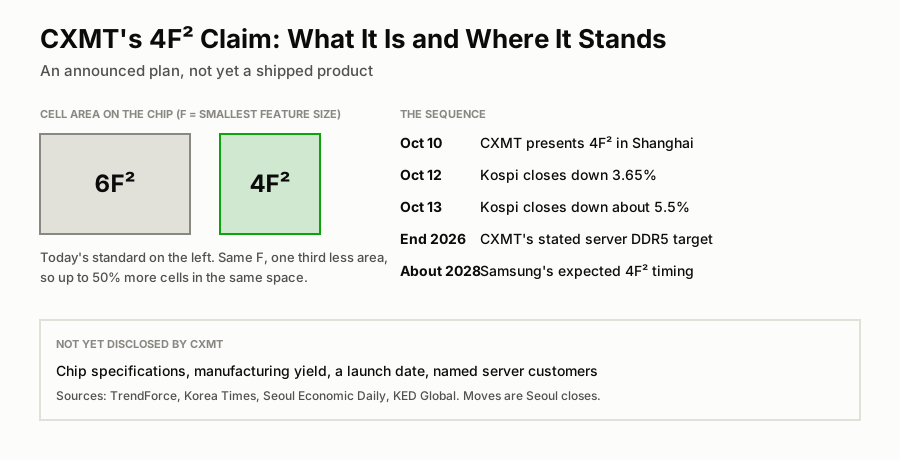
The claim is about how small a memory cell can be made, and the stocks moved before anyone has seen a chip.
Why Did Samsung and SK Hynix Fall After CXMT's Announcement?
Investors sold the two Korean memory makers because CXMT said it is close to a denser chip design that Samsung and SK Hynix themselves have not shipped. The fear is that a cheaper Chinese supplier closes the technology gap and pushes memory prices down. CXMT is the company whose July IPO already hit this group, which I covered in the earlier CXMT piece on Micron.
The moves ran in this order:
- Saturday, October 10: CXMT president Cao Kanyu presented the 4F² design at the Integrated Circuits and Chiplet Conference in Shanghai, per TrendForce. He said CXMT will introduce DDR5 server memory modules on it by year-end.
- Monday, October 12: The Kospi closed down 3.65%. Micron closed down about 4% in New York, per Seoul Economic Daily.
- Tuesday, October 13: The Kospi closed down about 5.5%, per KED Global, after trading as low as 7.4% down during the session. The exchange halted program selling for the first time since August. The Korea Times reports Samsung down 7.39% and SK Hynix down 10.09%. An earlier midday report had them down 7.7% and 8.8%. I am quoting "roughly 7%" and "9-10%" because the sources do not agree on one close.
- Tuesday morning in New York: Micron was down about 5.8% in early trading, an intraday move and not a close.
Samsung's Tuesday drop was its fifth losing session in a row. Foreign investors had been net sellers of Korean shares for six sessions. One strategist quoted by Bloomberg said investors were already looking to take profits in memory names after large gains this year. My read is that the CXMT news gave an existing sell-off a reason. Tuesday's drop reflects that positioning as much as the technology.
What Is a 4F² DRAM Cell?
A 4F² cell is a memory cell whose area is four times F squared, where F is the smallest feature a factory can draw. Almost all DRAM today uses a 6F² cell, which occupies six times that area.
The arithmetic is short. At the same F, a 4F² cell uses 4/6 of the area of a 6F² cell, which is one third less. Fitting more cells in the same space means 6/4, or 50% more cells on a chip of the same size. TrendForce quotes a 30-50% density gain. Seoul Economic Daily and the Korea Times both give the one-third area reduction.
More cells per chip means more memory per wafer, and that lowers the cost of each bit. That is why 4F² matters to prices. A producer that ships it first can sell the same amount of memory with less silicon. CXMT's version uses a transistor design it calls Vertical Surrounded Gate, built in-house.
How Far Along Are Samsung and SK Hynix?
Both are building 4F² DRAM, and neither has announced a mass-production date. TrendForce reports Samsung showed a 16Gb prototype with 4F² cells at the ISSCC 2026 conference, with commercial use not expected before 2028. SK Hynix is developing a vertical-gate 4F² design. Seoul Economic Daily says that on announced timelines, CXMT would be about two years ahead of Samsung.
That "two years" compares a promise with a research timeline. It is not a comparison of shipped products. Samsung already mass-produces 128GB DDR5-6400 server modules. CXMT has no comparable server product on the market yet.
CXMT is no longer small. TrendForce puts its share of second-quarter 2026 DRAM revenue at 9.5%, up from 7.6% in the first quarter. Counterpoint Research puts it near 10%, up from 4% a year earlier. Samsung holds about 39%, SK Hynix about 25% and Micron about 23% on TrendForce's count.
What Has CXMT Not Shown?
CXMT has not disclosed specifications, yields, a launch date or a customer. Each of those is a separate step between an announcement and revenue.
- Yield. Making a smaller cell is one thing. Making millions of working chips per month is another. Morningstar's analyst, quoted by Seoul Economic Daily, expects a meaningful gap between unveiling a 4F² product and reaching profitable yields.
- Partial adoption. TrendForce cites Money Today saying the first products may only partly use 4F² technology.
- Equipment. CXMT is cut off from the most advanced chipmaking machines by US-led export controls and builds on older equipment. The Korea Times says that limits how much the new cell can help.
- Server reliability. Yicai notes CXMT has focused on consumer electronics. Servers run around the clock and demand more reliability. A Korean industry official told the Korea Times CXMT has not secured major data-center orders.
- Timing. Officials quoted by the Korea Times suggested the announcement was timed to follow CXMT's recent IPO. That is their view, and I have not seen evidence for it.
I could not find CXMT's own presentation or a company release, so every figure above comes from press and trade reports of the speech.
What Would Change the Picture?
Three events, in the order they could arrive:
- SK Hynix's third-quarter report, expected in the week of October 26-28 (the date is not confirmed). Management will be asked about 4F² and CXMT. Samsung's full third-quarter results have no announced date. The SK Hynix Q2 preview shows how the company framed demand last time.
- A named customer for CXMT's server modules. A hyperscaler or server maker qualifying them would turn a claim into a product. Nothing like this has been reported.
- CXMT's year-end launch. If modules ship with a 4F² cell in them, the yield question starts to answer itself. If the date slips, the sell-off has priced something that did not arrive.
Micron's next report is expected in December. Its latest forecast is in the Micron expectations tracker. The wider memory argument is in the memory supercycle check.
The One-Line Read
CXMT announced a denser memory cell and a year-end target, and the Kospi lost about 9% over two sessions before any chip was shown. The test is yield and a named customer, and neither exists yet.
Next up:CPI, tomorrow at 8:30am ET →
More on $SKHY
$SKHY · 2026-08-03
SK Hynix on August 4: The US Rule That Gagged a Record Quarter, and What Actually Unlocks
$SKHY · 2026-07-29
Why SKHY Costs 22% More Than SK Hynix: The ADR Premium, the 2.5% Cap, and the Arbitrage That Cannot Happen
$SKHY · 2026-07-16
SK Hynix Earnings (July 29): The Single Most Important Print of the Memory Supercycle
Updated Every Saturday
The Week Ahead
Every earnings date, Fed event and setup for the current trading week, on one page.
Refreshed Weekly
Earnings Calendar
Who reports next, when, and what consensus and the whisper expect.
The Week-Ahead Brief
Don’t miss next week’s setups. Get the Sunday brief.
Latest issue, Oct 11“September CPI, the big banks and TSMC: earnings season starts”
Every Sunday: next week’s earnings dates, Fed days and the trades worth watching, from the same desk that writes the week-ahead hub. Free, built for retail investors.