Intel's $20 Billion Stock Offering: Upsized From $15bn, Priced At $95, 5x Oversubscribed
Intel upsized its stock sale from $15bn to $20bn and priced it at $95 a share, about 4.2% dilution against 5.04 billion shares. Wall Street's order book reportedly topped $100 billion, 5x the deal.
TL;DR
- Intel's stock offering grew from the $15 billion announced before Monday's open to $20 billion, priced at $95 a share after Monday's close, with a 30-day underwriters' option on a further $3.0 billion. The stock closed Tuesday, August 11 at $97.71, holding above the deal price.
- The headline is scary and the dilution is not. At $95 that is 210.5 million new shares against 5.04 billion outstanding: about 4.2%, or 4.8% if the full option is exercised.
- Put it next to last year's deal and the picture inverts. In 2025 the US government bought 433.3 million shares at $20.47 for $8.9 billion, taking 9.9% of the company. Intel raised roughly $0.9 billion per point of dilution then. It is raising about $4.8 billion per point now.
- It needs the cash, and the new number is larger than the old one. Cash and short-term investments fell from $37.4 billion at the end of 2025 to $29.7 billion on June 27, against $50.5 billion of total debt, while management has raised 2026 capital expenditure guidance to more than $20 billion and flagged 2027 as significantly higher. Net proceeds of roughly $19.7 billion would take net debt from about $20.8 billion to close to zero once the deal settles.
- My read: this is the right raise at the right time, made larger and cheaper than it needed to be by demand nobody forecast. Intel is telling you the 2027 build is bigger than the balance sheet, and a book that reportedly ran 5x covered says the market agrees. The bear case is serial dilution, and it rests entirely on a foundry that still lost $2.1 billion last quarter on $293 million of external revenue.
More on $INTC: Is Intel a Buy After the 9% Earnings Pop? Relief Bounce vs Real Turnaround →
Why Is Intel Stock Down Today?
Intel was selling new shares, and new shares dilute the ones you already own. Announced before the open on August 10, the original $15 billion offering knocked the stock about 3.5% to $98.06. That is a normal, mechanical reaction to any large equity deal: the market marks the price toward where the deal is likely to clear, because underwriters price these at a discount to the last trade.
The interesting question is not why it fell today. It is whether a company whose shares traded at $19.60 inside the last twelve months just did something genuinely smart with the re-rating.
The Board
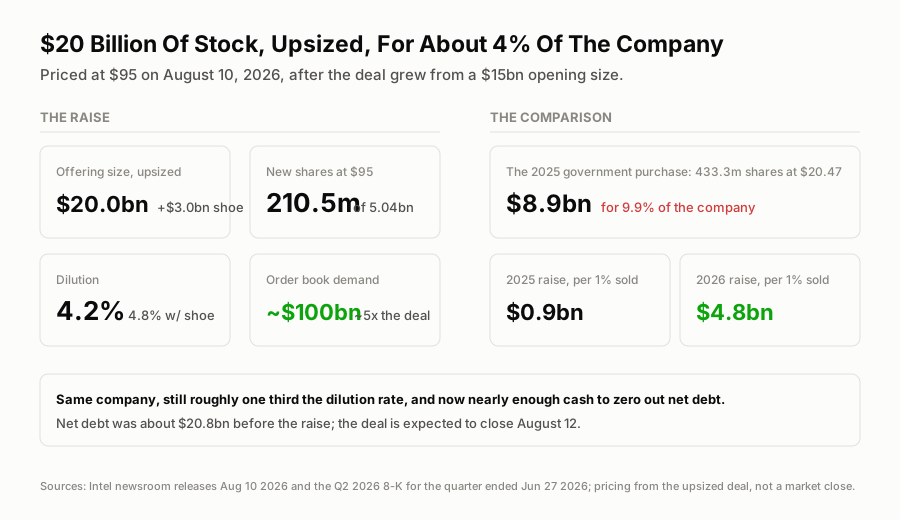
Same company, roughly a third of the dilution, nearly twice the cash. That is what a 5x share price buys you.
Percentage Of What? The Dilution Is About Four Percent
A $20 billion equity raise is an enormous number in absolute terms, and quoted on its own it sounds like a distress signal. It is not, and the reason is the denominator.
Intel carries about 5.04 billion shares outstanding. Do the division at the actual deal price:
- $20 billion at $95 is 210,526,315 shares, or 4.18% of the company.
- With the full $3.0 billion underwriters' option, $23 billion is 242,105,262 shares, or 4.80%.
Four per cent is not a rounding error, and existing holders should not pretend it is. But it is a long way from the kind of raise that signals a company selling whatever it can to whoever will buy, and a book reportedly five times covered is not the order flow of a company struggling to place stock. A number this large only reads as a crisis if you forget to ask what it is a percentage of.
Intel Sold 9.9% Of Itself For $8.9 Billion. Now It Is Selling About 4% For $20 Billion.
This is the comparison that decides whether today was good management or bad.
In 2025, under the CHIPS Act arrangement with the Trump administration, the US government bought 433.3 million primary shares at $20.47 each, for $8.9 billion, taking a passive 9.9% stake with no board seat or governance rights. It was funded from $5.7 billion of remaining CHIPS grants and $3.2 billion awarded under the Secure Enclave programme. SoftBank put in a further $2 billion around the same time.
Set the two raises side by side on the only metric that matters to an existing shareholder, which is how much cash arrives per point of ownership surrendered:
| 2025 government purchase | 2026 public offering | |
|---|---|---|
| Cash raised | $8.9bn | $20.0bn |
| Ownership sold | 9.9% | ~4.2% |
| Price per share | $20.47 | $95 |
| Cash per 1% sold | ~$0.9bn | ~$4.8bn |
Intel is now raising roughly five times as much money per point of dilution as it did last year. Same company, same assets, same management team. The entire difference is that the shares are worth about five times what they were.
That is what issuing equity is supposed to look like. Companies are meant to sell stock when it is dear and buy it back when it is cheap, and the overwhelming majority do precisely the reverse. Whatever else is true about this management team, on this decision they have the direction right, and doing it at $98 rather than at $20.47 is the difference between raising capital and surrendering the company in pieces.
Why It Needs The Money
The generous reading only survives if the cash is genuinely needed. It is. From the second-quarter release for the period ended June 27, 2026:
- Cash and short-term investments: $29.7 billion, made up of $12.9 billion of cash and $16.9 billion of short-term investments. That is down from $37.4 billion at the end of 2025, a fall of $7.7 billion in six months.
- Total debt: $50.5 billion, of which $48.5 billion is long term. Net debt is therefore about $20.8 billion.
- Second-quarter operating cash flow: $7.0 billion. First-half operating cash flow: $8.1 billion.
- First-half adjusted free cash flow: negative $8.4 billion.
Read that last line carefully rather than annualising it, because the release says what drove it: negative $12.2 billion of "Partner contributions, net" tied to the CHIPS Act partnership structure. That is a financing-shaped item inside a cash-flow line, not six months of operating bleed, and anyone turning minus $8.4 billion into "minus $17 billion a year" is compounding a number that will not repeat in that form.
What does repeat is capital expenditure. On the July 23 call management raised 2026 capital expenditure guidance to more than $20 billion and said 2027 would be significantly above that. (Coverage of the call disagrees on whether the prior guide was $17 billion or $18 billion, so treat the increase as "into the low twenties from the high teens" rather than a precise delta.) Against roughly $8 billion of first-half operating cash flow and a $20.8 billion net debt position, a capex year meaningfully above $20 billion does not fund itself.
The upsized $20 billion raise, at roughly $19.7 billion of net proceeds, takes net debt from about $20.8 billion to close to zero once it settles on August 12. That is the whole trade, made more complete than the original $15 billion version: Intel is converting a leverage problem into a dilution problem at the best exchange rate it has ever been offered, and doing it thoroughly enough to walk away from the raise with a close-to-clean balance sheet rather than a merely lighter one. It is a static comparison, ignoring the capex spend that keeps drawing the cash back down, but it is the right order of magnitude.
The $11 Billion Loss That Was Caused By The Share Price Going Up
Here is the detail that makes this quarter worth understanding properly, and it is the same fact from two directions.
Intel's second quarter carried a GAAP net loss of $11.0 billion, or $(2.16) per diluted share, alongside non-GAAP net income of $2.2 billion and non-GAAP EPS of $0.42. Almost the entire gap is a single line: a $12.5 billion mark-to-market loss on Escrowed Shares, which the company describes as the change in fair value of a derivative liability connected to the US government warrant agreement. 158.74 million shares sit in escrow against the Secure Enclave commitment, roughly 143 million of them still untransferred as of June 27.
Because that liability is revalued every quarter against Intel's own share price, Intel booked an eleven-billion-dollar loss because its stock went up. It is an accounting consequence, not a cash cost, and it is the clearest example this year of why the four reconciliation checks exist: a GAAP headline of minus $2.16 next to a non-GAAP $0.42 is not two views of the same business, it is one operating result and one derivative revaluation stapled together.
The irony: the same share-price appreciation that produced a $12.5 billion accounting charge is the thing that makes the raise cost only about 4% of the company. Intel is monetising, in cash, exactly the move that its income statement had to book as a loss.
Is It A Good Idea?
Yes, and it is not close. Rank the ways a company in Intel's position can fund a capex cycle it cannot self-fund:
- Equity at a five-year high. Costs about 4% of the company, no covenants, no maturity, no rating consequence.
- More debt on top of $50.5 billion. Cheaper on paper, and it runs straight into the constraint management named in its own announcement: "maintaining a strong balance sheet and its commitment to an investment-grade rating."
- Under-invest. Intel has spent a decade discovering what happens when it does that, and the current 25% revenue growth is what happens when it stops.
- Sell assets. Slow, dilutive to the strategic story, and the assets worth selling are the ones the AI cycle needs.
Option one is the only one that is obviously right, and the fact that Intel chose it at $98 rather than being forced into it at $20 is the single most encouraging thing about the announcement.
The bear case is not about today, it is about the sequence. Intel Foundry lost $2.089 billion in the quarter on segment revenue of $5.8 billion, of which external foundry revenue was $293 million. Roughly one twentieth of the foundry's revenue comes from customers who are not Intel. That is a business consuming capital at scale while barely proving it can sell to anyone else, and if that has not changed by 2027, this raise buys eighteen months and then the question returns at whatever price the market offers next. A company that raises equity once at a high is being smart. A company that raises equity every eighteen months is diluting its shareholders on a schedule.
What The Market Should Read Into It
Four signals, in descending order of confidence.
1. The 2027 capex number is going up again, and this is the pre-announcement. Nobody raises $20 billion of equity to hold it. The offering is management telling you the spending plan is larger than the last guide, before the guide is formally revised.
2. Debt capacity is the binding constraint, not investor appetite. Intel named the investment-grade rating in its own release. Equity is the more expensive money; a company with room on the balance sheet issues bonds. This one did not.
3. Management thinks the equity is worth more than the dilution. This is the reading that cuts against the stock, and it is honest to say so: issuing shares is a statement that the board sees the current price as at least fair value. Against a 52-week range of $19.60 to $142.35, with the stock at $98.06, that is a defensible view rather than a bearish one, but nobody should pretend it is a bullish tell.
4. It says nothing bad about demand. Second-quarter revenue was $16.1 billion, up 25%, with Data Center and AI up 59% to $6.3 billion and Client Computing and Physical AI up 13% to $8.9 billion. Third-quarter guidance is $15.8-16.8 billion. This is not a raise into deteriorating orders, and the reflex of reading every equity offering as a distress signal fails on the numbers.
For context on what the sell side thinks the shares are worth, the consensus of 48 analysts is a Hold with an average 12-month price target of $115.17, about 17% above Monday's level. That is the Street's number and its horizon, not this site's, and it embeds an assumption the foundry has not yet earned: that external customers show up.
The Options Angle
Live option prices and an implied move for INTC could not be sourced at writing, so nothing below is logged with a premium, and the plays are quoted against the spot instead. That is a limitation, stated rather than hidden.
The deal has now priced, which resolves the mechanic this section originally flagged as the thing to wait for. The stock closed at $97.71 on Tuesday, 2.85% above the $95 deal price, rather than gravitating down toward it, which is itself informative: a book that reportedly ran 5x covered left buyers who did not get filled still wanting the stock at the close.
- The equity call is now live, not conditional. The deal priced at $95 and closed Tuesday, August 11 at $97.71; the pinned-by-supply window this page flagged has already passed.
- Calls rather than shares is still the structure that respects the uncertainty here: the fundamental case improved on July 23, the deal is now priced and (reportedly) oversubscribed, and defined risk is how you own both facts at once.
- Writing covered calls into a stock that is still well below a 52-week high set weeks ago, in the middle of a capex-driven re-rating with demand this strong, is the July mistake repeating: it collects a small premium and caps the outcome the whole thesis depends on.
Trade log
| # | Stance | Structure | Strikes and expiry | Cost or credit | Spot at writing | Implied move | Breakeven |
|---|---|---|---|---|---|---|---|
| 1 | Pass, superseded | Long shares before the deal priced | n/a | n/a | $98.06, Aug 10 session | Not sourced | The deal priced at $95, below the Monday close; the pass avoided nothing |
| 2 | Bullish, defined risk | Long call, post-pricing entry | Sep/Oct expiry, strike near $95-98 | Live prices not sourced | $97.71, Aug 11 close | Not sourced | Scored from here against the eventual move |
| 3 | Pass | Covered call against an existing holding | Aug/Sep upside strikes | Not sourced | $97.71, Aug 11 close | Not sourced | Scored on the whole position, not the leg |
Row 1 is marked superseded rather than deleted: the original pass was reasoning about an unpriced deal, and the deal has since priced below where the stock traded when the pass was logged, so it is scored as written rather than rewritten after the fact.
Correction: What This Site Published About Intel's Second Quarter
Verifying the figures for this article surfaced a serious error in our own July coverage, and it is recorded here rather than fixed without saying so.
Our Q2 breakdown, published July 24, reported revenue of $12.9 billion "roughly flat year over year", adjusted EPS of $0.02, a foundry operating loss of $2.3 billion narrowed from $2.9 billion, non-GAAP gross margin near 37%, and third-quarter guidance of $12.6-13.6 billion. Our follow-up, Is Intel A Buy After The 9% Earnings Pop, built its "the beat was cost-led and AI revenue is still absent" argument on those numbers.
Intel's own 8-K, filed July 23 for the quarter ended June 27, 2026, reports revenue of $16.1 billion, up 25%; non-GAAP EPS of $0.42 against a $(0.10) loss a year earlier; non-GAAP gross margin of 41.8% (GAAP 40.4%); an Intel Foundry operating loss of $2,089 million; and third-quarter guidance of $15.8-16.8 billion. Data Center and AI revenue rose 59%.
The pattern is diagnostic: $12.9 billion is Intel's Q2 2025 revenue, so the article appears to have carried the year-ago comparison forward as the current quarter and reasoned from it. Every downstream conclusion inherited the error, including the claim that AI revenue was absent from a quarter in which the AI segment grew 59%. Both articles now carry a correction notice pointing here. The four reconciliation checks in our own house rules would have caught this at the first one: a flat revenue line did not fit a company the market was simultaneously repricing.
The One-Line Read
Intel is selling about four per cent of itself for $20 billion, upsized from $15 billion after a book that reportedly ran five times covered, a year after selling nearly ten per cent for $8.9 billion, which makes this the best-priced and most oversubscribed capital the company has raised in a decade and a clear signal that the 2027 capex plan has outgrown a balance sheet carrying $50.5 billion of debt; the case only breaks if a foundry doing $293 million of external revenue is still doing $293 million when the money runs out.
Next up:PCE inflation, Wednesday at 8:30am ET →
More on $INTC
Updated Every Saturday
The Week Ahead
Every earnings date, Fed event and setup for the current trading week, on one page.
Refreshed Weekly
Earnings Calendar
Who reports next, when, and what consensus and the whisper expect.
The Week-Ahead Brief
Don’t miss next week’s setups. Get the Sunday brief.
Latest issue, Sep 20“The week after the hike: two housing reads and Costco earnings...”
Every Sunday: next week’s earnings dates, Fed days and the trades worth watching, from the same desk that writes the week-ahead hub. Free, built for retail investors.