Is Zymeworks (ZYME) a Buy Before the August 25 FDA Decision? A $250 Million Check Is on the Line
Zymeworks carries none of the launch risk itself, but a $250 million U.S. milestone and up to $1.5 billion more hinge on the FDA's August 25 call on Ziihera in first-line gastric cancer.
UPDATE (August 25): The FDA Approved Both Regimens, and the Stock Sold Off Anyway
The FDA approved zanidatamab (Ziihera) in first-line HER2-positive gastroesophageal cancer on August 25, and it cleared the wider of the two outcomes this piece described: both the triplet-with-tislelizumab regimen and the doublet-alone regimen got the green light, not just the better-tolerated doublet this piece set as its minimum bar. The approval triggers the $250 million U.S. milestone payment to Zymeworks from Jazz Pharmaceuticals, per Zymeworks' and BeOne's approval release.
ZYME still fell on the news. Shares dropped as much as 9.9% intraday to $25.92 immediately after the approval headline, then pared the loss through the session to close at $27.47, down 4.5% on the day from Monday's $28.77 close, per Google Finance and stockanalysis.com. That is a sell-the-news reaction to good news: Wall Street's 13-analyst average target of $40.33 already had an approval largely priced in before the 25th, and a broader-than-required label wasn't enough on its own to push the stock further into that gap on the day.
Scored against this piece's own entry, the position is still a win: ZYME closed at $27.47 against a $25.12 entry on August 14, up 9.36% over the holding period, even after Monday's single-day pullback. The options pass stands as logged and unscored, below.
More on Single Stocks: Options Scorecard: A Reddit Put and a Nutanix Pass, Both Right at Expiry →
TL;DR
- The FDA's target action date for zanidatamab (Ziihera) in first-line gastroesophageal cancer is August 25, 2026. The application carries Priority Review and Real-Time Oncology Review status, and the drug already has a market safety record from a 2024 approval in a different cancer.
- Zymeworks doesn't launch anything itself. It invented the drug and licensed it to Jazz Pharmaceuticals and BeOne Medicines, who sell it. Approval alone triggers a $250 million U.S. milestone paid straight to Zymeworks, plus up to $190 million more tied to approvals elsewhere, against $322.5 million of cash on the books at June 30.
- The efficacy question was already answered, in public, three months ago. Phase 3 HERIZON-GEA-01 showed a median overall survival of 26.4 months on the triplet regimen against 19.2 months for the standard of care (HR 0.72, p=.0043), published in the New England Journal of Medicine on May 27.
- Thirteen analysts carry a Strong Buy consensus and an average 12-month target of $40.33, about 61% above Friday's $25.12 close, a number set almost entirely before this specific date arrived.
- A second, unrelated catalyst is stacked on the same stock. Zymeworks' $929 million all-cash deal to acquire Theravance Biopharma is due to close in the second half of 2026, adding a royalty stream tied to GSK's Trelegy Ellipta regardless of what the FDA decides on the 25th.
The Board
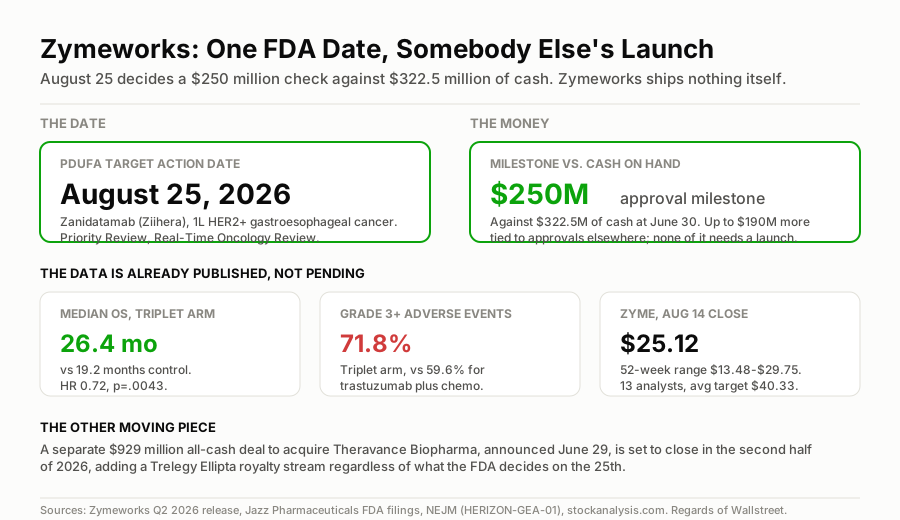
The FDA rules on somebody else's launch. Zymeworks just cashes the milestone.
What Does the FDA Decide on August 25?
The FDA is due to rule on whether Jazz Pharmaceuticals and BeOne Medicines can sell zanidatamab, branded Ziihera, as a first-line treatment for HER2-positive gastric, gastroesophageal junction and esophageal adenocarcinoma, collectively GEA. The supplemental Biologics License Application was accepted with Priority Review and is moving through the FDA's Real-Time Oncology Review program, which lets the agency start working through trial data before the full application lands (Jazz Pharmaceuticals' filing announcement). Both of those are speed and confidence signals, not guarantees.
This isn't the drug's first FDA review. Ziihera already carries an accelerated approval from November 20, 2024, as a monotherapy for previously treated HER2-positive biliary tract cancer, based on a 52% response rate and a 14.9-month median duration of response in the HERIZON-BTC-01 trial (Jazz's approval release). The agency has reviewed this molecule, approved it once, and has two years of post-market safety data on file. The August 25 question is narrower: does the evidence support a much bigger population, gastric cancer, as a first-line treatment ahead of chemotherapy rather than after it.
The Milestone Dwarfs the Quarter
Zymeworks is not the company that would launch this drug. It invented zanidatamab, licensed it out, and now collects payments while Jazz and BeOne run the commercial side. That structure is why this PDUFA date matters more to Zymeworks' balance sheet than most approval dates matter to most companies: an approval converts directly into cash with no sales force to hire first.
An FDA approval on August 25 triggers a $250 million U.S. milestone payment, with up to $190 million more tied to approvals in other territories, for $440 million total near-term regulatory milestones. Zymeworks reported $322.5 million in cash, cash equivalents and marketable securities as of June 30, 2026, against a Q2 net loss of $45.0 million, versus net income of $2.3 million a year earlier on the absence of a one-time collaboration payment (Zymeworks' Q2 2026 results). The U.S. milestone alone is worth roughly 78% of the cash on hand. This is not a company that needs the money to survive; it is a company where one regulatory letter moves the balance sheet by a fraction close to its entire float.
The milestone economics don't stop at approval. Zymeworks has named $89 million more in regulatory milestones tied to a third indication, and up to $977.5 million in commercial milestones as sales scale, for up to $1.5 billion of total remaining payments under its Jazz and BeOne license agreements (Royalty Pharma's financing announcement). Set that against a $1.78 billion market cap and the August 25 date is the first domino in a chain that's worth close to the company's own valuation if everything downstream plays out.
The Trial Already Answered the Efficacy Question
HERIZON-GEA-01 randomized 914 patients across more than 300 sites in over 30 countries into three arms: zanidatamab plus chemotherapy plus the PD-1 inhibitor tislelizumab, zanidatamab plus chemotherapy alone, and trastuzumab plus chemotherapy as the control. Median overall survival came in at 26.4 months for the triplet, 24.4 months for the doublet, and 19.2 months for the control arm, with a hazard ratio of 0.72 (p=.0043) for the triplet against control and 0.80 (p=.0564, not statistically significant) for the doublet against control (the trial results in the New England Journal of Medicine). That data has been public since May. Nothing about the efficacy case changes between now and the 25th; the FDA has had this exact package for months.
The safety data is where the label question actually lives. Grade 3-or-higher treatment-related adverse events hit 71.8% of patients on the triplet, against 59.0% on the doublet and 59.6% on the control arm, with diarrhea the most common serious event across all three and most frequent early in treatment (a BeOne safety poster presented on the trial). Adding tislelizumab bought two extra months of median survival and a meaningfully worse tolerability profile, and the doublet's own survival edge over control didn't clear statistical significance on its own. That is the split the FDA has to resolve: approve the whole three-drug package, approve only the better-tolerated doublet, or ask for something in between. Any of the first two outcomes is an approval on this site's terms. Only the third, a request for more information, would actually move the date the way Capricor's deramiocel decision moved three days before its own August 22 target.
Who Actually Collects the Check
Zymeworks isn't selling anything here, which is worth being precise about. It discovered zanidatamab and licensed commercial rights to Jazz Pharmaceuticals and BeOne Medicines, who run the trials, file the applications and would run the launch. Zymeworks' own line item is milestones and royalties; there is no product revenue to model.
In March 2026, Zymeworks sold Royalty Pharma a $250 million note backed by 30% of its worldwide tiered Ziihera royalties, keeping the remaining 70% of royalty payments and, importantly, all of the regulatory and commercial milestone payments named above (Zymeworks' financing announcement). That deal financed Zymeworks' cash position without touching the August 25 milestone check; the $250 million approval payment is unaffected by it and flows entirely to Zymeworks if the FDA says yes.
Wall Street Already Likes This, Which Cuts Both Ways
Thirteen analysts carry a Strong Buy consensus on ZYME with an average 12-month target of $40.33, a spread running from Truist's $32 to Stifel's $46, against Friday's $25.12 close (stockanalysis.com's forecast page). Every one of the five most recent named targets, B. Riley at $44 (raised from $40 on August 10), H.C. Wainwright at $51, Truist at $32, Stifel at $46 and Citi at $37, was set or reiterated in the days right after Zymeworks' August 6 earnings call, before the FDA has said anything about the 25th.
I read that as the Street already modeling an approval into its base case: five targets, all above the current price, moved in the same direction in the same week. None of them implies downside from here, which means none is obviously carrying a scenario where the FDA asks for more data. If August 25 goes the way the trial data suggests it should, the stock has room to run toward those numbers. If it doesn't, the reset isn't from $25.12, it's from a valuation that already assumes the good outcome.
How It Actually Loses
The bear case here isn't about the science, which is genuinely strong. It's about scope and timing. The FDA could approve only the doublet, cutting BeOne's tislelizumab out of the U.S. label and shrinking what "approval" is worth to a triplet-based sales pitch. Enhertu, the market-leading HER2 drug from Daiichi Sankyo and AstraZeneca, is running its own first-line GEA trial, DESTINY-Gastric05, and could contest this exact market within a few years of zanidatamab getting there first (Daiichi Sankyo's trial announcement). A company with Enhertu's commercial footprint doesn't need to be first to eventually win the bigger share of a market.
There's also the Theravance deal sitting on top of all of this. A $929 million all-cash acquisition, announced June 29 and expected to close in the second half of 2026, turns Zymeworks from a pure licensing-and-royalty story into an operating pharma company carrying Theravance's commercial infrastructure, a partial stake in the COPD drug Yupelri, and a CVR tied to a discontinued asset (Zymeworks' acquisition announcement). That's a different kind of company than the one being valued on Ziihera milestones alone, and the market hasn't fully worked out what multiple the combined entity deserves.
And regulatory dates are not settlement dates. A PDUFA target can move for reasons that have nothing to do with the trial data, and this site logged that lesson directly two weeks ago when Capricor's own August 22 date shifted eight days out over a label amendment nobody had priced. Zanidatamab's case is far stronger than deramiocel's ever was, but "far stronger" is not "certain," and the calendar itself is a variable the Street's targets don't obviously carry a discount for.
The Options Angle
A straddle into a binary regulatory date is the textbook structure here, and this site could not source a live ZYME option chain this session. On a name with a real but thin daily volume and a genuine binary catalyst nine days out, quoting a made-up premium would be worse than quoting none. The call below is a stock-direction position rather than a priced options structure, plus a pass on options specifically because the pricing can't be verified.
Trade log
| # | Stance | Structure | Strikes and expiry | Cost or credit | Spot at writing | Implied move | Conviction | Breakeven | Result |
|---|---|---|---|---|---|---|---|---|---|
| 1 | Bullish | Long ZYME common stock into the August 25 PDUFA date | n/a | n/a | $25.12, Aug 14 close | Not sourced | 6/10 | Any close above $25.12 | Win. Closed $27.47 on Aug 25, +9.36% |
| 2 | Pass | Any options structure into Aug 25 | No live chain sourced | Premiums not sourced | $25.12, Aug 14 close | Not sourced | 5/10 | n/a | Unscorable. No chain ever sourced to grade against |
Row 1 is sized on the trial data, which is already public and already strong. It doesn't need the FDA to deliver a surprise. Row 2 is a pass on my own terms: I'd rather own the stock through this date than pay an unverifiable premium for the right to be right about a decision the underlying already reflects most of.
Row 1 scored a win. The FDA approved both regimens on August 25, broader than the doublet-only bar this call needed, and ZYME closed the reaction session at $27.47 against the $25.12 entry, up 9.36%, despite a same-day intraday drop of as much as 9.9% on a sell-the-news reaction. Row 2 stays unscorable: no ZYME option chain was ever sourced before the decision, so there is no premium and no implied move to check the realized move against, and this ledger will not invent one after the fact to force a verdict either way.
The One-Line Read
The efficacy case for zanidatamab in gastric cancer was decided months ago in a peer-reviewed journal, so August 25 is mostly a question of how wide the FDA draws the label, and whether Wall Street's already-bullish targets leave any room for the version of this story where the agency asks for more.
Next up:PCE inflation, today at 8:30am ET →
More on Single Stocks
Updated Every Saturday
The Week Ahead
Every earnings date, Fed event and setup for the current trading week, on one page.
Refreshed Weekly
Earnings Calendar
Who reports next, when, and what consensus and the whisper expect.
The Week-Ahead Brief
Don’t miss next week’s setups. Get the Sunday brief.
Latest issue, Sep 27“Micron, PCE and the jobs report that decides October”
Every Sunday: next week’s earnings dates, Fed days and the trades worth watching, from the same desk that writes the week-ahead hub. Free, built for retail investors.