Lyntris (LYNX) IPO: 80% of the $492M Deal Is Insiders Selling
Lyntris priced below range at $17.50 on a downsized deal, raised $297.5m not $492m, and closed day one down 14.2%. The debt runs 3x EBITDA, inside covenant, and the lockup releases in four waves.
TL;DR
- Lyntris prices its NYSE listing under the ticker LYNX at $19.00 to $22.00, with trading estimated for Wednesday, August 19. That date is a market estimate; the company has never confirmed one.
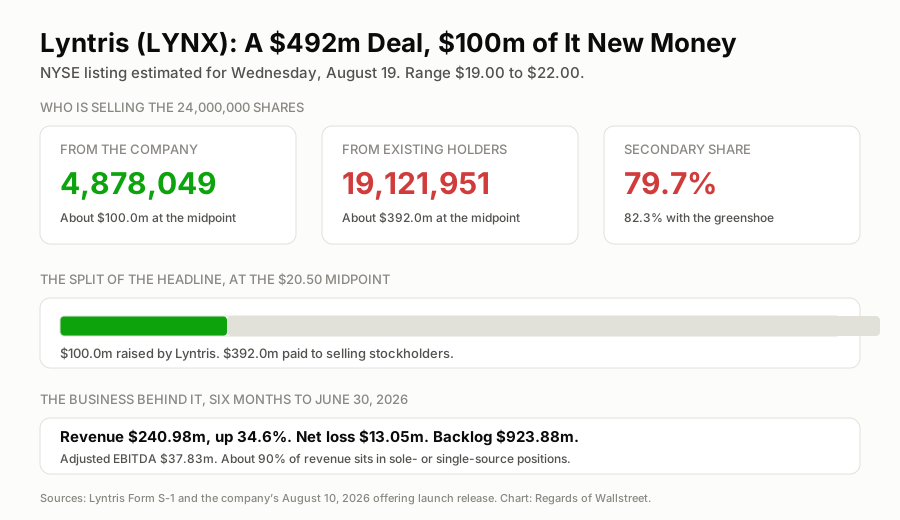
- Only 4,878,049 of the 24,000,000 shares come from Lyntris. The other 19,121,951 come from existing holders, so about 80% of the deal is a cash-out. At the $20.50 midpoint the company keeps roughly $100m of the $492m headline.
- The over-allotment is secondary too. All 3,600,000 greenshoe shares are granted by the selling stockholders, which takes the insider share of a fully exercised deal to about 82%.
- Trive Capital owns roughly 68% going in and intends to own nothing coming out, distributing its stake in kind to its own fund investors rather than selling it on the exchange.
- The business is growing and still loses money on a GAAP basis. First-half revenue rose 34.6% to $240.98m against a $13.05m net loss, with $923.88m of backlog behind it.
UPDATE (August 19, 2026): the actual deal came in well below what this piece modeled, and priced below its own range. Lyntris sold 17,000,000 shares at $17.50, not the 24,000,000 shares this piece priced at a $19-22 range. Total raised was $297.5 million, not the $492.0 million headline above. The company's own share count barely moved, 5,714,286 shares against the 4,878,049 modeled here, still worth roughly $100 million. The selling-stockholder count fell hard, to 11,285,714 shares worth $197.5 million, from the 19,121,951 shares and $392.0 million modeled above. The fraction held: 66% of this smaller deal is still insiders selling, not far off the 80% this piece flagged for the larger one; the total shrank, the imbalance did not. Shares opened at $15.50, 11.4% under the offer, and closed the first session at $15.01, down 14.2%.
UPDATE (August 21, 2026): three sessions in, still below the offer, and the two questions this piece left open now have answers. LYNX closed Thursday, August 20 at $15.55, and traded near $15.30 Friday morning (an intraday level, not a close), still roughly 12-13% under the $17.50 offer. On the debt: Lyntris entered a new credit facility on July 31, a $200 million term loan plus a $100 million revolver, replacing the separate Accelint and Vitesse facilities that had carried a combined $276.5 million. About $60 million of the company's own IPO proceeds repaid a revolver draw. Against $62.6 million of 2025 adjusted EBITDA, $200 million of term debt prices out to roughly 3x leverage, comfortably inside the 4.25x covenant (stepping to 3.50x by 2028). "Substantial indebtedness" reads scarier in a risk factor than it computes in practice. On the lockup this piece could not source: Trive's distributed shares release in quarters over 720 days, not a single 180-day cliff, so a quarter unlocks at 180 days, another at 360, another at 540, and the rest at 720. The supply this piece worried about arrives in four waves through August 2028, not all at once. One figure repeats unchanged: backlog was $923.9 million at June 30 against $475.8 million at December 31, 2025, both on the same combined basis, confirmed again in the final prospectus. The near-doubling in six months still has no stated driver.
| Modeled (this piece, Aug 16) | Actual (final terms) | |
|---|---|---|
| Shares offered | 24,000,000 | 17,000,000 |
| Price | $19.00-$22.00 | $17.50 |
| Total raised | $492.0m | $297.5m |
| To the company | $100.0m (4.88m sh) | $100.0m (5.71m sh) |
| To selling stockholders | $392.0m (19.12m sh) | $197.5m (11.29m sh) |
| Insider share of deal | 80% | 66% |
| Day-one close | $15.01, -14.2% |
More on Single Stocks: Options Scorecard: A Reddit Put and a Nutanix Pass, Both Right at Expiry →
What Is Lyntris, and When Does LYNX Start Trading?
Lyntris is a defense technology company in Falls Church, Virginia, and its shares are estimated to begin trading on the New York Stock Exchange on Wednesday, August 19 under LYNX. Every source carrying that date labels it an estimate. The company announced the launch of the offering on August 10 and has not confirmed a pricing date itself, so I would treat the 19th as a working assumption rather than a fixture.
The company sells what its S-1 calls "sense-to-act" connectivity: sensor hardware, sensor architecture and the data layer that ties them together, aimed at three missions. Maritime domain awareness, air and missile defense, and space ISR and resilient communications. Customers are the US Department of Defense and allied governments.
It is a new corporate entity wrapped around two older ones. Trive Capital bought Vitesse in December 2018 and Accelint in November 2022, formed Lyntris LLC in April 2026, converted it to a corporation on May 1 and combined the two businesses on May 7. There was a 2.54-to-one reverse split on July 17.
The Board
Trading estimated for Wednesday, August 19 on the NYSE.
Where the $492 Million Actually Goes
The press release gives the split in one line, and it is the most useful sentence in the document: 4,878,049 shares offered by Lyntris, 19,121,951 offered by selling stockholders, and "Lyntris will not receive any proceeds from any sale of shares by the selling stockholders."
Run it at the $20.50 midpoint of the range:
- 4,878,049 x $20.50 = $100.0m to the company
- 19,121,951 x $20.50 = $392.0m to existing holders
- Total $492.0m, which is where the headline comes from
The primary leg is sized to raise exactly $100m at the midpoint, which is what the odd share count is doing there. Add the greenshoe and the balance tilts further, because all 3,600,000 of those shares are granted by the selling stockholders rather than the company. A fully exercised deal is 27.6m shares, of which 22.72m are secondary, or 82.3%.
None of that makes the offering a bad one. Sponsor-backed listings are usually part exit, and a $100m primary raise against roughly $75m of trailing adjusted EBITDA is not nothing. But a reader who sees "$492 million IPO" and pictures half a billion dollars of new money going into missile-defense engineering has the wrong picture, and the AI summaries I checked repeat the headline without the split.
Trive Owns Two-Thirds and Intends to Own None
Trive Capital holds roughly 68% across four fund vehicles before the offering. The S-1 describes what happens afterwards as a pro rata distribution in kind to Trive's limited and general partners, after which Trive "will no longer beneficially own any shares."
That is a different animal from a sponsor selling down over eighteen months. The shares do not hit the tape at the IPO; they land in the hands of several hundred fund investors who never chose to own a defense listed equity and who face their own decisions once any lockup lapses. Whether that supply arrives in a trickle or a wave depends on lockup terms I have not been able to read in the excerpts available, so I am not going to put a number on it. It is the thing I would want answered before paying up on day one.
What $2.4 Billion Buys
The expected market cap runs $2.36bn at the midpoint and $2.53bn at the $22 top, which reconciles: both figures imply about 115m shares outstanding.
Against that, from the S-1's own numbers. The trailing-twelve-month figures below are my own arithmetic:
| FY2024 | FY2025 | H1 2025 | H1 2026 | |
|---|---|---|---|---|
| Revenue | $333.96m | $388.94m | $179.08m | $240.98m |
| Adjusted EBITDA | $48.65m | $62.56m | $25.27m | $37.83m |
| Net loss | $(31.02)m | $(8.46)m | $(9.71)m | $(13.05)m |
Trailing twelve months to June 30 works out at $450.8m of revenue and $75.1m of adjusted EBITDA, so the midpoint prices the equity at roughly 5.2x trailing sales and 31x trailing adjusted EBITDA before counting debt.
The gap between $75.1m of adjusted EBITDA and an $11.8m trailing net loss is about $87m of depreciation, amortisation, interest and add-backs. For a roll-up of two private-equity-owned businesses that is mostly purchase-accounting amortisation and the cost of the "substantial indebtedness" the filing flags in its risk factors. The company converted an accelerating top line into a wider loss in the first half, which is the tension in the numbers.
What I like: $923.88m of backlog at June 30, roughly two years of revenue at the current run rate, spread over about 200 programs and 150 customers with no single program above 7% of 2025 revenue. Around 90% of revenue sits in sole-source or single-source positions. That is a genuinely defensive revenue base, and it is the reason the multiple is not obviously silly.
The One-Line Read
A real defense business with real backlog, listing at a price that assumes the growth holds. The $492m headline is mostly a cash-out, and the sponsor's exit route puts the supply question after the lockup, not at the bell.
No options play is logged here. LYNX has no listed options chain three sessions into trading, so there is still nothing to price and nothing to score.
Related: SK Hynix's Nasdaq listing is the template for how a new listing with thin English coverage trades, SunScout's first week is the template for how one breaks, T3 Defense's float squeeze is the opposite failure mode in the same sector, too little float rather than too much sponsor selling, and the rest of the week is in our August 17-21 hub.
Next up:PCE inflation, today at 8:30am ET →
More on Single Stocks
Updated Every Saturday
The Week Ahead
Every earnings date, Fed event and setup for the current trading week, on one page.
Refreshed Weekly
Earnings Calendar
Who reports next, when, and what consensus and the whisper expect.
The Week-Ahead Brief
Don’t miss next week’s setups. Get the Sunday brief.
Latest issue, Sep 27“Micron, PCE and the jobs report that decides October”
Every Sunday: next week’s earnings dates, Fed days and the trades worth watching, from the same desk that writes the week-ahead hub. Free, built for retail investors.