MU and SNDK: Up 210% and 503% This Year, Down Every Day Since June. Is This the Dip to Buy?
Micron is down 22% and SanDisk 30% from June highs after leading the Nasdaq-100 all year. Why they fall daily, what the valuation says, and the options problem a $1,270 stock creates.
TL;DR
- They were the year's two best Nasdaq-100 stocks: SanDisk up 503%, Micron up 210% year to date. Then June arrived.
- Micron is down ~22% from its June 25 high to around $871. SanDisk is down ~30% from its June 22 high to around $1,270.
- They fall almost daily because three separate forces are stacked: China's CXMT supply threat, supply-glut fears, and profit-taking in the most crowded trade in the market (82% of fund managers say semis).
- SanDisk carries a practical trap most coverage ignores: at $1,270 a share, one options contract controls $127,000 of stock, and fractional options don't exist. Details below.
Why Do Micron and SanDisk Keep Falling?
The short answer: nothing is broken, but everything that made them work is being repriced at once. The physical shortage is real, revenue is still exploding, and the AI demand is not in question. What changed is that the market stopped assuming the shortage lasts forever, because China announced funded capacity to end it, and because 82% of professional investors were already crowded into the same trade with enormous paper gains to protect.
That combination produces a grind, not a crash. Every bounce meets sellers who are still up triple digits for the year and increasingly willing to ring the register.
The Board
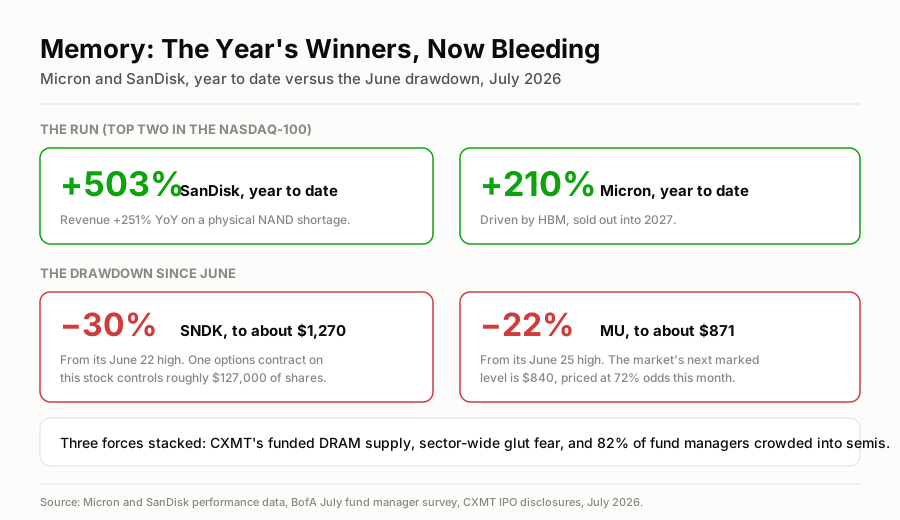
Both are still enormously up on the year. That is precisely why they keep falling.
The Three Forces Doing the Damage
1. CXMT is a funded supply threat. China's state-backed DRAM champion grew revenue sevenfold in the first half, is now the world's #4 DRAM producer, and filed an $8.5 billion IPO to add capacity. That directly disputes the "supply can't respond until 2028" half of the memory supercycle thesis. It's the one genuinely new fundamental of the last month, and it's why MU broke $900.
2. Glut fear is contagious across products. The selling has hit DRAM and NAND names together: on recent sessions SanDisk fell 11-12%, Micron 4-5%, Seagate 7%, SK Hynix 8%. A coordinated move like that is the market repricing the cycle, not any single company. That's a blunt instrument, and blunt instruments create mispricing.
3. Crowding. Bank of America's July survey found 82% of global fund managers call semiconductors the most crowded trade. Crowded trades don't need bad news to fall, they need the absence of new buyers. After a 503% run, there aren't many.
What the Valuation Actually Says
Here's where it gets uncomfortable for both sides.
The bull's number. SanDisk's revenue is up 251% year over year, NAND contract prices are running +70-75% quarter over quarter, and the company hiked flash prices roughly 50%. On trailing earnings power these stocks look cheap, because the earnings are genuinely exploding.
The bear's number. That's the problem with cyclicals: they look cheapest at the top. A memory company trading on peak-cycle earnings with a low multiple is not a bargain, it's a warning, because the multiple is low precisely because the market expects those earnings to fall. The classic cyclical trap is buying a single-digit P/E at the exact moment the E collapses.
So the honest valuation answer is: it depends entirely on whether this is a cycle or a structural shift. If AI demand makes memory a secular growth business, current prices are reasonable. If it's the same cycle as always with a new story attached, the multiple is telling you something the P/E can't.
The Split That Decides Everything
Don't own "memory." Own the part CXMT can't touch.
- Commodity DRAM: genuinely threatened. This is where CXMT lands first and where subsidised supply distorts pricing fastest. Micron has real exposure here.
- HBM: not threatened yet. Sold out into 2027, and requiring packaging and yield that CXMT doesn't have. This is why Micron 5x'd, and this quarter's news doesn't touch it.
- NAND: a different product on a different cycle. SanDisk's shortage is a NAND story, and CXMT's DRAM capacity is not a NAND fix. The market sold SNDK harder than MU anyway, which is either an overreaction or a warning that glut fear has gone product-agnostic.
We marked our own memory thesis down on exactly this basis: the supercycle survives, narrowed to HBM and NAND, with the commodity-DRAM leg amputated.
Is It Time to Buy?
Not with both hands, and not yet at full size. Three specific reasons to wait rather than lunge:
- The knife is still falling. These names have declined on consecutive sessions with no capitulation signal. Down 22% and down 30% are not obviously "enough" for stocks up 210% and 503%.
- Earnings are the falsification test. SanDisk has to prove the shortage and SK Hynix's print reads across to everything. Buying before those is guessing when you could be reading.
- MU has a marked level. The market's next number is $840, and prediction markets priced a 72% chance of touching it. Respect a level the market has explicitly named.
What would make it a buy: MU near $840 with an intact HBM story after the sector's earnings land. That is the setup where you're buying an AI-memory franchise at a commodity-memory discount, which is a genuinely different trade from buying a falling knife today.
The SNDK Options Problem Nobody Mentions
This is the practical constraint that changes what's actually available to you, and most coverage skips it entirely.
One options contract controls 100 shares. SanDisk trades near $1,270. That's roughly $127,000 of notional exposure per contract. And there is no such thing as a fractional option: virtually every broker offers standard 100-share contracts only, even those that happily sell you 0.1 shares of stock.
What that rules out for most retail accounts:
- Cash-secured puts are effectively off the table. Selling a single $1,200-strike put requires about $120,000 of collateral held aside. That is a full portfolio for many people, concentrated into one leg of one trade on one volatile stock.
- Covered calls require owning 100 shares, roughly $127,000 of SanDisk, before you can write a single call. If you own 30 shares, you own zero contracts' worth.
- Even long options are expensive in absolute terms, because premium scales with the share price. A modest-looking 3% out-of-the-money call can cost thousands of dollars per contract.
What actually works instead:
- Vertical spreads. Buying one call and selling a higher one caps the cost to the net debit, which turns a five-figure position into a manageable one. Defined risk is the only realistic way most accounts express a view on a four-figure stock.
- Use Micron as the liquid proxy. At around $871 MU is still expensive per contract, but it's meaningfully more accessible than SNDK, with deeper chains and tighter spreads. Much of the memory thesis expresses fine through MU.
- Just buy shares, including fractional ones. Fractional shares are widely available even though fractional options are not. For a stock this expensive, owning $500 of stock is a real position; attempting the same via options is not possible.
- Check the multiplier before you trade. On very high-priced names, verify contract size and margin requirements in your platform first. The number of people who discover a $127,000 collateral requirement at the order screen is not small.
The Options Angle
- Put-selling on MU remains suspended in our framework. We sold fear on every dip this year while the dips were flows. This one has a funded fundamental attached, and selling puts into a live supply threat with a 72%-priced path to $840 is picking up dimes in front of a bulldozer that published its route.
- If you want upside, own it through spreads and time. Call spreads two months out cap the premium bleed and survive the chop that a repricing cycle produces.
- The cleanest expression is the split, not the sector. Long the HBM and NAND stories against the commodity-DRAM exposure separates what CXMT threatens from what it can't. The market sold them together; it won't forever.
- Whatever you do, size it as a cyclical. A stock up 503% in seven months moves both ways with equal violence, and treating it as a core holding rather than a high-volatility speculation is how paper gains become round trips.
The One-Line Read
Micron and SanDisk led the entire Nasdaq-100 this year and are now down 22% and 30% from June because China funded a real supply threat into the most crowded trade in the market, so the falling-knife phase is not obviously over; wait for the sector's earnings and MU's marked $840 level before sizing up, and if you're trading SanDisk, remember that a $1,270 share price makes one contract a $127,000 position, which quietly removes most options strategies from the menu.
More on AI & Semiconductors
$ARM · 2026-07-28
Arm Earnings Preview (July 29): The Purest AI Royalty Play, at the Least Forgiving Valuation
$QCOM · 2026-07-28
Qualcomm Earnings Preview (July 29): The Apple Countdown Clock Is the Whole Story
$MU · 2026-07-27
What Is CXMT? The Chinese DRAM Maker That Broke Micron, and Whether You Can Actually Buy It
The Sunday Setup
Enjoyed this breakdown? Don’t miss the next market setup.
Get deep-dive analyses delivered to your inbox every Sunday. Free, and built for retail investors.
Comments
0 totalNo comments yet. Be the first to drop a take.