Was Last Week's Memory Rally a Dead Cat Bounce? Half of It Was
Memory rallied for one US session and one Korean session, then gave back a third of it. Whether the July 30 bounce was a dead cat, what genuinely changed, and how to size memory stocks now.
TL;DR
- Update, August 19: the sizing call from three weeks ago is being tested again. Memory gave back another leg on August 18 (MU -7.02%, SNDK -9.01%, SKHY -9.20%) on rates, not fundamentals, and SK hynix answered with a $28.6 billion buyback the next morning. Nvidia (Aug 26) and Broadcom (Sept 2) are the next two scheduled reads on AI-side demand for this complex.
- The rally was two sessions long and neither of them agreed with the other. The US ran on July 30 (SanDisk +26.29%, Micron +16% intraday). Korea ran on July 31 (KOSPI +17.91% to 6,595.45, SK Hynix limit-up). By the time Korea was celebrating, US memory had already turned: Micron closed Friday down 5.9% at $823.03, finishing the week -10.6%.
- This morning Korea gave back a third of it. The KOSPI fell 5.12% to 6,257.45, SK Hynix -7.92%, Samsung -8.19%. Micron traded near $801 premarket.
- A true dead cat bounce means nothing changed and the bounce was noise. That is not what this was. Samsung's record quarter and its 2028 shortage guidance are real, and DRAM contract prices are still projected up 13% to 18% quarter over quarter in Q3.
- But the bounce was still too big, and it was the wrong kind of buying. A hedge fund unwind was cited as a driver on July 30. Short covering is not a re-rating.
- What is actually being repriced is the multiple, not the earnings. Micron's next quarter is consensus $50.72 billion of revenue against $11.31 billion a year ago. That is not a company in trouble. It is a cyclical up 227% in seven months meeting a Fed with three hawkish dissenters.
- Our answer: it was a real bounce that overshot, not a bottom. The July flush had one bear case. It now has three, and two of them arrived last week. Sizing guidance below.
More on $MU: Mag 7 Slides, Memory Rips: The AI Trade Splits in Two →
Was the Memory Rally a Dead Cat Bounce?
It was a real bounce on real news that ran roughly twice as far as the news justified, which is not the same thing as a dead cat and is also not a bottom.
A dead cat bounce has a specific meaning worth keeping precise. It is a rally in a falling asset where nothing underneath it changed, driven purely by mechanics: shorts covering, stops filling, oversold indicators unwinding. The definitional test is whether new information arrived. On July 30, it did. Samsung posted a record quarter and told the market the shortage extends into 2028. That is information.
The problem is what the market paid for it. SanDisk went up 26.29% in one session. No single quarter from a competitor is worth a quarter of a company's value in six and a half hours. When a move is that large relative to its catalyst, most of it is positioning, and positioning unwinds.
The Board
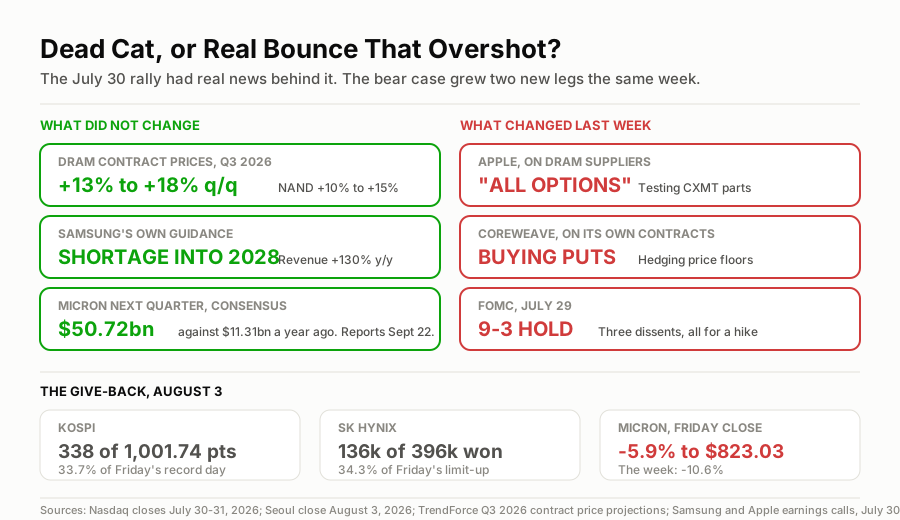
Two columns and a tally. The left column is why the bounce was real. The right column is why it stopped.
The Two Rallies Never Overlapped
This is the detail that decides the question, and it is hiding in the time zones.
The memory rally was not one event. It was two, and they happened on different days in different countries.
Thursday July 30, United States. SanDisk closed +26.29% near $1,261. Western Digital +18%. Seagate +16%. SK Hynix ADRs +16%. Micron ran as high as +16% intraday. The Nasdaq Composite closed +2.48% at 25,049.96. We covered it live in the SanDisk relief rally piece.
Friday July 31, South Korea. The KOSPI posted +17.91%, the largest single-day gain in its history, largely as a delayed reaction to Thursday's Wall Street session plus a domestic story about chairman buying and buyback signalling. The full breakdown is here.
Now stack them. While Seoul was pricing Thursday's American optimism into a record, America had already changed its mind. Micron fell 5.9% in that same Friday session. SanDisk closed at $1,214.83, below Thursday's close. The three Fed dissenters were out explaining why they wanted to hike.
So the sequence was: US up, Korea up on the US being up, US down while Korea is up, Korea down. Only one of those four legs was a market absorbing genuinely new information. The rest was echo.
That is why this morning's Korean session felt violent and was actually arithmetic. The KOSPI handed back 338 of Friday's 1,001.74 points, or 33.7%. SK Hynix handed back ₩136,000 of ₩396,000, or 34.3%. Two instruments, the same third, no new bad news required.
What Genuinely Changed, in Both Directions
Here is the ledger. It is the only way to answer this question, because both columns are longer than either side wants to admit.
Changed for the better
- Samsung's quarter. Revenue up 130% year over year, profit up more than 1,800%, a record on both operating profit and sales, and explicit guidance that the shortage deepens and extends well into 2028. That comes from the largest producer, and it corroborates what Intel and Silicon Motion had independently said, as we flagged in which stocks get hit next by memory costs.
- Contract prices are still going up. DRAM up 13% to 18% quarter over quarter in Q3 2026, NAND up 10% to 15%. UBS went further and lifted its DDR contract forecast to +32% for Q3 from +17%, and Q4 to +18% from +12%.
- The earnings arrive on a schedule. Micron reports September 22 with consensus at $50.72 billion of revenue and $31.24 of earnings per share, against $11.31 billion and $3.03 a year ago.
Changed for the worse, and this is the new part
- Apple is shopping. On July 30 Tim Cook called memory pricing a "hundred-year flood", said Apple expects to pay more again in September, and said of alternative DRAM suppliers: "we're evaluating all options." Apple has reportedly been testing CXMT parts for devices sold in China. The largest non-cloud buyer in the world is publicly working on a fourth supplier.
- CoreWeave is hedging its own contracts. CoreWeave has been exploring derivatives, including put options, to protect against a fall in memory prices, because its long-term deals with Micron and SanDisk carry price floors that leave it paying above market if prices drop. A major buyer is paying to be right about lower prices.
- The Fed has three hawks with names. The July 29 FOMC held at 3.5% to 3.75% on a 9-3 vote, with Logan, Hammack and Kashkari dissenting in favour of a hike. For the highest-multiple cyclical on the board, that is the risk that does not care about DRAM at all.
Changed for neither, but worth knowing
- A hedge fund unwind was cited as a driver of the July 30 move. Mechanical buying inflates a rally and predicts nothing about the next one.
- CXMT is three to four years behind on HBM, not absent from it. It has HBM3 samples out and is targeting mass production, but runs fewer than 2% of its roughly 265,000 monthly wafer starts on HBM, about 5,000 wafers, at low yield, while Samsung and SK Hynix race toward HBM4. Export controls bite at the tooling, which is why the gap is years rather than quarters. The high-margin AI pool is defended by that gap, not by a prohibition. The CXMT explainer carries the full split.
The Distinction That Settles It
Nothing in either column touched the revenue line. Everything in the "worse" column touched the multiple.
That distinction is the whole answer. In July, the bear case for memory was one thing: a new Chinese competitor with state money. Today the bear case is three things: a new competitor, the biggest customers publicly preparing for lower prices, and a central bank with a live hike faction. The July low was priced against one bear case. It has not been re-tested against three.
Meanwhile the bull case is unchanged and unusually well documented: contract prices rising, the largest producer guiding a shortage into 2028, and revenue lines up fourfold with printed dates attached.
You do not resolve that with a two-day rally. Which is why the two-day rally did not resolve it.
So Is This the Bottom?
No, and the reason is boring rather than bearish: nothing this week can settle it.
Micron does not report until September 22. The next real information in this complex is SanDisk's fiscal Q4 on Wednesday, August 5 at 1:30pm PT, with an Investor Day on August 13. Between now and Wednesday, memory prices are set by Seoul's opening bell and by whatever the Fed's dissenters say next.
A bottom is made when a sector stops falling on bad news. This one is still falling on no news at all, which is what a 5% Korean profit-take is. That is a market that has not finished deciding, and it is a bad market to be certain in.
The Playbook
The sizing question matters more than the direction question here, because the direction question is genuinely unresolved and the volatility is not.
- If you are underweight and want in, buy in thirds, and buy the producers rather than the storage names. Micron and SK Hynix carry the HBM exposure where CXMT is three to four years and one to two product generations behind. That gap, not a legal prohibition, is what protects the margin.
- Do not average down on a schedule Korea sets. Every gap-down this month has been a Seoul session, and buying US memory at 9:30am after an 8% Korean fall has been consistently worse than waiting for the American close.
- Watch the buyers, not the sell-side. Price targets on Micron run to $1,548.86 on consensus. What actually moved the sector last week was two customers talking about paying less. Customer behaviour is leading the analysts here.
- Size for a 26% day in either direction, because this complex printed one nine sessions ago. If a position would be intolerable after a repeat, it is too big now.
Our own record, since the rule here is that we publish it: through July our reflex was that implied volatility looked expensive and readers should avoid buying it. That was badly calibrated for this season, and passing on SanDisk before a 26.29% session was the costliest call of the month. Realised has been beating implied in memory for six weeks. Until that stops, the house bias is to own the move rather than sell it.
Trade log
| # | Stance | Structure | Strikes and expiry | Cost or credit | Spot at writing | Implied move | Breakeven |
|---|---|---|---|---|---|---|---|
| 1 | Constructive, staged | Long MU shares, first third | No expiry | Market | $801, premarket 8:00am ET, Aug 3 | n/a | Scored against $801 on the September 22 print |
| 2 | Pass | Selling memory premium (covered calls on MU or SNDK) | Any August expiry | Live chain not sourced at time of writing | MU $801 premarket Aug 3, SNDK $1,214.83 close Jul 31 | Not sourced | Scored on the whole position, not the option leg |
| 3 | Pass | Long MU straddle with no catalyst before Sept 22 | Aug 7 weekly | Live chain not sourced | $801, premarket 8:00am ET, Aug 3 | Not sourced. MU August implied volatility was last quoted near 102% | Needs a move inside a week with no scheduled event |
Row 1 is the constructive call, struck against $801 and scored against that level when Micron reports. Row 2 is a pass and gets scored on the whole position: if MU falls another 15% and a covered call collected 2%, that is a loss, not a win. Row 3 is a pass on buying volatility in the wrong name, and it is the row most likely to embarrass us, because that is exactly the call that failed in July. If MU moves more than the implied move this week, row 3 is a losing call and it will appear in the next scorecard.
Note what is not in this table: a directional bet on Wednesday. That is deliberate. SanDisk's implied move is being quoted anywhere from 17.5% to ~25%, its published consensus already sits at or above the top of the company's own $7.75 billion to $8.25 billion guide, and the evidence on direction genuinely cuts both ways: NAND contract prices up 70-75% quarter over quarter argue for a beat, while this season's reaction function has sold beats from crowded names all month. When magnitude is knowable and direction is not, you buy the move or you wait for the guide. You do not pick a side.
The trade with an actual date on it is the SanDisk print, and we set it out in this morning's Micron piece rather than logging it twice.
The One-Line Read
It was not a dead cat, because the news was real, and it was not a bottom, because the bear case grew two new legs the same week the rally happened: buy this sector in thirds, size it for a 26% day, and stop trying to call the low on a chart that is being drawn in Seoul.
Next up:MU reports Wed, Sep 30 after the close →
More on $MU
Updated Every Saturday
The Week Ahead
Every earnings date, Fed event and setup for the current trading week, on one page.
Refreshed Weekly
Earnings Calendar
Who reports next, when, and what consensus and the whisper expect.
The Week-Ahead Brief
Don’t miss next week’s setups. Get the Sunday brief.
Latest issue, Sep 7“Week ahead in the stock market...”
Every Sunday: next week’s earnings dates, Fed days and the trades worth watching, from the same desk that writes the week-ahead hub. Free, built for retail investors.