OpenAI IPO: The $40bn Run Rate Isn't What's Holding It Up
OpenAI's revenue run rate topped $40bn, double end-2025. The confidential S-1 is filed and the banks are hired. What is stalling the listing is the $1 trillion price, not the revenue.
TL;DR
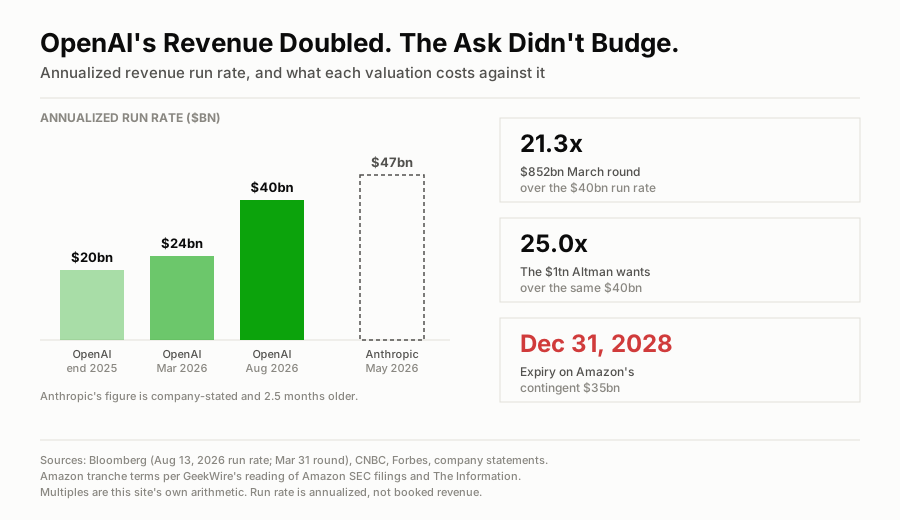
- Bloomberg reported on August 13 that OpenAI's annualized revenue run rate passed $40 billion, roughly double the $20 billion-plus it carried at the end of 2025. President Greg Brockman told staff the run rate rose more than 20% month-on-month in July.
- The confidential S-1 has been filed since June 8 and Goldman Sachs, Morgan Stanley and JPMorgan are on it. The paperwork is not the constraint.
- The price is. Advisers reportedly offered Sam Altman a choice: wait until 2027 for a $1 trillion debut, or list sooner at less. He called cutting the trillion a "nonstarter".
- $852bn is the last real mark, set on March 31 when OpenAI closed a $122 billion round. Against the $40bn run rate that is 21.3x. At $1tn it is 25.0x.
- There is a clock almost nobody quotes. Per Amazon's own filings, $35bn of its $50bn commitment expires on December 31, 2028 unless an IPO or an AGI milestone triggers it first.
More on Single Stocks: Options Scorecard: A Reddit Put and a Nutanix Pass, Both Right at Expiry →
The Board
The bar on the right belongs to a competitor and is 2.5 months older.
Is OpenAI Going Public in September?
Probably not, and the company has never confirmed that date. The Wall Street Journal reported a September target earlier in the year. By late June the reporting had turned: OpenAI was leaning toward waiting until 2027 to hold out for a $1 trillion valuation, after SpaceX's debut and its rocky lock-up aftermath took some of the shine off the mega-listing trade.
What is confirmed is narrower. OpenAI filed confidentially with the SEC, and said so publicly on June 8. Goldman Sachs, Morgan Stanley and JPMorgan lead it. No prospectus is public, no range exists, and no date has been set by the company.
So what exists today is a filed shell with an unresolved price on it.
What $40 Billion Actually Buys
Run rate is an annualization of a recent month, so it is not booked revenue and I would not treat it as such. It is still the best current read on the business, and the ramp behind it is steep: above $20bn at the end of 2025 per CFO Sarah Friar, $2bn per month when the March round closed ($24bn annualized, my arithmetic), $40bn-plus now.
Put the March mark over it. $852bn / $40bn = 21.3x. Put Altman's number over it: $1tn / $40bn = 25.0x.
Neither multiple is absurd for something growing at this rate. The gap between them is only about 17%, which is a strange thing to delay a listing by a year over, and that is the part I keep turning over.
One comparison the coverage mostly skips. Anthropic said its own annualized run rate passed $47 billion on May 29, and its backers have floated a $2 trillion October listing. Anthropic's May figure was already above OpenAI's August one. The two are not measured on the same day and Anthropic's is company-stated while OpenAI's is reported, so I would not push the comparison further than this: the revenue lead in this race is not obviously where the valuation gap says it is.
The Deadline Nobody Is Quoting
Amazon led the March round with $50 billion, alongside $30bn each from Nvidia and SoftBank. Those three sum to the $110bn OpenAI announced in February, before the round closed at $122bn. The arithmetic ties, which is a small reassurance that the reported figures are the real ones.
The structure underneath is the interesting part. GeekWire's reading of Amazon's SEC filings, and reporting from The Information, describe $15bn paid upfront and $35bn contingent on one of two triggers before December 31, 2028: an OpenAI IPO, or an AGI milestone whose definition is redacted. If neither happens, the obligation lapses.
I cannot tell from the public summaries exactly how the confidential June filing interacts with that trigger, and nothing has been reported to suggest it fired, so I am leaving that alone rather than guessing at contract mechanics I have not read.
The expiry date survives the uncertainty though. Waiting for a better tape is cheap in 2026 and gets expensive as 2028 closes, because $35bn walks out of the door on a fixed date. Altman can hold out for the trillion for a while. He cannot hold out indefinitely.
Can You Buy OpenAI Stock Before the IPO?
No. There is no ticker and no public market in the shares. The March round did include roughly $3bn from retail investors, per TechCrunch, but that was an offering into a private round rather than something a brokerage account could reach.
Anything advertising itself as pre-IPO OpenAI exposure deserves a hard look at what it actually holds, which is usually a fund position or a derivative wrapper. The listed proxies are the counterparties instead: Amazon, Nvidia, SoftBank and Microsoft all carry a piece of this, and the compute contracts behind it show up in our AI compute deal ledger. Those track what OpenAI spends rather than what it is worth.
For what actually trades this week, the week ahead has the retail prints and the Fed minutes.
The One-Line Read
The S-1 is filed, the banks are hired and revenue doubled. The only thing still unpriced is Altman's trillion, and Amazon's $35bn expires at the end of 2028 whether he gets it or not.
Next up:PCE inflation, today at 8:30am ET →
More on Single Stocks
Updated Every Saturday
The Week Ahead
Every earnings date, Fed event and setup for the current trading week, on one page.
Refreshed Weekly
Earnings Calendar
Who reports next, when, and what consensus and the whisper expect.
The Week-Ahead Brief
Don’t miss next week’s setups. Get the Sunday brief.
Latest issue, Sep 27“Micron, PCE and the jobs report that decides October”
Every Sunday: next week’s earnings dates, Fed days and the trades worth watching, from the same desk that writes the week-ahead hub. Free, built for retail investors.