How Much Money Is Actually Committed to AI Data Centers? We Built a Free Ledger of Every Deal.
We tracked every verified AI compute deal into one free dataset: $627 billion binding, $350 billion announced but not binding, 7.2 GW contracted. Here is what the headlines hide.
TL;DR
- We launched the AI Compute Deal Ledger: a free, source-linked dataset of every verified AI compute deal, from data center leases to GPU cloud contracts to the financing that makes them circular.
- Across the verified rows as of publication (August 3, 2026), $627 billion of deal value is actually binding, on 7.21 GW of contracted IT capacity. A further $350 billion is announced but not binding: a letter of intent and a reported backstop that headlines routinely add together with signed contracts.
- Renewal options add another $32.6 billion of theoretical upside, and the ledger keeps that out of the headline number on purpose. So are $596 billion of backlog restatements, order intake and program envelopes (Stargate's announced $500 billion among them) that would otherwise be double counted.
- The whole thing is CC BY 4.0: download the JSON or CSV, chart it, republish it, cite it. Attribution with a link is the entire price.
More on AI & Semiconductors: Options Scorecard: The Week of August 24, Graded (4 Calls, 75% Right) →
The Board
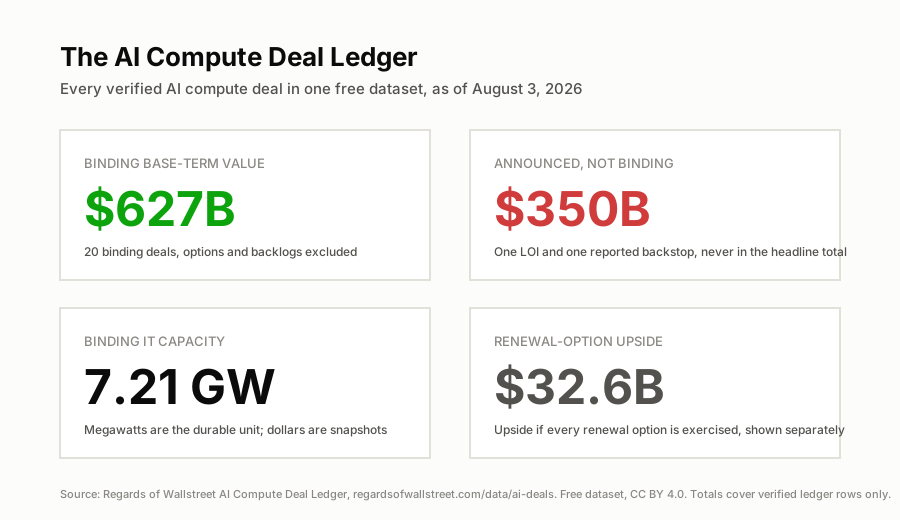
The gap between the green number and the red number is the entire point of the dataset.
How Much Money Is Actually Committed to AI Data Centers?
Across the deals we can verify to a primary or tier-1 source as we publish on August 3, 2026, $627 billion is contractually binding, and hundreds of billions more are announced without being signed.
That $406 billion is real, base-term contract value, and one contract dominates it: OpenAI's $300 billion, roughly five-year compute purchase from Oracle, the largest compute contract on record, corroborated the day before it leaked by Oracle's own disclosure of backlog jumping 359% to $455 billion. Around it sit Meta's roughly $35 billion of disclosed CoreWeave commitments, Microsoft's third-party capacity contracts with Nebius ($17.4 billion) and IREN ($9.7 billion), Anthropic's cloud commitments to Azure ($30 billion) and AWS (over $100 billion), Hut 8's two $9.8 billion Beacon Point leases, Applied Digital's $20.2 billion hyperscaler package, and CoreWeave's three OpenAI agreements. The $350 billion next to all of that is a different animal: Nvidia's up to $100 billion OpenAI partnership is a letter of intent, and the up to $250 billion Ohio backstop is, as of today, a report about talks. Both get a row in the ledger. Neither touches the binding total, because a letter of intent is a press release with better lawyers.
One honesty note before anyone quotes this: these are totals of the ledger's verified rows, not of the industry. The dataset launches with the deals that survived verification, and it will grow. What it will never do is inflate.
Why Every Headline Number You've Seen Is Too Big
Add up the AI deal headlines from the past year and you get a number several times larger than anything that has actually been signed. Four mechanisms do the inflating, and the ledger is built to reverse each one:
- The LOI dressed as a contract. "Nvidia to invest $100 billion in OpenAI" was a letter of intent, staged gigawatt by gigawatt. The ledger grades every row: binding, LOI, framework, or reported. Only binding sums.
- The backlog counted twice. Applied Digital announced $20.2 billion of new leases and, in the same release, a $36 billion total backlog that contains them. Reporters quoted both. We covered the print in the APLD breakdown; in the ledger, the backlog is a labeled snapshot that is never added to anything. Same treatment for Super Micro's $60 billion of quarterly order intake from the July 22 order bomb.
- The renewal option in the headline. Hut 8's Beacon Point campus is $19.6 billion of signed leases, or $50.2 billion "with all renewal options exercised". That second number appeared in plenty of coverage without the qualifier. The gap between those two figures lives entirely in that qualifier, which is why we read the fine print in the Beacon Point breakdown. The ledger stores option value in its own field, permanently quarantined from the headline.
- The circle counted as demand. When Nvidia invests in OpenAI, which buys systems built on Nvidia chips, or Microsoft and Nvidia invest up to $15 billion in Anthropic while Anthropic commits $30 billion to Azure, both legs are real and adding them still overstates net external demand. Circular rows carry a visible flag. We flagged the pattern the day the market did, in the July 27 close, when Nvidia fell 5% on the backstop report and Michael Burry posted "Around and around we go."
The Number Nobody Publishes: When the Power Actually Arrives
Dollars get restated every time a stock moves. Megawatts and delivery dates do not, which makes them the durable facts in every one of these deals. So the ledger leads with capacity: 7.21 GW of binding IT load, and a delivery-ramp view showing when it energizes.
That view contains the most under-reported fact in the sector: 1.2 GW starts in 2026 (Google's TPU capacity for Anthropic, IREN's Microsoft build), the Oracle contract's 4.5 GW carries only a year-level start (2027), Hut 8's second Beacon Point hall is the single row with a quarter-level date (Q2 2028), and the remaining 1,162 MW is signed, celebrated, and scheduled on a date nobody has published at all. The market is paying today for revenue whose start date is, in most cases, not public information. That is not a scandal. It is just a fact that should be attached to every backlog headline, and now it is.
What's Deliberately Missing
The ledger publishes its own gaps, and the biggest one closed within hours of launch. The $300 billion OpenAI and Oracle contract launched in the candidate queue, not the dataset, because at publish time no retelling of it could be pinned to a capturable primary or tier-1 source. It was promoted the same day, once two tier-1 URLs and Oracle's own backlog disclosure were on file, and the row carries the caveat most coverage skips: the planned 600 MW Abilene flagship expansion was scrapped in March 2026 while the contract and the wider 4.5 GW program continued. The queue still holds the deals we believe exist but have not verified, listed on the methodology page. A dataset that included them anyway, without flagging it, would be one you couldn't trust on anything else.
Same discipline going forward: every row needs two independent sources with at least one primary or tier-1, every figure has to reconcile arithmetically (a lease's dollars, megawatts and term have to multiply out to a sane price), and every correction lands in a public changelog instead of a silent edit. The verification rules are the product. The table is just where they live.
Use It, Take It, Link It
Everything is free under CC BY 4.0, including commercial use. Grab the full JSON or the flat CSV, or browse per company: every entity in the ledger has its own page, like Hut 8's deal record or Nvidia's. If you write about AI infrastructure, the citation line is on every page. If you spot an error or a missing deal, the methodology page explains what qualifies, and we log every correction in the open.
New deals get added as they verify, not as they trend. An EDGAR watcher now reads every deal-shaped 8-K so the queue fills itself; humans do the verifying.
The One-Line Read
The AI buildout's real, signed number is $627 billion as of August 3, 2026, hundreds of billions more are announced without being signed, and the entire value of tracking the difference is that nobody else is doing it in public, for free, with the receipts attached.
Next up:PCE inflation, Wed, Sep 30 at 8:30am ET →
More on AI & Semiconductors
Updated Every Saturday
The Week Ahead
Every earnings date, Fed event and setup for the current trading week, on one page.
Refreshed Weekly
Earnings Calendar
Who reports next, when, and what consensus and the whisper expect.
The Week-Ahead Brief
Don’t miss next week’s setups. Get the Sunday brief.
Latest issue, Sep 7“Week ahead in the stock market...”
Every Sunday: next week’s earnings dates, Fed days and the trades worth watching, from the same desk that writes the week-ahead hub. Free, built for retail investors.