Oracle's Project Jupiter Pipeline Slipped to 2027: The Three FERC Dates That Decide It
Transwestern moved the Green Chile pipeline's in-service date to February 1, 2027, and Oracle closed down 3.65%. The FERC docket carries three dates that matter more than Friday's tape.
TL;DR
- Transwestern Pipeline told FERC on Friday that the Green Chile Project will now enter service on February 1, 2027, six months later than the August 15, 2026 date it had been carrying. Oracle closed at $150.52, down 3.65%, after trading as much as 5% lower.
- The pipeline is sized at up to 400,000 dekatherms per day. Running Project Jupiter's announced 2.5 GW of Bloom Energy fuel cells flat out needs roughly 349,000 to 428,000 a day on Bloom's own published heat rates. This is the campus fuel supply, sized to the fleet.
- Oracle says "Project Jupiter remains on schedule." That statement survives the filing, because Oracle leases the campus for 18 years and owns none of it. The developers are BorderPlex Digital Assets and Stack Infrastructure, and FERC's named shipper is Green Chile Ventures, LLC.
- The $165 billion is an industrial revenue bond ceiling over a 30-year term, a county tax mechanism rather than Oracle capex. The county's own release puts the near-term commitment at $50 billion within five years.
- Three dates now matter more than Friday's close: September 4 (FERC environmental assessment), December 3 (federal authorization decision deadline), February 1 (revised in-service).
More on Single Stocks: Options Scorecard: A Reddit Put and a Nutanix Pass, Both Right at Expiry →
The Board
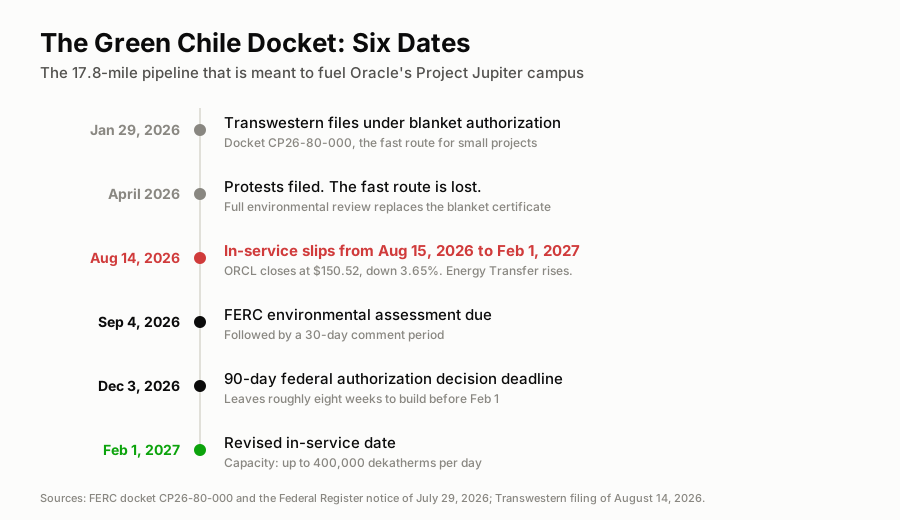
Six dates on one docket. Two of them have not happened yet and both come before the pipeline can be built.
What Actually Changed on Friday
A subsidiary of Energy Transfer filed a revised in-service date. That is the whole event.
Transwestern Pipeline submitted the update in response to a FERC data request dated August 11, moving the Green Chile Project from August 15, 2026 to February 1, 2027. The project is docket CP26-80-000: approximately 17.8 miles of 24-inch pipeline in Doña Ana County, New Mexico, taking gas off the El Paso Natural Gas system and delivering it to Green Chile Ventures, LLC for a data centre campus.
The tape split on it. Oracle fell and Energy Transfer rose about 1.5% in the same session. The builder gets paid either way; the tenant waits.
Does 400,000 Dekatherms Cover 2.5 Gigawatts?
Yes, with very little to spare, and that is the part I find most useful in the filing.
Project Jupiter's power comes from Bloom Energy fuel cells rated at up to 2.5 GW. Bloom's own February 2026 datasheet puts the Energy Server 6.5 heat rate at 5,811 to 7,127 Btu/kWh (HHV). Run 2.5 GW continuously across that range and the gas burn works out at roughly 349,000 to 428,000 dekatherms a day. The pipeline is certificated for up to 400,000.
My assumption there is a 100% capacity factor, which is aggressive for most power plants and roughly the design case for an AI training campus. Flex it down and the pipeline covers the fleet comfortably; hold it at full load and the efficient end of Bloom's range is doing the work.
Either way the conclusion holds: Green Chile is not a supplementary lateral. It is the fuel line for the announced generation, which is why a six-month slip reads as a schedule problem rather than a procurement inconvenience.
Why Oracle Can Say Jupiter Is On Schedule
Because Oracle does not own the pipeline, the land or the buildings.
The campus is being developed by BorderPlex Digital Assets with Stack Infrastructure, and Oracle Cloud Infrastructure leases it for 18 years, with OpenAI as the primary client. FERC's shipper of record is Green Chile Ventures, LLC. Oracle's spokesman said Jupiter "remains on schedule, and we continue to work closely with our partners to move the project forward," and nothing in Friday's filing contradicts that on its face.
I would still treat the statement as narrow. A tenant can be on schedule with its own obligations while the thing that powers the building is six months late. Oracle has not said which Jupiter milestone it is measuring, and I have not seen a phase-by-phase energisation schedule published anywhere. Until one exists, "on schedule" is a claim about Oracle's paperwork, not about megawatts arriving in Santa Teresa.
The $165 Billion Is a Bond Ceiling
Almost every write-up of this story calls Jupiter a "$165 billion Oracle data center." The county documents describe something different.
Doña Ana County approved up to $165 billion in industrial revenue bonds over a 30-year term. In New Mexico an IRB is a tax mechanism: the county takes title to the property and equipment and leases it back, which delivers a property tax abatement offset by payments in lieu of taxes. The county's own announcement puts the actual near-term commitment at $50 billion within five years, alongside $50 million for water and wastewater infrastructure and $6.9 million for community investment funds.
So the $165bn is an authorisation ceiling on a financing structure, spread over three decades, for a campus Oracle rents. Treating it as Oracle capex overstates the near-term number by more than three times and attributes it to the wrong balance sheet. Readers who followed the $370 billion attached to Broadcom's financing platform will recognise the shape of the error: a headline notional doing duty as a spending figure.
Oracle's real exposure here is the 18-year lease and the compute contracts behind it, which is the same question the $638 billion RPO raises across the whole company. The backlog coverage dataset is where that arithmetic lives.
Three Dates, and a Lawsuit
FERC staff plan to issue the environmental assessment on September 4, followed by a 30-day comment period, with a December 3 deadline for federal authorization decisions. That schedule exists because the project lost its fast track: the Sierra Club Rio Grande Chapter, the Center for Biological Diversity and Food & Water Watch protested the use of a blanket certificate in April, and the project moved to full environmental review.
Work backwards from Feb 1 and the arithmetic is tight. A December 3 decision leaves roughly eight weeks to build 17.8 miles of 24-inch pipe. Bloomberg quoted Energy Aspects analyst Josh Garcia calling the new date "probably not realistic," and on that timetable I think the scepticism is fair rather than reflexive.
Separately, the New Mexico Environmental Law Center's challenge to the county's approval of the bonds survived a motion to dismiss in March and is in discovery. It targets the incentives rather than the pipeline, so it is a slower and more distant risk. It is also the reason this story has a tail that runs past the winter.
The One-Line Read
The gas line is sized to the fuel cells, so a six-month slip is a real schedule problem. September 4 and December 3 will tell you whether February 1 was ever a date or just a placeholder.
Next up:PCE inflation, today at 8:30am ET →
More on Single Stocks
Updated Every Saturday
The Week Ahead
Every earnings date, Fed event and setup for the current trading week, on one page.
Refreshed Weekly
Earnings Calendar
Who reports next, when, and what consensus and the whisper expect.
The Week-Ahead Brief
Don’t miss next week’s setups. Get the Sunday brief.
Latest issue, Sep 27“Micron, PCE and the jobs report that decides October”
Every Sunday: next week’s earnings dates, Fed days and the trades worth watching, from the same desk that writes the week-ahead hub. Free, built for retail investors.