Stock Market Week Ahead (Oct 12-16): JPMorgan and the Big Banks, September CPI, TSMC, and the Last Fed Speeches Before October 28
Week ahead October 12-16: JPMorgan, Goldman and UnitedHealth report Tuesday, September CPI lands Wednesday at 8:30am ET with headline inflation forecast near 3.6%, and TSMC reports Thursday.
TL;DR
- September CPI publishes at 8:30am ET on Wednesday, October 14, and it is the last inflation reading before the Fed decides on October 28. Forecasters expect headline inflation to rise to about 3.6% from 3.4%, with core inflationCore inflation strips food and energy out of CPI or PCE, because those prices swing with the weather and the oil market rather than the economy. The Fed watches core as the cleaner read on underlying price pressure, even though people still pay for food and fuel. near 0.2% on the month. Core inflation is what decides whether the Fed raises rates on October 28 or waits until December 9.
- The 10-year Treasury yield closed Friday at 5.24%, after reaching its highest level since 2002 during the week. Freddie Mac's 30-year mortgage rate rose for a seventh straight week, to 7.40%. Stocks rose anyway: the S&P 500 hit a record close of 7,818.93 earlier in the week and closed Friday at 7,811.54.
- Monday, October 12: the stock market trades normal hours and the bond market is closed for Columbus Day.
- Tuesday, October 13: JPMorgan, Wells Fargo, Citigroup, Goldman Sachs, UnitedHealth and Johnson & Johnson all report before the open. Bank of America, Morgan Stanley, ASML and BlackRock follow on Wednesday.
- Thursday, October 15: September PPI and retail sales at 8:30am ET, TSMC before the bell. Fed Chair Kevin Warsh speaks at 11:30pm ET, the last scheduled Fed comments on policy before officials stop discussing it publicly on Saturday, October 17.
More on $SPY: Stock Market Week Ahead (Sep 28-Oct 2): Micron Earnings, PCE Inflation, and the Jobs Report That Decides an October Fed Hike →
The Board
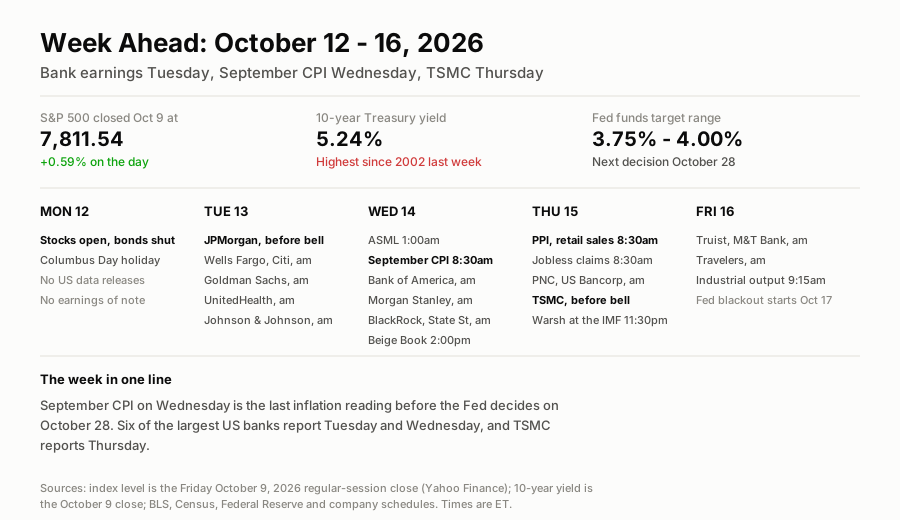
Bank earnings Tuesday, CPI Wednesday, TSMC Thursday.
What Time Is the September CPI Report?
8:30am ET on Wednesday, October 14, per the Bureau of Labor Statistics schedule. Forecasters expect headline inflation of 3.6% to 3.7% over twelve months, up from 3.4% in August. The Cleveland Fed's nowcast, updated October 2, has prices up 0.53% on the month and 3.60% over the year.
Core inflation strips out food and energy. Forecasts for it cluster tightly: 0.2% for the month and about 2.4% over the year, roughly where August landed. August's report came in at 3.4% headline with a hotter 0.3% core, and that core reading is what pushed September's hike through. The rolling date for every print is on the CPI release-date page.
Last Week: the 10-Year Treasury Yield Closed at 5.24% and Stocks Set a Record Anyway
The 10-year Treasury yieldThe 10-year Treasury yield is the interest rate the US government pays to borrow for ten years. Mortgage rates and most long-term borrowing costs are set off it, which is why a move in this one number reaches housing, corporate borrowing and stock valuations. finished Friday at 5.24%, up from 5.18% two weeks earlier, per ETF Trends' yield snapshot. It reached its highest level since 2002 during the week, per the Washington Post. Freddie Mac's 30-year mortgage rate went to 7.40% on Thursday, from 7.28% a week earlier and 6.30% a year ago, per Freddie Mac. That is a seventh straight weekly rise and the highest in nearly three years.
Stocks rose anyway. The S&P 500 set a record close of 7,818.93 last week and finished Friday's regular session at 7,811.54, 0.1% below it. The sector heatmap shows which groups carried the index, and the last edition has the September jobs report and the August PCE figures.
My read: investors are treating high borrowing costs as the price of an economy that is still growing. That is how a 5.24% yield and a record close sit together. Wednesday's inflation reading tests it.
Why Headline Inflation Is Expected to Rise While Core Falls
Gasoline. US crude spent last week above $90 a barrel, and pump prices rose through September. The seasonal adjustment the BLS applies expects pump prices to fall at that time of year. So a month when they rise instead gets amplified in the adjusted figure. The energy line does most of the work in a move from 3.4% to 3.6%.
Gasoline prices are what push the headline figure up, so a higher headline reading would not automatically mean the Fed raises rates. The Fed has generally treated energy as noise and watched core, and core is forecast flat on August. Markets are priced accordingly. A quarter-point rise on October 28 carries roughly a 17% to 22% chance. December 9 carries 71% to 85%, per CME's FedWatch tool. October's odds were about 64% before the September jobs report, which added 29,000 jobs against the 90,000 expected.
Forecasters expect core inflation of 0.2% on the month, so a 0.3% reading is the one that would move markets on Wednesday. That is the figure I would watch at 8:30am, because it is what would put an October rise back in play. The Fed hub tracks the odds and the Fed calendar has the dates.
Six Large Banks Report in Three Days, With Long-Term Yields at Their Highest Since 2002
JPMorgan, Wells Fargo, Citigroup and Goldman Sachs report before Tuesday's open, Bank of America and Morgan Stanley before Wednesday's. Analysts want $5.91 a share from JPMorgan on $51.0 billion of revenue, per the earnings calendar.
Analysts' forecasts for Goldman Sachs differ sharply from one another. Its consensus was cut $1.71 a share in the thirty days to October 3, to $14.72, and the 19 estimates run from $11.61 to $18.34. A spread that wide means they disagree about how much the trading desks made, not about a rounding error.
Higher long-term yields cut both ways for all of them. Banks earn more on new loans and on the cash they hold at the Fed. The same move has taken mortgage rates to 7.40%, which slows the lending that fee income depends on. Both effects land in this quarter, so I would read the mix each bank reports rather than whether it beat.
Analysts expect a strong quarter from US companies in general. FactSet's October 9 Earnings Insight puts expected third-quarter earnings growth for the S&P 500 at 29.6% year over year. Estimates have risen 1.3% since June 30, against a five-year average decline of 2.2%. Analysts usually trim their numbers as a quarter goes on, so an increase is unusual.
The percentage after each company below is its implied moveThe implied move is how far the options market expects a stock to move on an event, up or down, worked out from options prices. A 12% implied move on a $50 stock means traders are paying for a swing to roughly $44 or $56. It is what is already priced in, so the stock has to beat it for an options bet to pay.: the size of share-price swing that options prices suggest investors expect after the results. Each is struck against the October 2 close.
Monday, October 12: Stocks Trade, Bonds Do Not
- The stock market is open for normal hours, 9:30am to 4:00pm ET. Columbus Day is not an NYSE closure, per the exchange's 2026 holiday calendar.
- The bond market is closed. SIFMA recommends a full close for Treasuries, agency debt and municipal bonds, so Treasury yields will not print a new level until Tuesday. Banks and Fedwire are shut too, which pushes settlement to Tuesday. Every holiday and half-day is on the market hours page.
- No US economic releases. The Fed's own daily and weekly statistical releases move to Tuesday.
- No earnings of note.
Tuesday, October 13: Four Big Banks, UnitedHealth and Johnson & Johnson
- 3:45am ET: Fed Governor Waller speaks on AI in New Delhi.
- Before the open: JPMorgan (implied move 4.4%), Wells Fargo (5.6%), Citigroup (5.5%), Goldman Sachs (5.8%).
- Before the open: UnitedHealth (8.0%), the widest implied move of the week, and Johnson & Johnson (4.2%). Analysts want $4.15 a share from UnitedHealth, against $6.38 adjusted in the June quarter, per the company's release. That drop is seasonal: medical costs run heavier later in the year. The full-year adjusted guide of $19.50 to $20.00 is what the quarter gets measured against.
Wednesday, October 14: ASML at 1:00am, CPI at 8:30, Then Bank of America and Morgan Stanley
- 1:00am ET: ASML, which releases at 7:00am Central European Time. It guided third-quarter net sales to €11.0 billion to €12.0 billion and gross margin to 55-57%, per its July 15 second-quarter release. Options priced a 7.4% move.
- 8:30am ET: September CPI.
- Before the open: Bank of America (implied move 4.9%), Morgan Stanley (5.6%), State Street (6.0%), BlackRock (6.0%).
- 2:00pm ET: the Beige BookThe Fed’s Beige Book is a report on how the US economy is doing across the Federal Reserve’s 12 districts. It covers things like jobs, wages, prices, consumer spending and business activity, using surveys and conversations with businesses., the Fed's survey of conditions across its twelve districts, and the last one before the October meeting.
Thursday, October 15: PPI and Retail Sales at 8:30, TSMC Before the Bell, Warsh at 11:30pm
- 8:30am ET: September PPI, the producer-price measure, per the BLS schedule. August ran 0.4% on the month and 5.4% over the year.
- 8:30am ET: September advance retail sales, per the Census Bureau's schedule. August rose 1.2%, well past the roughly 0.8% expected. I could not source a September consensus, so there is no forecast figure here.
- 8:30am ET: weekly jobless claims.
- Before the open: TSMC (implied move 4.9%), plus PNC (4.9%) and U.S. Bancorp (5.0%). TSMC's quarterly revenue is already known, because it reports sales monthly. The three months together come to about NT$1.49 trillion, roughly 51% above the same quarter of 2025, per its own disclosures. So the call is about next year's capital spending budget, which sets how much advanced capacity Nvidia, AMD and Broadcom can book.
- 11:30pm ET: Fed Chair Kevin Warsh, in conversation with IMF Managing Director Kristalina Georgieva in Bangkok, per the Fed's calendar. It is Friday morning there, and it is the last scheduled Fed comment on policy before the blackout.
Friday, October 16: Truist, M&T and Travelers, and No More Fed Speeches Until After October 28
- Before the open: Truist (implied move 4.8%), M&T Bank (4.4%), Travelers (4.5%).
- 9:15am ET: industrial production and capacity utilisation.
- The Fed's blackoutThe blackout is the quiet period before each Fed meeting when policymakers stop speaking publicly about rates and the economy. It exists so markets are not steered in the final days before a decision. period starts Saturday, October 17 and runs to October 29, per the Atlanta Fed. No official will discuss policy in public between Warsh's appearance and the decision. Nothing new from the Fed reaches the market between Friday evening and October 28.
The full list of economic releases is on the economic calendar, and each morning's timetable is on /today.
The One-Line Read
The core CPI reading at 8:30am Wednesday shows whether a rate rise on October 28 is still possible. Six large banks and TSMC report while long-term yields sit at their highest since 2002.
Next up:CPI, Wednesday at 8:30am ET →
More on $SPY
$SPY · 2026-09-27
Stock Market Week Ahead (Sep 28-Oct 2): Micron Earnings, PCE Inflation, and the Jobs Report That Decides an October Fed Hike
$SPY · 2026-09-19
Stock Market Week Ahead (Sep 21-25): Costco, AutoZone, KB Home and a 5% Ten-Year
$SPY · 2026-09-18
Options Scorecard: A Reddit Put and a Nutanix Pass, Both Right at Expiry
Updated Every Saturday
The Week Ahead
Every earnings date, Fed event and setup for the current trading week, on one page.
Refreshed Weekly
Earnings Calendar
Who reports next, when, and what consensus and the whisper expect.
The Week-Ahead Brief
Don’t miss next week’s setups. Get the Sunday brief.
Today's issue“September CPI, the big banks and TSMC: earnings season starts”
Every Sunday: next week’s earnings dates, Fed days and the trades worth watching, from the same desk that writes the week-ahead hub. Free, built for retail investors.