Synopsys (SNPS) Earnings Aug 26: Revenue Up 40%, Profit Up 9%
Synopsys reports fiscal Q3 on August 26 at 5pm ET, the same minute as Nvidia. Consensus of $3.68 sits one cent under the top of the company's own guide, and the stock is 33% off its high.
TL;DR
- Synopsys reports fiscal Q3 2026 on Wednesday, August 26, after the close, with the call at 5:00pm ET. Nvidia, Salesforce and CrowdStrike all hold calls on that same minute, so this print goes off in the loudest hour of the quarter.
- Consensus is $2.44bn of revenue and $3.68 of non-GAAP EPS. The company guided $2.410bn to $2.460bn and $3.63 to $3.69. The Street is sitting one cent under the top of the guide.
- Those two consensus numbers imply revenue up 40.2% and profit up 8.6% against last year's Q3. That spread is the Ansys acquisition, and it is the thing to understand before reading any headline on Wednesday night.
- Last quarter, GAAP EPS was $0.09 against $3.35 non-GAAP. For the full year the company guides $2.49 to $2.91 GAAP and $14.72 to $14.80 non-GAAP: the adjustments are more than four times the GAAP profit.
- The stock closed $421.50 on August 14, 32.7% below its 52-week high of $626.24, in a month when the AI trade printed records. That gap is the setup.
More on Earnings: Stock Market Week Ahead (Sep 21-25): Costco, AutoZone, KB Home and a 5% Ten-Year →
The Board
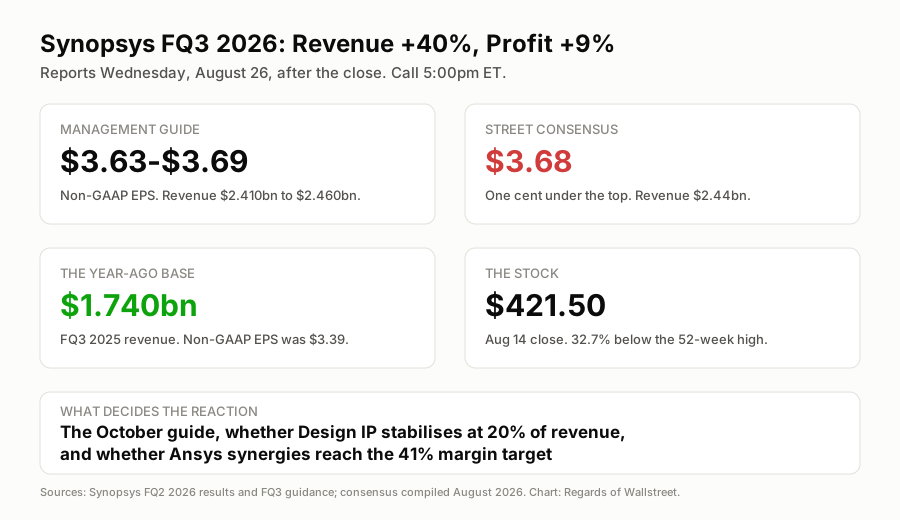
Forty percent more revenue, nine percent more profit, and a stock a third below its high.
When Does Synopsys Report Earnings?
Wednesday, August 26, after the market closes, with the conference call at 2:00pm Pacific and 5:00pm Eastern. Synopsys confirmed the date itself on July 22.
The quarter it is reporting ended on July 31. Everything in the results is already fixed; the only live number on Wednesday is the guide for the October quarter and whatever management says about the fiscal year.
That 5:00pm slot is crowded. Our hour-by-hour board for August 26 already had three calls landing together, and Synopsys makes four. Nvidia is the one everybody will be on. If you care about EDA, the Synopsys transcript is going to be read late.
The Forty-Point Spread
Consensus has revenue up 40.2% and non-GAAP EPS up 8.6%. Both are real, and the distance between them is the whole company right now.
Synopsys closed the Ansys acquisition in July 2025. Fiscal 2026 guidance carries $2.96bn of expected Ansys revenue inside a $9.665bn midpoint, which is 30.6% of the year. So a growth rate in the high thirties or low forties is mostly a comparison against a company that did not own Ansys yet, and it stops being flattering some time next year when the quarters lap.
The profit line is where the deal shows its cost. Last quarter revenue rose 41.9% to $2.276bn and non-GAAP EPS fell to $3.35 from $3.67. Nothing improper about that: you buy a large business, you get its revenue and its expenses, and the share count goes up because part of the price was stock. But it does mean the growth headline and the earnings headline are describing different things, and Wednesday's coverage will lead with the first one.
The segment split from that quarter: Design Automation $1.821bn, exactly 80% of the total, and Design IP $454.2m. Design IP is the piece that has been struggling, and Synopsys is divesting its Processor IP Solutions business, which took $40m out of the full-year guide.
One Cent of Room
Here is the part I find genuinely awkward for the stock.
Management guided non-GAAP EPS of $3.63 to $3.69. Consensus is $3.68. There is a single cent between where the Street sits and the highest number the company itself was willing to put on paper three months ago.
Revenue is the same story with slightly more slack: guide of $2.410bn to $2.460bn, midpoint $2.435bn, consensus $2.44bn. The Street has parked itself just above the middle on revenue and just under the ceiling on profit.
A company that lands inside its own guide will therefore print something that reads as a miss on EPS unless it clears the top. That is a normal position for a business that habitually sandbags, and Synopsys has historically guided conservatively. It is a bad position for a stock that has already lost a third of its value and needs a reason.
What GAAP Says
Full-year guidance: $2.49 to $2.91 of GAAP EPS, $14.72 to $14.80 non-GAAP. Take the midpoints and the adjustments come to about $12.06 a share, against $2.70 of GAAP profit. The stuff being added back is roughly 4.5 times the earnings that survive the accounting.
Most of that is purchase accounting on Ansys, which is a real and well-understood adjustment, and I am not going to pretend amortisation of an intangible is a cash cost. What I would say is that the trailing GAAP P/E of 99.8 and the forward non-GAAP P/E of 28.6 (on the $14.76 midpoint, at Friday's $421.50 close) are so far apart that the valuation argument depends entirely on which one a reader has been shown. Both are correctly calculated. Only one of them makes the stock look ordinary.
China Is In The Guide As A Zero-Change Assumption
Synopsys did $989.5m of China revenue in fiscal 2024, about 16% of the company; more recent quarters have run nearer 10%. In May 2025 the Bureau of Industry and Security effectively halted EDA sales to China and Synopsys pulled its guidance outright. The restriction was later rolled back and access restored.
The current guide assumes no further changes to export controls or the Entity List. That is the only sensible way to guide, and it also means the number carries a policy risk that no amount of modelling will price. Anyone buying this into Wednesday is taking a small position on Washington alongside a position on chip design software.
Three Things That Decide Wednesday Night
The October guide. The fiscal year ends October 31, so Q4 guidance and the full-year number arrive together. With three quarters banked, the Q4 implied revenue is nearly arithmetic, and the room for a surprise is in margin and in what management says about fiscal 2027, the first year without an easy Ansys comparison.
Design IP. Two consecutive quarters of weakness, a divestiture in progress, and 20% of revenue. If this segment stabilises the story gets simpler. If it does not, the bear case writes itself: the growth engine is an acquisition and the organic business is going sideways.
Synergies. Management raised the full-year EPS guide in May on cost discipline and "accelerating synergies", with an operating margin midpoint near 41% against the 38.5% posted a year earlier. Deal synergies are the most checkable promise in corporate finance, because they either show up in the margin line or they do not. This is the quarter where they should be visible.
Where I Come Out
The setup is better than the tape suggests and worse than the growth rate suggests. A stock at 28.6 times forward guided earnings, growing organically in the high single digits, with a structural position in a market where every AI chip has to be designed by somebody, is not expensive. Sell-side consensus has trimmed its target to roughly $538 from $557, which against $421.50 implies about 27% upside on a twelve-month view; that is the Street's number and not mine, and it assumes Design IP recovers.
My reservation is narrower than the valuation. It is that one cent. When consensus sits at the top of a guide the company issued in May, an in-line quarter is a disappointment, and Synopsys has spent the last year proving it cannot control the variable that would produce an upside surprise. I would rather own this after the print than before it, and I would rather own it than AMD at a $2 trillion price target.
No options play is logged here. I could not source a live chain on a Saturday, and a structure without an entry price cannot be scored later.
The One-Line Read
Forty percent revenue growth that is mostly an acquisition, nine percent profit growth that is the real business, and a Street parked one cent under the company's own ceiling. Good asset, awkward week to own it.
Also reporting into that window: Nvidia, Salesforce and CrowdStrike, all on August 26. The full run of dates is in the earnings calendar, and this week's schedule is in the week ahead.
Next up:PCE inflation, today at 8:30am ET →
More on Earnings
Updated Every Saturday
The Week Ahead
Every earnings date, Fed event and setup for the current trading week, on one page.
Refreshed Weekly
Earnings Calendar
Who reports next, when, and what consensus and the whisper expect.
The Week-Ahead Brief
Don’t miss next week’s setups. Get the Sunday brief.
Latest issue, Sep 27“Micron, PCE and the jobs report that decides October”
Every Sunday: next week’s earnings dates, Fed days and the trades worth watching, from the same desk that writes the week-ahead hub. Free, built for retail investors.