Why Is AXT (AXTI) Stock Up 43%? Record Indium Phosphide, and a Gross Margin That Went From 8% to 45% in a Year
AXT jumped over 40% after revenue rose 164% to $47.59m on record indium phosphide sales, gross margin hit 45% from 8.2%, and it guided Q3 to $66m. What indium phosphide is, and why AI needs it.
TL;DR
- AXT rose more than 40% after a quarter that was not a beat so much as a different company. Revenue $47.59 million, up 164% year over year and 77% sequentially, against estimates in the low $30 millions.
- Adjusted EPS of $0.19 against $0.07 expected, and a swing to non-GAAP operating profit of $11.2 million from a loss in the previous quarter.
- The line that explains the move: gross margin of 45.0%, against 29.9% last quarter and 8.2% a year ago.
- Indium phosphide revenue hit $30.7 million, an all-time high, on demand for AI data centre infrastructure. That one product is now roughly two thirds of the company.
- And the guide is bigger than the quarter. Q3 revenue of about $66 million with EPS of $0.30 to $0.32, far above the street, implying the acceleration is not finished.
More on AI & Semiconductors: Options Scorecard: The Week of August 24, Graded (4 Calls, 75% Right) →
Why Is AXT Stock Up Today?
AXT makes indium phosphide substrates, the wafers that optical components inside AI data centres are built on. Demand for those went vertical, revenue rose 164% year over year, and a company that was barely gross-margin-positive a year ago just posted a 45% gross margin and guided next quarter higher still.
This is what operating leverage looks like when it arrives all at once in a small company.
What Is Indium Phosphide, and Why Does AI Need It?
Worth answering properly, because almost nobody owns this keyword and it explains the entire thesis.
Most chips are built on silicon. Silicon is superb at switching electricity and hopeless at producing light. Indium phosphide is a compound semiconductor substrate that does the thing silicon cannot: it emits and detects light efficiently, at the specific infrared wavelengths that travel well down fibre optic cable.
That matters because of how AI data centres are built. A training cluster is not one computer, it is tens of thousands of accelerators that have to talk to each other constantly and at enormous bandwidth. Copper runs out of road quickly at those speeds and distances. So the interconnect is optical: lasers, modulators and photodetectors converting electrical signals to light and back, in transceivers plugged into every switch and every rack.
Every one of those lasers and detectors starts life on a substrate. For the high-speed, long-reach optics that data centres need, that substrate is overwhelmingly indium phosphide.
So the chain runs: more AI clusters, more interconnect, more transceivers, more lasers, more indium phosphide wafers. AXT sells the wafer. It is several layers upstream of anything with a brand name on it, which is exactly why it went from an 8.2% gross margin to 45% without most investors noticing it existed.
The Board
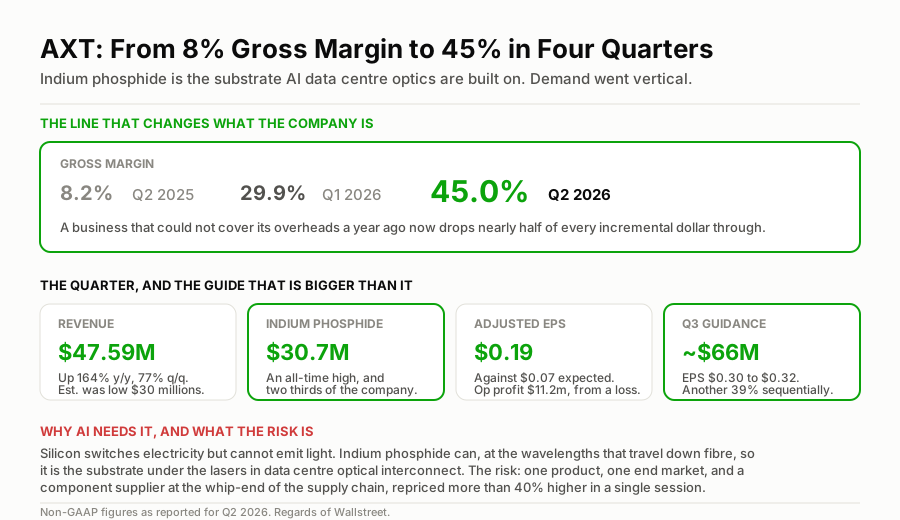
A gross margin that went from 8.2% to 45.0% in four quarters. Everything else on the board follows from it.
Why the Gross Margin Matters More Than the Revenue
Revenue tripling is impressive. The margin move is the part that changes what the company is worth.
| Quarter | Gross margin |
|---|---|
| Q2 2025 | 8.2% |
| Q1 2026 | 29.9% |
| Q2 2026 | 45.0% |
A business running at an 8.2% gross margin is not really a business. After manufacturing costs there is almost nothing left to pay for engineering, sales or overheads, which is why AXT was losing money. At 45%, every incremental dollar of revenue drops through to profit at a rate that transforms the income statement, which is exactly what the swing to $11.2 million of non-GAAP operating profit shows.
Two things drive a move like that in a substrate business. Utilisation, because these are capital-heavy fabs where fixed costs are spread across whatever volume you can push through them. And mix, because record indium phosphide revenue displaces lower-value products. AXT got both at once.
The reason this matters more than the headline: a company can beat on revenue once. A gross margin that goes from 8% to 45% is a structural change in the economics, and if volumes hold, it does not reverse next quarter.
The Guide Is Bigger Than the Quarter
Most 40% moves are about the quarter that just happened. This one should not be.
AXT guided Q3 revenue to roughly $66 million with EPS of $0.30 to $0.32. Against the $47.59 million it just reported, that is another 39% sequential increase, and EPS roughly 60% above the $0.19 it just delivered.
Sequential guidance of that size means management is looking at an order book, not a hope. Substrate businesses have long lead times: wafers ordered now go into transceivers built later for clusters deployed later still. You do not guide up 39% sequentially on sentiment.
It also puts the company on an annualised revenue run rate several times what it was doing a year ago, which is the arithmetic doing most of the work behind a 43% session.
The Bull Case and the Bear Case
Bull case. A structural margin transformation, record volumes in the product with the best end-market in technology, a swing to real operating profit, and a sequential guide implying the acceleration continues. AXT sits upstream of the optical interconnect build-out, which is one of the few parts of the AI supply chain where demand is being confirmed rather than forecast. Microsoft, Amazon and the memory complex have all now put receipts behind AI capex this week, and optical interconnect is where a meaningful share of that spending physically goes.
Bear case, and it is not small. This is a concentrated bet. One product line is roughly two thirds of revenue, serving one end market, in a company small enough that a single large customer's order timing swings the quarter. Substrate and component suppliers are also the classic whip-end of the supply chain: they see demand amplified on the way up and amplified again on the way down, because customers order ahead and then digest inventory. A 45% gross margin achieved on peak utilisation compresses fast if volumes pause.
And you are buying it after a 43% day. Whatever the next few quarters hold, a meaningful slice of it was repriced into the stock in a single session.
Our read: a genuinely interesting business at an uncomfortable entry point. The margin story is real and it is not a one-quarter artefact. But the correct response to a 43% move in a small-cap component supplier is to build a position on the inevitable pullback, not into the print reaction. If you want the theme immediately, note that the same AI interconnect demand shows up with far less single-name risk across the memory complex, where we laid out the bounce-versus-bottom question this week.
The Options Angle
- Options on a small-cap that just moved 43% are wide, thin and expensive. Buying calls here means crossing a large spread to pay peak implied volatility for a move that already happened.
- Selling premium is more dangerous than it looks in a name this size. Illiquid options on a stock that can move 40% in a session do not offer enough premium for the tail you are taking.
- The clean expression is shares, sized small, with the explicit acceptance that a component supplier this concentrated is a high-variance holding.
- The dated catalyst worth waiting for is the Q3 report, which either confirms the $66 million guide or reveals it as an order-timing pull-forward. That is the number that decides whether the margin transformation is structural.
The One-Line Read
AXT rose more than 40% because revenue grew 164% to $47.59 million on record indium phosphide sales into AI data centre optics, and gross margin went from 8.2% a year ago to 45.0%, which is a change in what the company is rather than a good quarter: the guide to roughly $66 million next quarter implies an order book to match, and the risk is that a concentrated substrate supplier sitting at the whip-end of the AI supply chain has just been repriced 43% higher in one session, leaving very little margin for the first quarter that disappoints.
Next up:Fed decision, tomorrow →
More on AI & Semiconductors
Updated Every Saturday
The Week Ahead
Every earnings date, Fed event and setup for the current trading week, on one page.
Refreshed Weekly
Earnings Calendar
Who reports next, when, and what consensus and the whisper expect.
The Week-Ahead Brief
Don’t miss next week’s setups. Get the Sunday brief.
Latest issue, Sep 7“Week ahead in the stock market...”
Every Sunday: next week’s earnings dates, Fed days and the trades worth watching, from the same desk that writes the week-ahead hub. Free, built for retail investors.