Why Is SanDisk (SNDK) Up 26% Today? The Memory Bounce, and Whether It's a Bottom or a Dead Cat
SanDisk closed up 26.29% and Micron ran as high as 16% as Samsung posted record profit and flagged a shortage into 2028. Is this the bottom, and should you buy calls? We take a side on both.
TL;DR
- SanDisk closed up 26.29%, ending near $1,261, and it was not alone. Micron ran as high as 16%, Western Digital rose 18%, Seagate 16%, SK Hynix ADRs 16%, and the Roundhill DRAM ETF 13%.
- The whole tape came with it. The Nasdaq Composite closed at 25,049.96, up 607.02 points or 2.48%.
- Three real catalysts: Samsung posted record Q2 profit and sales, with revenue up 130% and profit up more than 1,800%, and said it expects the chip shortage to deepen and extend well into 2028. UBS initiated SK Hynix at Buy with a $204 target. And DRAM contract prices are projected up 13% to 18% quarter over quarter in Q3, with NAND up 10% to 15%.
- One catalyst is not fundamental at all: a hedge fund unwind is being cited as a driver. That is the signature of a mechanical squeeze, not a re-rating.
- Our answer on calls: no, not today. Buying options after a 26% session means paying peak implied volatility for a move that already happened. If you want the trade, there are better structures, and they are below.
More on $SNDK: SanDisk Investor Day: The 80% Margin Is the Floor Case →
Why Is SanDisk Stock Up Today?
Samsung told the market the memory shortage runs to 2028, and the most beaten-down names in the market were positioned for the opposite.
Set the starting point, because it explains the violence. SanDisk fell roughly 55% during July, wiping out close to $200 billion of market value. When a stock has done that, it does not need good news to bounce. It needs an absence of bad news and a reason for somebody to cover.
It got both, plus genuine fundamentals.
The Board
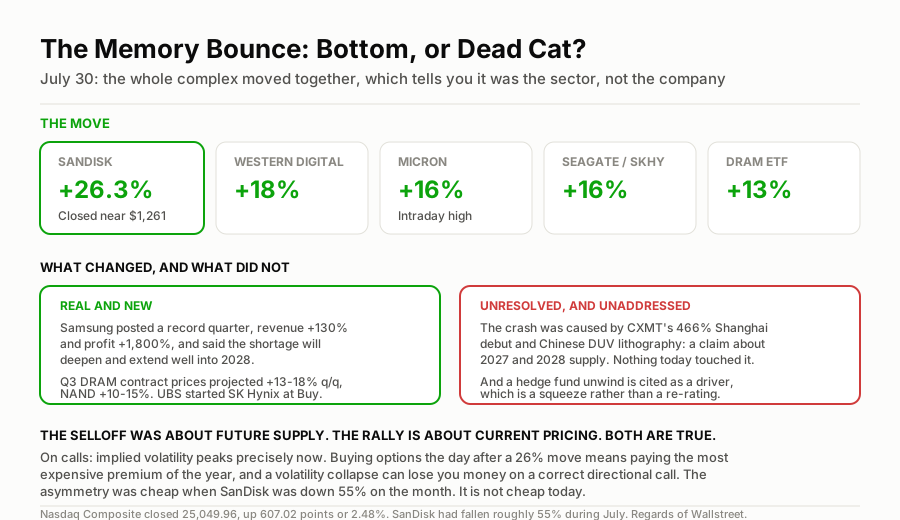
The whole complex moved together; this was about the sector, not the company.
What Moved, and By How Much
| Name | July 30 move |
|---|---|
| SanDisk (SNDK) | +26.29%, closing near $1,261 |
| Western Digital (WDC) | +18% |
| Micron (MU) | ran as high as +16% intraday |
| Seagate (STX) | +16% |
| SK Hynix ADRs (SKHY) | +16% |
| Roundhill DRAM ETF | +13% |
| Nasdaq Composite | +2.48% to 25,049.96 |
Every name in the complex moved double digits in the same direction on the same day. That is a sector repricing, not stock picking, and it matters for how you read it: nobody discovered anything about SanDisk specifically.
The Three Things That Actually Changed
1. Samsung's quarter, and its 2028 comment. Revenue up 130% year over year and profit up more than 1,800%, a record on both operating profit and sales. Then the part that moved the sector: Samsung said it expects the shortage fuelling those sales to deepen and extend well into 2028.
That is the single most important sentence of the day, because it comes from the largest producer. It also corroborates what we flagged in which stocks get hit next by memory costs, where Intel and Silicon Motion had independently pointed at 2028. Three participants now say the same thing.
2. Contract prices are still rising, hard. DRAM contract prices are projected up 13% to 18% quarter over quarter in Q3 2026, with NAND up 10% to 15%, on sustained AI server and data centre demand. Contract prices are the revenue line for these companies. They are going up, not down.
3. UBS initiated SK Hynix at Buy with a $204 target, arguing the market does not reflect a structural improvement in the memory industry driven by AI demand. On Micron, price targets were lifted toward $1,500 to $1,700, Bank of America added MU to its US 1 List of highest-conviction ideas, and Melius carries a $2,200 target. Micron's consensus sits at 29 Buys and one Hold.
And the One Thing That Should Give You Pause
A hedge fund unwind is being cited as a driver of the surge.
That is not a fundamental catalyst. It is somebody being forced to buy back stock they were short, and it produces exactly this shape: a violent, correlated, single-day move across every name in a beaten-up group, with the most heavily shorted names moving most. SanDisk leading at +26% while the ETF managed +13% is consistent with that.
Squeeze-driven moves have a specific failure mode. Once the covering is done, the marginal buyer disappears, and the stock drifts back down on falling volume because nothing about the ownership base has actually changed.
So Is This the Bottom, or a Dead Cat?
Start by separating two questions the market keeps merging.
The selloff was about future supply. The rally is about current pricing. Both can be true at once.
The crash had a specific cause: CXMT's 466% Shanghai IPO debut made a Chinese memory price war concrete, on top of a report of Chinese-made immersion DUV lithography machines entering production. That is a claim about 2027 and 2028 supply. We wrote it up in the CXMT explainer and why everything was crashing on July 28.
Nothing that happened today addressed that. Samsung's record quarter, rising contract prices and a UBS upgrade are all statements about demand and pricing right now. They are real, and they do not refute the bear case, because the bear case was never that current pricing was weak.
So the correct reading is: today was a repricing of the near term, inside an unresolved argument about the medium term. That is neither a clean bottom nor a pure dead cat.
What would make it a genuine bottom:
- Follow-through on Friday and Monday. Dead cat bounces characteristically fail on the second and third day, when the covering finishes. A rally that holds without new catalysts is a different animal.
- The complex holding while a negative CXMT headline lands. That is the real test. If Chinese supply news stops producing 10% down days, the market has finished pricing it.
- Volume declining as price holds. Squeezes need volume. Bases do not.
What would confirm a dead cat:
- A gap up Friday that fades through the session, especially on the most heavily shorted names.
- SanDisk giving back the majority of a 26% move within a week, which after a 55% monthly decline would be unremarkable.
Our read: the risk-reward has genuinely improved and we are not going to pretend otherwise. Three independent sources now point at a shortage running to 2028, contract prices are rising double digits quarter over quarter, and the stocks entered today down enormously. But one session does not resolve a supply argument that plays out over two years, and a hedge fund unwind in the driver's seat means a meaningful part of today's move had no opinion in it at all. Our fuller valuation work is in MU and SNDK after the selloff and the framework in the memory supercycle thesis check.
Should You Buy Calls? Not Today.
This is the question that was asked, so here is a direct answer rather than a hedge.
Buying calls the day after a 26% move is close to the worst entry available, and the reason is mechanical rather than a matter of opinion.
Implied volatility is at its peak precisely now. A stock that just moved 26% in a session, in a group that has been moving 10% to 15% daily, carries enormous option premium. You are buying at the most expensive point in the cycle. If the stock then goes up 5% over the next month, the volatility collapse can still lose you money on a correct directional call. That is the trap, and it catches people every single time a beaten-down sector rips.
And the asymmetry has already been spent. The attractive moment to own convexity was when SanDisk was down 55% on the month and nobody wanted it. That premium was cheap then and it is expensive now. Buying calls today is paying up for a view the market has just adopted.
Better structures if you want the exposure:
- Cash-secured puts. Sell elevated premium and get paid to set an entry below today's close. You profit from the volatility collapse instead of fighting it, and if the bounce fails you buy the stock at a level you chose. This is the structure that suits this setup, and it is the wheel in its natural habitat.
- Shares, staged in thirds. Unglamorous and correct if you believe the 2028 shortage call. No expiry risk, no volatility decay, and you survive being early.
- If you insist on defined-risk upside, go further out in time than feels necessary. A supply argument resolving over 2027 and 2028 cannot be expressed in a monthly option. Short-dated calls on a two-year thesis is a timing bet dressed as an investment.
- Do not sell naked premium into this either. A group that can move 26% in a session can move 26% the other way, and a hedge fund unwind is not a risk you can model.
One practical constraint worth naming: at roughly $1,261, a single SanDisk contract controls about $126,100 of stock. That removes cash-secured puts and covered calls from most retail accounts entirely, and it is the same problem we flagged when the stock was at $1,270. For most people that leaves shares or nothing. If options are new to you, start with calls and puts explained.
What Happened Next
Update, August 3: the bounce lasted one US session. SanDisk closed the following Friday at $1,214.83, Micron fell 5.9% that day, and Seoul gave back a third of its record Friday on Monday morning. We answered the question this piece raised, with the benefit of three more sessions, in was the memory rally a dead cat bounce.
The One-Line Read
SanDisk closed up 26.29% and the whole memory complex rallied double digits because Samsung posted a record quarter and said the shortage runs into 2028, with DRAM contract prices projected up 13% to 18% next quarter: that is a genuine improvement in the near-term picture and it does not resolve the Chinese supply question that caused the crash, so treat it as a tradeable bounce inside an unfinished argument, and do not express it by buying calls into the most expensive implied volatility of the year.
Next up:Fed decision, Tuesday →
More on $SNDK
Updated Every Saturday
The Week Ahead
Every earnings date, Fed event and setup for the current trading week, on one page.
Refreshed Weekly
Earnings Calendar
Who reports next, when, and what consensus and the whisper expect.
The Week-Ahead Brief
Don’t miss next week’s setups. Get the Sunday brief.
Latest issue, Sep 7“Week ahead in the stock market...”
Every Sunday: next week’s earnings dates, Fed days and the trades worth watching, from the same desk that writes the week-ahead hub. Free, built for retail investors.