Why Is RVII Stock Down? Robinhood's New Venture Fund, Explained
RVII, Robinhood's second venture fund, opened about 8% below its $25 IPO price on its NYSE debut. What it holds, what it costs, and what RVI's wild first year predicts.
TL;DR
- RVII priced its IPO at $25 and started trading on the NYSE Thursday. By early afternoon it was changing hands around $23.09, down about 7.6% from that offering price, on roughly 2 million shares of volume.
- It's a closed-end business development company holding about 80 early-stage startups tied to Y Combinator, near-equally weighted around 1.12% each, with Tasklet the single largest position at 4.5%.
- The fee load is steep: a 2% annual management fee plus a 20% incentive fee on realized gains, adding up to a 4.18% total expense ratio. On the $225.5 million raised, that's roughly $9.4 million a year before the fund earns a dollar.
- Its older sibling, RVI, is the precedent worth knowing. RVI fell about 11% on its own first day in March, more than doubled to over $56 by late May, gave nearly all of it back to $24.81 by July 31, and sits around $28.45 today, up about 14% since its own IPO.
- RVII holds none of RVI's already-massive bets (SpaceX, OpenAI, Anthropic). It's a basket of much earlier, much smaller companies, which cuts both ways: less blowup risk from any one name, less of a reason for the stock to ever trade at the kind of premium that made RVI interesting to watch.
More on Single Stocks: Options Scorecard: A Reddit Put and a Nutanix Pass, Both Right at Expiry →
The Board
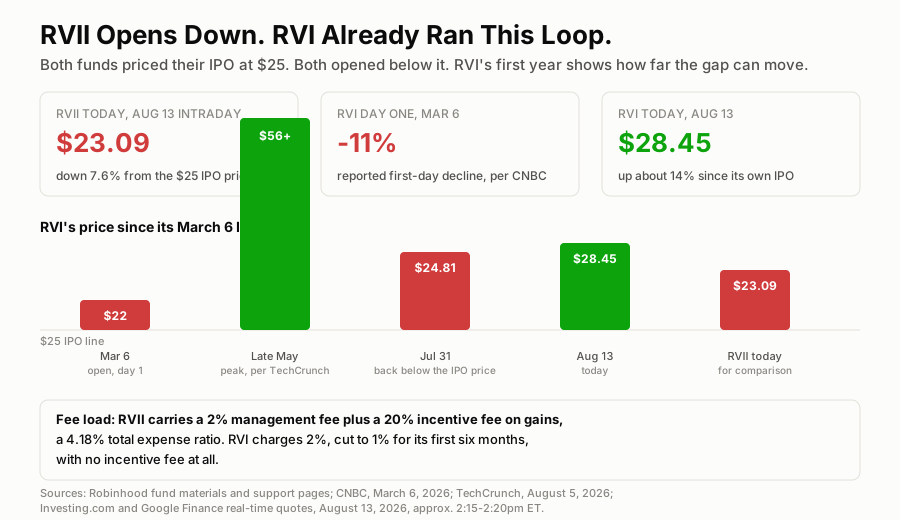
RVII opened where RVI's story hasn't finished being written yet.
What Is RVII, and Why Did It Open Below $25?
RVII is Robinhood's second venture-access fund, and it started trading on the NYSE Thursday afternoon at a price below its own $25 IPO offering. That's not a surprise if you watched the first one. Robinhood Ventures Fund I (RVI) opened below its offering price too, back in March, and CNBC reported it fell about 11% on its debut day. RVII's roughly 7.6% opening-day gap is milder, but it's the same pattern: a closed-end fund priced at $25 by underwriters, then immediately repriced by a market that has to guess at what 80 illiquid private stakes are actually worth.
Neither fund has disclosed RVII's exact net asset value yet. RVI listed at $25 against a $24.70 NAV, a gap of about 1%. If RVII is anywhere close to that ratio, today's roughly $23 price means the stock opened not just below its offering price but potentially below its own NAV on day one, something RVI never did even at its lowest point in July. I'd treat that as the more interesting number to watch once the fund actually publishes it, rather than the $25 print everyone is anchoring to.
This isn't the first time a retail vehicle for private-company exposure has traded far from its underlying value. Fundrise's VCX did the opposite: it traded as high as 30 times its own NAV within weeks of listing, before giving back most of the gap. RVII's problem today runs the other direction, a discount instead of a premium, but the underlying issue is the same one that trips up every closed-end wrapper around illiquid assets: the exchange price and the thing it supposedly represents don't have to agree, and nothing forces them to.
The Fee Structure That Makes This a Different Bet Than RVI
RVII charges a 2% annual management fee plus a 20% incentive fee on realized capital gains, net of losses and unrealized depreciation. Robinhood's own fund materials put the total expected annual expenses at 4.18%. That's a straight "2 and 20" venture-capital fee structure wrapped around a public stock.
RVI charges less. Its management fee is 2%, cut to 1% for the first six months after listing, and it carries no incentive fee at all. TechCrunch, reporting on RVII's launch, called the new fund's fee load "just over 4%" against RVI's roughly half that. On $225.5 million raised in the IPO, RVII's 4.18% works out to about $9.4 million a year in expenses, before a single portfolio company has a liquidity event.
I'm not convinced that fee gap is priced into today's 7.6% discount. A retail buyer comparing the two tickers side by side sees "$25 fund, private-company exposure" on both; the fee disclosure is buried several pages into a prospectus most buyers won't open.
RVI's First Year Is the Cautionary Tale
RVI is the closest thing RVII has to a track record, and it's a genuinely wild one. It priced at $25 on March 6, fell roughly 11% on day one per CNBC, then did something closer to a straddle payoff than a normal stock chart: it topped $56 by late May, more than double its IPO price, driven by concentrated bets in SpaceX, OpenAI, Anthropic, Stripe and Databricks, five names that made up roughly 73% of the fund's net asset value at the time. Retail investors were paying a large premium for access to companies most of them couldn't otherwise buy.
That premium didn't hold. As SpaceX actually completed its own IPO in June, giving investors a direct way to own the stock instead of a wrapper around it, RVI's premium unwound week after week. It closed at $24.81 on July 31, back below its own offering price five months after listing. A more recent rally, tied to news of the fund's OpenAI stake, pushed it back up toward $39 in early August before it settled to around $28.45 today, still up about 14% since IPO but well off both extremes.
That round trip is the whole argument for and against RVII. RVI's swings came from having almost all its eggs in a handful of baskets that were themselves becoming tradeable. RVII was built the opposite way.
What's Actually in the Portfolio
RVII holds roughly 80 companies, every one connected to Y Combinator either directly or through a founder who came up through the accelerator. Regulatory disclosures on the fund show 78 of those 80 positions sitting at a near-equal weight around 1.12% each. The one overweight is Tasklet, a cloud-agent-OS startup, at 4.5%. The one meaningful underweight is a company called Luel at 0.45%. The rest of the fund sits in cash.
That structure removes RVI's single-name blowup risk almost entirely. No one Y Combinator seed company failing or succeeding is going to move RVII's NAV the way OpenAI news moves RVI's. It also removes RVI's reason for trading at more than double its offering price in the first place: there's no headline name in this basket that a retail investor is paying up to access. Most seed-stage startups fail. A diversified basket of 80 of them is a bet on the average outcome of an asset class with a high baseline failure rate, run through a fund that takes 20% of whatever gains eventually show up.
The Options Angle
I couldn't find a listed options chain for RVII, which is normal for a stock that started trading a few hours ago. Day-one options listings on a $225 million closed-end fund aren't guaranteed at all, and even if a chain exists by the close, there's no pricing history to judge whether a quote is fair.
Pass, on any options structure here. There's nothing to size a trade against yet, and RVI's own history argues for waiting regardless: the stock's biggest moves came from single-name portfolio news months after listing, well past the debut-day mechanics this piece covers. If RVII starts trading at a large premium to its NAV once that figure is published, the way RVI did in April and May, that premium is the more interesting setup to come back to.
Trade log
| # | Stance | Structure | Strikes and expiry | Cost or credit | Spot at writing | Implied move | Breakeven |
|---|---|---|---|---|---|---|---|
| 1 | Pass | Any options structure | n/a, no chain listed yet | n/a | $23.09, Aug 13 intraday (~2:15pm ET) | not sourced | n/a, logged as a pass to be scored |
The One-Line Read
RVII opened near a discount to its own IPO price in one afternoon, on a diversified basket of unproven startups. RVI took five months and a round trip through SpaceX and OpenAI to land in roughly the same place.
Next up:PCE inflation, Wednesday at 8:30am ET →
More on Single Stocks
Updated Every Saturday
The Week Ahead
Every earnings date, Fed event and setup for the current trading week, on one page.
Refreshed Weekly
Earnings Calendar
Who reports next, when, and what consensus and the whisper expect.
The Week-Ahead Brief
Don’t miss next week’s setups. Get the Sunday brief.
Today's issue“Micron, PCE and the jobs report that decides October”
Every Sunday: next week’s earnings dates, Fed days and the trades worth watching, from the same desk that writes the week-ahead hub. Free, built for retail investors.