Why Is the Stock Market Down Today? August 18: $91 Oil, a 2007-High Bond Yield and a Chip Pullback
Nasdaq down 1.4% late morning as Brent held above $91 after the US-Iran ceasefire expired, the 30-year yield sat at 2007 highs near 5.3%, and chips gave back Monday's memory rally.
TL;DR
- Late-morning snapshot, about 11:00am ET: Nasdaq -1.37% at 26,278.58, S&P 500 -0.63% at 7,696.16, Russell 2000 -0.77%, Dow -0.11%. These are intraday figures, not closes.
- Brent crude traded at $91.06, its third straight session higher, after the 60-day US-Iran ceasefire expired Monday and President Trump said he was not interested in extending it.
- The 30-year Treasury yield held near 5.30% after topping 5.31% Monday, its highest since July 2007. The 10-year sat at 4.70%.
- Chips led the decline: Intel -6%, Micron and Applied Materials around -5%, Nvidia, TSMC and Broadcom down 2%+, a reversal of Monday's memory-stock pop.
- Home Depot rose about 1.6% after beating on both lines, which is most of the reason the Dow is barely down.
More on $SPY: Stock Market Week Ahead (Sep 28-Oct 2): Micron Earnings, PCE Inflation, and the Jobs Report That Decides an October Fed Hike →
Why Is the Stock Market Down Today?
Oil, the long bond, and a chip reversal, in that order. Brent crude is above $91 for a third session because the US-Iran ceasefire expired without a deal, the 30-year Treasury yield is sitting at levels last seen in July 2007, and semiconductors are giving back Monday's memory-driven gains.
By late morning the Nasdaq was down 1.37% at 26,278.58, the S&P 500 off 0.63% at 7,696.16, the Russell 2000 down 0.77% at 3,033.96, and the Dow down 0.11% at 53,399.43. All of that is a snapshot near 11:00am ET; the sector heatmap has the live picture. For context, the S&P set its record close of 7,798.99 only last Thursday, so the index is about 1.3% off an all-time high. This is a bad morning, a long way from a rout.
The Board
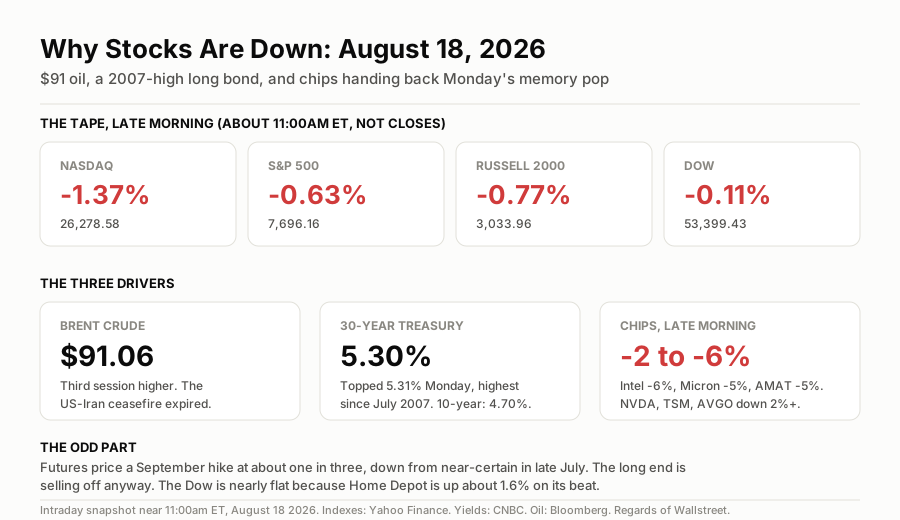
Three drivers, one tape, all of it read near 11:00am ET with the session still running.
Brent at $91: The Ceasefire Ran Out
The 60-day memorandum between Washington and Tehran expired Monday, and Trump told reporters he is in no hurry to replace it. Brent settled just below $91 Monday and traded up to $91.06 overnight, the third consecutive session of gains. WTI sat near $84. Yahoo Finance's live coverage adds a detail I had not registered: the US Strategic Petroleum Reserve is at its lowest level since 1982, so the usual release-the-reserve pressure valve has less in it than at any point in four decades.
Crude at $91 does two things to equities at once. It squeezes margins for anyone who buys fuel, and it feeds directly into the inflation prints that decide what the Fed does next. The second effect is the one the bond market spent Monday and this morning trading.
A 5.3% Long Bond, While Hike Odds Fall
The 30-year yield topped 5.31% on Monday, its highest since July 2007, and held near 5.30% this morning, with the 10-year at 4.70%.
Here is the part worth slowing down for. Futures pricing puts the odds of a September hike at roughly one in three, down from near-certain in late July. If the long end were selling off because traders expected Warsh to raise rates, those two numbers would be moving together. They are moving apart. My read is that this is a supply-and-inflation premium: the Treasury keeps issuing at a deficit-funding pace, oil is climbing, and the 50% Section 338 tariffs on about $20bn of Canadian imports take effect at 12:01am Wednesday. Buyers of 30-year paper are charging more to hold it regardless of what the next meeting brings.
A 5.3% risk-free rate 25 years out is direct competition for equity multiples, and the longer a stock's promised payoff sits in the future, the harder that competition bites. That is the whole explanation for today's pecking order: Nasdaq worst, Dow barely scratched.
The Fed calendar from here is short. The July FOMC minutes land Wednesday at 2:00pm ET, from the meeting that held at 3.50-3.75% with three dissents in favour of a hike. Then Jackson Hole runs August 27-29, with Warsh's first keynote as chair on the Friday morning.
Chips Hand Back Monday's Memory Pop
Monday's tech strength came from memory: SanDisk closed +8.88% and Western Digital +5.35% after Elon Musk replied to a Peter Diamandis post about the AI memory bottleneck. Today the same complex is the drag. By late morning Intel was down about 6%, Micron and Applied Materials around 5%, and Nvidia, TSMC and Broadcom each more than 2%.
Seoul ran this exact loop overnight before New York opened. The Kospi opened up as much as 3.4% on Monday's Wall Street memory rally and closed down about 1.7% as oil rose, with SK Hynix and Samsung round-tripping the same way.
Fabrinet did not help the mood. The AI-optics assembler reported fiscal Q4 revenue of $1.316 billion against a consensus near $1.27 billion, with EPS of $4.10 versus $3.81 expected, and the stock fell 8.6% premarket anyway on softer margins, negative free cash flow and a sequential-decline guide. That is now three straight quarters of beat-and-drop for Fabrinet, after 10.22% in February and 8.01% in May. I read a beat sold that hard as a positioning problem for the whole complex rather than a Fabrinet problem, and this morning's chip tape fits that.
What Held Up, and What Comes Next
Home Depot beat on both lines this morning: sales of $47.9 billion, up 5.7%, EPS of $4.79 against $4.58 a year ago, comps up 1.7% with the US at +1.3%, and a reaffirmed full-year guide. Consensus wanted $4.71 on about $47.5 billion, so the quarter cleared the bar and the comp number nearly tripled Q1's +0.6%. The stock was up about 1.6% late morning, and in a price-weighted index a $338 stock rising 1.6% covers a lot of red on its own.
The rest of the mover column is thin. Klarna fell about 18% after trimming guidance, per Yahoo Finance's live blog. Meta is lower for a fifth straight session, with the social-media addiction trial opening in court today.
Retail earnings week has barely started: Target, Lowe's and TJX report Wednesday morning, then the FOMC minutes at 2:00pm, then Walmart Thursday. One big-ticket retailer clearing a low bar is a data point. Six retailers and the Fed's internal argument, all inside 72 hours, is the actual test.
The One-Line Read
The tape set records last week on the assumption that oil stays contained and yields stay put. Both assumptions got more expensive inside 48 hours, and the Nasdaq is where that bill always lands first.
Next up:ISM Services PMI, Monday at 10:00am ET →
More on $SPY
$SPY · 2026-09-27
Stock Market Week Ahead (Sep 28-Oct 2): Micron Earnings, PCE Inflation, and the Jobs Report That Decides an October Fed Hike
$SPY · 2026-09-19
Stock Market Week Ahead (Sep 21-25): Costco, AutoZone, KB Home and a 5% Ten-Year
$SPY · 2026-09-18
Options Scorecard: A Reddit Put and a Nutanix Pass, Both Right at Expiry
Updated Every Saturday
The Week Ahead
Every earnings date, Fed event and setup for the current trading week, on one page.
Refreshed Weekly
Earnings Calendar
Who reports next, when, and what consensus and the whisper expect.
The Week-Ahead Brief
Don’t miss next week’s setups. Get the Sunday brief.
Latest issue, Sep 27“Micron, PCE and the jobs report that decides October”
Every Sunday: next week’s earnings dates, Fed days and the trades worth watching, from the same desk that writes the week-ahead hub. Free, built for retail investors.