Retail Sales Fell 0.6% in July. Take Out Online and the Core Rose
July retail sales fell 0.6% to $763.6 billion against a +0.1% to +0.3% consensus, and the control group fell 0.5%. Strip out nonstore retailers and the rest of the control group rose 0.4%.
Show 1 earlier update
TL;DR
- July advance retail sales lands at 8:30am ET on Friday, August 14, from the Census Bureau. Consensus is +0.2% on the Investing.com table and +0.3% on Trading Economics, after a prior month at +0.2%. Ex-autos is seen at +0.2%, reversing a 0.2% decline. The control group, the cut that feeds GDP, is seen near +0.3%.
- The preliminary August Michigan sentiment reading comes at 10:00am ET, alongside June business inventories. July's final was 55.2 and the forecasts I found sit in the mid-54s.
- The market goes in at a record. Thursday closed the S&P 500 at 7,798.99, up 0.7%, the Nasdaq at 26,803.03, up 0.8%, the Dow at 53,839.99, up 0.1%, and the Russell 2000 at 3,052.85, up 0.2%.
- This is the first spending read since July payrolls fell 23,000. It is also the third macro print of a week that has gone the doves' way twice already.
- My read: with three FOMC dissents in favour of a hike still on the record, the outcome that hurts a market at an all-time high is a strong consumer, not a weak one.
More on $SPY: Stock Market Week Ahead (Sep 28-Oct 2): Micron Earnings, PCE Inflation, and the Jobs Report That Decides an October Fed Hike →
What Time Is the Retail Sales Report on Friday?
8:30am ET on Friday, August 14, from the Census Bureau, covering July. It is the Advance Monthly Sales for Retail and Food Services release, and the July import price index publishes on the same minute.
That makes Friday the closing leg of a three-day run: July CPI on Wednesday, July PPI on Thursday, and the consumer on Friday. The whole week sits in the week-ahead hub, and next week's slate is in the earnings calendar.
The Board
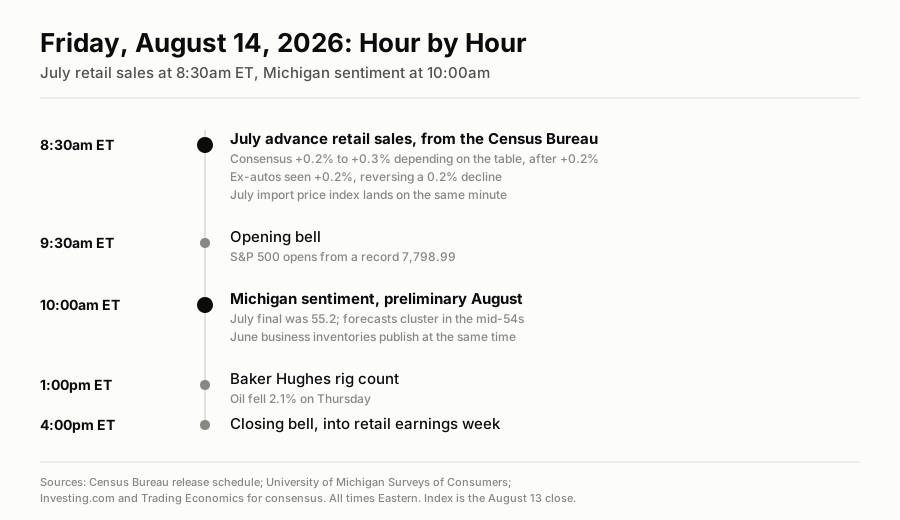
Two prints that matter, four hours apart, into a market with nothing priced for bad news.
Friday, Hour by Hour
- 8:30am ET: July advance retail sales. Headline consensus depends on which table you open, which is the next section. Ex-autos is the cleaner line this month.
- 8:30am ET: July import prices. A second-order read on whether tariffs are still passing through at the border.
- 9:30am ET: the open. The cash market trades an hour-old reaction.
- 10:00am ET: preliminary August Michigan sentiment, plus June business inventories. Inflation expectations inside the survey have been sitting near 4.2% on the one-year measure, and that series has mattered more to this Fed than the headline index has.
- 1:00pm ET: Baker Hughes rig count. Worth a glance after oil fell 2.1% on Thursday.
- 4:00pm ET: the close, and the handoff to retail earnings week, when Home Depot, Target, Lowe's and Walmart say whether Friday's number was real.
The Consensus Is Two Different Numbers
Investing.com's calendar has July headline retail sales at +0.2%. Trading Economics has +0.3%. Both were pulled Thursday evening and neither is obviously the stale one, so I am quoting the range instead of picking.
It matters less than the gap suggests. A tenth either way on a headline that includes gasoline stations and auto dealers is noise, and gasoline was falling through July. The line I would read first is ex-autos, seen at +0.2% after a -0.2% month. That flip from negative to positive is the actual claim being made about the consumer, and it is the one a tenth of drift cannot rescue.
The Line That Feeds GDP
Neither the headline nor ex-autos is what the Fed's staff pulls out of this release first. That is the control group: retail sales excluding motor vehicles, gasoline stations, building materials and food services. It maps to the consumer spending component of GDP, which is why a surprise there moves rate expectations and a surprise in the headline often does not.
The consensus I could source for it is +0.3%, against roughly +0.5% in June. Treat that as approximate, because desks publish different cuts of the same release and the names get used interchangeably. Continuum Economics forecasts +0.4% for ex-autos-and-gasoline, a broader measure that still contains building materials and restaurants. Those are two different series, and +0.4% on one is not a beat on the other.
The headline range is also wider than two calendar entries make it look. Against Investing.com's +0.2% and Trading Economics' +0.3%, MNI's preview reports consensus at +0.1% and Continuum models the headline unchanged. A flat print on Friday therefore sits inside the forecast range rather than below it. Those two houses also carry June's headline as unchanged rather than the +0.2% on the calendars, so whether Friday reads as an acceleration depends on which June you start from. I could not reconcile that before the release and am not going to pick one.
The Print That Revives September
Here is the part that makes Friday awkward for a market at a record.
This Fed is not debating a cut. Its target sits at 3.50-3.75%, July's hold drew three dissents in favour of a hike, and Chair Kevin Warsh has taken forward guidance out of the statements, so every data point lands without a verbal cushion. Wednesday's CPI came in at 3.4% headline and 2.5% core, dead on the nowcast. Thursday's PPI printed unchanged on the month with the annual rate down to 4.7% from 5.5%. Two soft inflation reads in two days, and the S&P closed at an all-time high on the second one.
So the doves have banked the inflation half of the argument. What is left unresolved is demand. A consumer still spending after payrolls went negative is a consumer who can absorb a hike, and it is the single reading most likely to put September back in play. I think a +0.5% headline would do more damage on Friday than a -0.1% would, which is an odd sentence to write and I am fairly confident about it anyway.
The weak-print case is not comfortable either. It confirms the labour market damage in the July payrolls report and hands the growth bears their datapoint. Watch how the sector map reacts rather than the index level: a soft number that rallies bonds and defensives is a different message from one that just sells everything.
What Else Is Live at the Open
Two after-hours stories from Thursday carry into Friday's session. Applied Materials beat its fiscal Q3 and guided Q4 about $700 million above consensus, and the stock fell anyway. And Capricor traded up about 86% premarket after saying on its Q2 call that it will narrow the deramiocel label and that the August 22 FDA date will be pushed out. Heartflow is up about 23% on a guidance raise worth more than its beat.
The One-Line Read
Friday is the week's third macro print and the first one where good news for the economy is bad news for the tape. Ex-autos is the line; the headline is gasoline arithmetic.
Next up:PCE inflation, Wednesday at 8:30am ET →
More on $SPY
$SPY · 2026-09-27
Stock Market Week Ahead (Sep 28-Oct 2): Micron Earnings, PCE Inflation, and the Jobs Report That Decides an October Fed Hike
$SPY · 2026-09-19
Stock Market Week Ahead (Sep 21-25): Costco, AutoZone, KB Home and a 5% Ten-Year
$SPY · 2026-09-18
Options Scorecard: A Reddit Put and a Nutanix Pass, Both Right at Expiry
Updated Every Saturday
The Week Ahead
Every earnings date, Fed event and setup for the current trading week, on one page.
Refreshed Weekly
Earnings Calendar
Who reports next, when, and what consensus and the whisper expect.
The Week-Ahead Brief
Don’t miss next week’s setups. Get the Sunday brief.
Today's issue“Micron, PCE and the jobs report that decides October”
Every Sunday: next week’s earnings dates, Fed days and the trades worth watching, from the same desk that writes the week-ahead hub. Free, built for retail investors.