20-Year Bond Auction Aug 19: The 5.245% Record Line, an Hour Before the Fed Minutes
Treasury sells $16 billion of new 20-year bonds Wednesday at 1:00pm ET, an hour before the FOMC minutes. Above 5.245% and it is the highest 20-year auction yield since the tenor came back in 2020.
TL;DR
- Treasury sells $16 billion of a new 20-year bond on Wednesday, August 19. Competitive bids close at 1:00pm ET, results within minutes, and the July FOMC minutes land at 2:00pm. One hour apart.
- The marker to watch is 5.245%. That is the highest yield any 20-year auction has cleared since Treasury brought the tenor back in May 2020. The 20-year sat at 5.20% on August 13, so Wednesday is close enough to matter.
- Thursday's 30-year sale cleared at 5.216%, up 17bp from May's 5.046%. Nothing in Treasury's published auction records, which run back to 2012, cleared higher.
- The sale was reported as both $25bn and $31.3bn, and both were right. $25.0bn went to the public; the Fed rolled another $6.3bn into its own portfolio. The bid-to-cover ratio of 2.39 is struck against the smaller number.
- Demand was mediocre, not broken. Dealers were left with 11.5% against a recent average near 10.6%, and bid-to-cover slipped from 2.44 in July.
- The long end sold off in a week when it should have rallied. Retail sales fell 0.6% and sentiment dropped to 51.0, and the 30-year still finished Friday near 5.26%.
More on $TLT: What Is a Bear Steepener? Why Stocks Fell 2% When the Fed Did Nothing →
When Is the 20-Year Bond Auction?
Wednesday, August 19. Noncompetitive bids close at 12:00pm ET and competitive bids at 1:00pm ET, with results posted within a few minutes of the hour. It is a single-price auction of $16 billion of a new 20-year bond, CUSIP 912810UX4, announced on August 13, settling August 31 and maturing August 15, 2046.
The following afternoon brings $8 billion of a 29-year-6-month TIPS, which is the inflation-linked half of the same question.
The Board
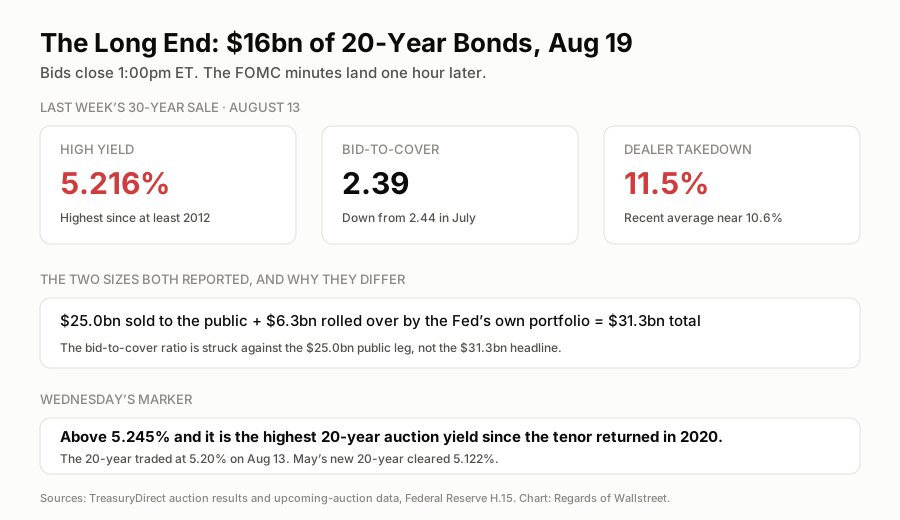
Wednesday's auction closes at 1:00pm ET. The minutes follow at 2:00pm.
The Same Auction, Reported Two Ways
Thursday's 30-year sale went out into the press as $25 billion in some places and $31.3 billion in others. Both figures are in Treasury's own results sheet, and they measure different things.
$25,000,015,300 was sold to actual bidders. On top of that, the Fed's System Open Market Account rolled $6,323,518,500 of maturing holdings straight into the new bond, which is an accounting move inside the central bank rather than money raised from investors. Add them and you get the $31.3 billion headline.
Which number you use changes the demand read, so it is worth being careful. The bid-to-cover ratio of 2.39 comes from dividing $59.8 billion of bids by the $25.0 billion public leg. Run the same bids against $31.3 billion and you would get 1.91, which would look like a failed auction and would be wrong. My rule with any auction figure is to check what sits in the denominator before quoting the ratio.
Several outlets called 5.216% the highest 30-year auction yield since 2001. I can only verify a narrower claim, and I would rather publish that one: Treasury's published auction dataset goes back to May 2012, and none of the 58 thirty-year sales in it cleared above 5.216%. The 2001 version is plausible, because Treasury stopped issuing the 30-year in late 2001 and sold none at all until February 2006, so there is a four-year hole where no auction could have set a higher mark.
The Number That Would Set a Record
5.245%, set on October 18, 2023. That is the high-water mark for 20-year auction yields since the tenor was reintroduced in May 2020, and Wednesday has a live shot at it.
The recent record is close underneath. May's new 20-year, also $16 billion, cleared 5.122% with a bid-to-cover of 2.55. July's smaller $13 billion reopening cleared 5.163% at 2.64. And the 20-year constant maturity yield printed 5.20% on August 13, per the Fed's H.15 release. A few basis points of concession into the auction, which is normal, puts the clearing yield in record territory.
I want to be clear that a record clearing yield would be a symptom rather than an event. Auctions get sold. The thing worth reading is the composition: whether indirect bidders, the category that captures foreign central banks and funds, keep taking roughly two-thirds, and whether dealers get stuffed again.
A Weak Consumer Should Have Rallied Bonds
Last week the data said the American consumer is struggling. July retail sales fell 0.6% against a +0.1% consensus, and preliminary August sentiment came in at 51.0, down from 55.2. Producer prices were soft. July CPI landed dead on the nowcast.
That combination usually pulls yields down, because weaker demand means less inflation and a Fed that eventually cuts. The short end behaved: the 10-year fell to 4.63% on August 13 from 4.72% on the 10th. The long end went the other way, with the 30-year finishing Friday near 5.26%, its highest in about 19 years.
When the curve moves like that, the bond market is repricing something other than growth. Supply and the compensation demanded for holding duration are the usual suspects, and the mechanics of why it hurts equities are in our bear steepener explainer. The 30-year against the 10-year widened to 58bp by August 13 from 54bp a week earlier.
One O'Clock, Then Two O'Clock
A soft auction at 1:00pm followed by hawkish-sounding minutes at 2:00pm is the sequence that would put a dent in an equity tape sitting near records, and it lands in the middle of retail earnings week, with Target, Lowe's and TJX all reporting that morning.
I do not expect it. Minutes from a meeting held three weeks before the data turned rarely move much, and a 20-year auction clearing at a record yield is the kind of thing that gets absorbed by Thursday. The scenario I would actually watch for is narrower: dealers stuck with a large share at 1:00pm, and then a minutes document showing more hawks than the three who dissented. That pairing would tell you the long end is being asked to fund a government whose central bank is still arguing about hiking, and Warsh speaks at Jackson Hole nine days later.
The One-Line Read
Wednesday's $16 billion 20-year is a record test at 5.245%, an hour before the minutes. Watch the dealer takedown rather than the yield: the level is scenery, the composition is the demand.
Next up:PCE inflation, today at 8:30am ET →
More on $TLT
Updated Every Saturday
The Week Ahead
Every earnings date, Fed event and setup for the current trading week, on one page.
Refreshed Weekly
Earnings Calendar
Who reports next, when, and what consensus and the whisper expect.
The Week-Ahead Brief
Don’t miss next week’s setups. Get the Sunday brief.
Latest issue, Sep 27“Micron, PCE and the jobs report that decides October”
Every Sunday: next week’s earnings dates, Fed days and the trades worth watching, from the same desk that writes the week-ahead hub. Free, built for retail investors.