Stock Market Today, July 27, 2026: Dow Climbs 262 Points on Cheap Oil While Nvidia's 5% Drop Sinks the Nasdaq
Stock market close July 27 2026: Dow +0.51% to 52,210.08, S&P 500 +0.02% at 7,413.18, Nasdaq -0.18%. Nvidia fell 5% on a $250 billion OpenAI backstop report.
TL;DR
- Dow +0.51% to 52,210.08 (up 262.83 points). S&P 500 +0.02% to 7,413.18, a gain of 1.20 points. Nasdaq Composite −0.18% to 24,932.08. Two different markets in one session.
- Futures were up 1.4% on the Nasdaq before the bell. All of it was gone by the close. The thing that killed it: Nvidia fell about 5%, its worst day since February.
- The reason is a report that Nvidia is in talks to backstop up to $250 billion so OpenAI can lease a $500 billion, 10-gigawatt SoftBank-led data centre campus in Ohio, with a parallel discussion of up to $350 billion to finance the chips. Michael Burry's response: "Around and around we go."
- Apple retook the crown as the world's most valuable company at roughly $4.94 trillion, passing Nvidia's $4.83 trillion. The market is paying up for the megacap that spends least on AI.
- Memory got destroyed on China's CXMT listing: SanDisk −12%, Micron −5%, SK Hynix ADRs −8%. Cheap oil (Brent −6.3% to $85.87) paid for the Dow.
Why Did the Nasdaq Fall Today When the Dow Went Up?
The short answer: the Dow owns cheap oil and the Nasdaq owns Nvidia, and today those two things went in opposite directions hard enough to split the market in half.
The macro was unambiguously good. The US and Iran paused military strikes over the weekend, and Brent crude settled at $85.87, down 6.3%, having traded as high as $102 a barrel last week. WTI fell about 7% to $83.15. That is a genuine disinflationary impulse landing two days before a Fed decision, and the rate-sensitive, oil-consuming, value-heavy parts of the index took it: real estate ETFs gained 2.2%, materials added 1.9%, and consumer defensive and communication names led.
Then the tech sector did the opposite. Technology fell 1.4% as a sector, and the reason was one stock and one story. We flagged the fade as it was happening this morning, before the Nvidia headline landed.
The Board
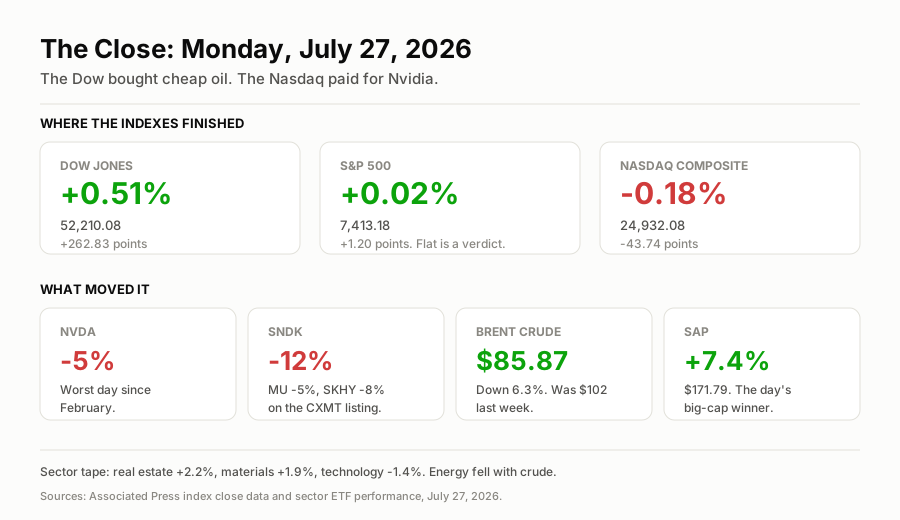
One index bought the oil news. The other one read the Nvidia headline.
Why Is Nvidia Down? The $250 Billion Circle
Nvidia fell roughly 5%, its largest single-day drop since February 2026, and dragged the whole semiconductor complex with it. AMD fell 5%. Teradyne fell 4%.
The trigger was a report that Nvidia is in early talks to provide up to $250 billion in financing guarantees so that OpenAI can lease compute from a planned $500 billion, 10-gigawatt data centre campus in southern Ohio. The project sits on the former Portsmouth uranium enrichment site in Pike County, is being developed by SoftBank subsidiary SB Energy, and targets an 800-megawatt first phase in 2028. Ten gigawatts is roughly the output of ten large nuclear reactors.
The backstop reportedly covers the lease and construction financing. Separately, Nvidia is said to be in talks to help fund OpenAI's chip purchases, a figure that could reach $350 billion. That second number is the one that made people uncomfortable, because the chips in question are Nvidia's own.
Here is the loop, stated plainly. Nvidia guarantees the financing that lets a customer build a data centre, the data centre exists to run Nvidia chips, and Nvidia may also finance the purchase of those chips. Revenue arrives, and so does the credit risk that created it. Michael Burry summarised it as "Around and around we go."
This is not an accounting scandal and nobody has alleged one. Talks are preliminary and could change. But it is the third or fourth version of the same structure this year, and the market's tolerance for it is visibly thinning. It arrived on top of a $500 billion-plus AI cooperation agreement between Nvidia and South Korea's SK Group announced Friday evening, which the tape also read as more circle rather than more demand.
The bull case is boring and probably right in the short run: guaranteeing a lease is not the same as buying the asset, Nvidia's balance sheet can absorb it, and the compute demand is real. The bear case is that circular financing works beautifully until demand disappoints once, and then every leg of the structure fails at the same time.
Apple Took the Crown Back by Not Spending
The cleanest signal of the day is who won while Nvidia lost. Apple rose more than 1% and retook the title of the world's most valuable public company at roughly $4.94 trillion, ahead of Nvidia's $4.83 trillion. Apple is now up more than 22% year to date, the best performer in the Magnificent Seven.
Read that next to the Nvidia story and the rotation writes itself. The market spent 2025 and the first half of 2026 rewarding whoever spent the most on AI. It is now rewarding the one that spent the least. Restraint has become a valuation input. That is exactly the lens Microsoft, Meta, Apple and Amazon get judged through when they report this week.
Apple reports Thursday.
Memory Had Its Own Disaster
Separate from Nvidia, the memory complex had one of its worst days of a bad month. SanDisk fell 12%, Micron fell 5%, and SK Hynix ADRs fell 8%.
The cause was in Shanghai, not New York. CXMT, China's largest DRAM maker, closed its first trading session up 466% at 49 yuan against an 8.66 yuan IPO price, raising 57.92 billion yuan (about $8.6 billion) in the largest mainland Chinese semiconductor offering ever. At roughly $488 billion it is now the most valuable company listed on a mainland exchange, ahead of ICBC.
The global DRAM board now reads: Samsung 36%, SK Hynix 29%, Micron 24%, CXMT 8%. The fourth player just raised $8.6 billion in an industry whose entire bull case is that supply cannot keep up. We covered what CXMT actually is and what it did to Micron the first time.
The counterargument stands: CXMT competes in commodity DDR4, DDR5 and LPDDR, is roughly four years behind SK Hynix in high-bandwidth memory, and does not touch the AI margin pool yet. The market chose not to care today.
Elsewhere, SAP rose 7.4% to $171.79, the day's standout large-cap gainer, extending last week's post-earnings move.
What Actually Happens Next
Monday was the warm-up. The schedule from here:
- Wednesday, July 29: the Fed decision, and the first hard meeting of the Warsh era. Today's oil crash lowers the hike risk. It does not eliminate it. Our breakdown of why this is his first real test.
- Wednesday night: Microsoft and Meta.
- Thursday: Apple.
- Friday: Amazon.
- And before any of that, Tuesday morning brings Boeing, PayPal, UPS and Coca-Cola, all before the bell.
The Options Angle
- The index did nothing and the components did everything. That is a dispersion tape: single-name volatility high, index volatility suppressed. Index options are the wrong instrument for a market like this, because the thing you want exposure to is precisely what the index nets out.
- Selling index premium into a Fed decision is picking up nickels. The S&P moved 1.20 points today. It will not move 1.20 points Wednesday afternoon.
- Nvidia's implied volatility is now carrying headline risk, not earnings risk. The backstop talks are described as preliminary and ongoing, which means the next move comes from a leak, not a calendar date. Owning premium against a story with no scheduled resolution is a slow bleed.
- If you are long memory and want to stay long, the covered call has never been better paid. Twelve percent daily moves in SanDisk mean genuinely rich premium. It also means the strike you pick gets taken out in a single session. A covered call here is income, not protection, and the distinction matters more in this group than almost anywhere else.
The One-Line Read
The market got a genuine gift today in the form of $86 oil, handed the whole thing back because Nvidia may be lending its customers the money to buy its own chips, and crowned Apple the world's most valuable company for the sin of underspending on AI. A flat S&P is not a quiet day. It is two violent opinions cancelling out.
More on Markets Today
$SKHY · 2026-07-27
KOSPI and SK Hynix After the Crash: Buy the Dip, Buy Puts, Sell Cash-Secured Puts, or Wait?
$SPY · 2026-07-27
SPY Is Only 3% Off Its Record. So Why Does It Feel Like a Bear Market?
$SPY · 2026-07-27
Stock Market Today, July 27: Stocks Opened Green and Gave It Back. The Sell-Off Was Underneath.
The Sunday Setup
Enjoyed this breakdown? Don’t miss the next market setup.
Get deep-dive analyses delivered to your inbox every Sunday. Free, and built for retail investors.
Comments
0 totalNo comments yet. Be the first to drop a take.