Money Is Fleeing AI for Walmart. The Bond Market Says That's Not a Plan.
The 2026 rotation out of AI stocks into Walmart, Target and Home Depot, explained: the hyperscaler liquidity suck, tech bonds trading at a discount, 13% credit card delinquencies, and what the Engels' Pause says about AI and your wages.
TL;DR
- The market is rotating out of AI hardware and into Walmart, Target, and Home Depot, and the equal-weight S&P (RSP) just printed all-time highs while big tech can't reclaim its own.
- The rotation isn't strength. It's escapism: hyperscaler capex is draining liquidity so hard that even hyperscaler bonds now trade at a discount on secondary markets, treasury premium and all.
- The consumer catching this rotation is cracking: 13% of credit card balances are 90+ days delinquent, a 15-year high, and chargebacks are up 29% since 2021, far outpacing transaction growth.
- Where we'd actually hunt: Netflix's ad business (on track to double annually), cybersecurity for agentic AI (CrowdStrike and the "shadow AI" problem), and Google at a ~1.3 PEG.
- The long lens: the Engels' Pause. The last time a technology boom this big hit the labor market, wages went nowhere for 40 years while corporations kept the surplus.
More on Markets Today: SB Energy Files for an IPO, Revealing a $439 Billion AI Backlog →
The Board
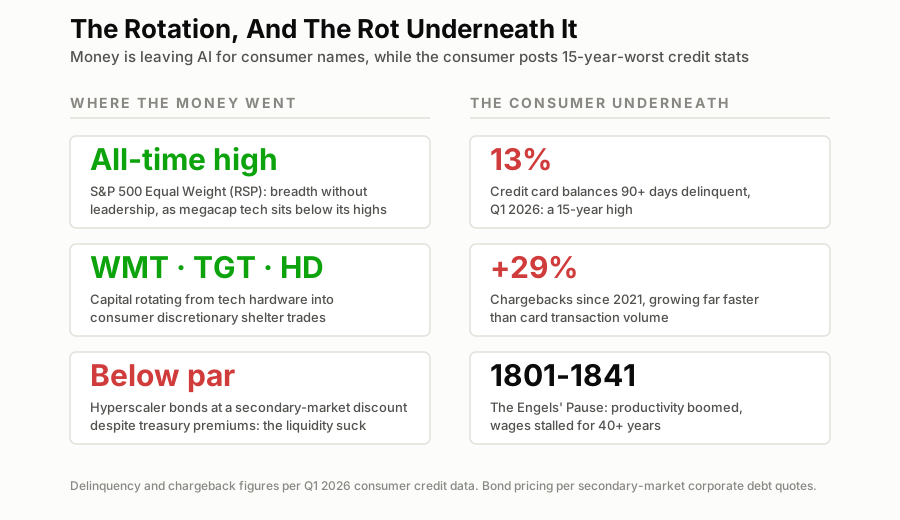
The rotation on the left, the rot underneath it on the right. Both are true at once, which is the whole problem.
The Great Escape
The tape says investors are done paying up for AI hardware and are hiding in the consumer aisle instead. Money has been walking out of technology and into Walmart, Target, and Home Depot, the kind of names your grandfather would approve of. Some of it even makes sense on paper: Target spent years as a genuine medium-term value case, dividend-aristocrat pedigree included, and Walmart has spent a decade proving it simply refuses to die.
The index math flatters the move. The S&P 500 Equal Weight (RSP) is sitting at all-time highs, which the brochure version calls "healthy market broadening." The less flattering read: breadth without leadership. The average stock is fine while the stocks that drove the last two years of returns can't get back to their highs. That's not a market finding new growth. That's a market finding new hiding spots, the same defensive reflex we flagged when healthcare caught the first wave of this money.
And here's the trap door under the whole trade: if AI genuinely rolls over, the consumer names catch the falling economy that follows. You cannot hide from an AI downturn inside the stocks that depend on the paychecks AI capex is currently propping up. The rotation works as a hedge only if nothing actually goes wrong, which is a strange thing to pay a premium for.
The Liquidity Suck
The reason this rotation feels defensive instead of opportunistic is sitting in the debt market, where nobody bothers with narratives.
The hyperscalers are spending on a scale that has started to drain the pool everyone else swims in. Google, SpaceX, and the rest of the capex monsters are hoovering up hundreds of billions for data centers and infrastructure, the $100-billion-per-gigawatt problem made flesh. Every dollar committed to a build-out is a dollar not bidding for anything else, and the market is starting to feel the vacuum.
Hyperscaler bonds are trading at a discount on secondary markets. These are bonds from the most creditworthy companies on earth, paying a real premium over Treasuries, and institutional buyers still aren't showing up at par. When the safest corporate paper in the world has to mark itself down to find a bid, that is not a story about credit risk. It's a story about how much cash is left in the room. Financial conditions are tightening from the inside, without the Fed lifting a finger.
The Consumer Cracks Underneath
Now look at who's supposed to carry the rotation. The American consumer, the destination for all this fleeing capital, is visibly running out of rope:
- Credit card delinquencies of 90+ days hit 13% in Q1 2026. That is a 15-year high. You have to go back to the wreckage after 2008 to find households this far behind on their cards.
- Chargebacks are up 29% since 2021, growing significantly faster than card transaction volume itself. People disputing charges at that rate isn't a fraud story. It's a desperation story: clawing back purchases is what households do when the math stops working and mobility dries up.
This is the contradiction in 2026 positioning. The market is buying consumer-facing stocks as a shelter at the exact moment the consumer's own balance sheet is flashing its worst readings in a decade and a half. Rotations built on that foundation don't end with a soft landing in Walmart. They end with the defensive trade needing a defense of its own.
Where We'd Actually Hunt
If the crowded trades are "own AI and pray" and "hide in retail and pray," the interesting names are the ones with their own engine:
Netflix, the sleeper. The stock gets covered as a streaming story, but the ads business has taken over the growth math: an advertising arm scaling from a small base with a credible path to doubling annually for the foreseeable future. Compounding like that hiding inside a company the market already thinks it understands is exactly where long-term money gets made.
Cybersecurity, the picks-and-shovels of agentic AI. Every company deploying AI agents is also deploying thousands of semi-autonomous processes with system access, and most IT departments cannot see half of them. That's "shadow AI," and securing the endpoints it runs on is about to be as non-negotiable as antivirus was in 2005. CrowdStrike sits directly on that chokepoint: endpoint management for a world where the workforce is part human, part agent.
Google, the value case nobody wants. The market is annoyed: Gemini 3.5 Pro is late, the coding-performance crown is contested, and the stock has taken its punches. But at a PEG ratio around 1.3, you're paying a near-market multiple for a company still compounding earnings like a growth stock. Frustration discounts on businesses this entrenched have historically been gifts, as we argued in the earnings preview.
The Engels' Pause: The 40-Year Warning Label
Here's the framework for the biggest question hanging over all of it: what AI does to wages.
From roughly 1801 to 1841, Britain industrialized at a pace the world had never seen. Steam power and mechanized manufacturing sent productivity vertical. And for those four decades, real wages went essentially nowhere. Output exploded, corporate profit captured virtually all of it, and workers waited more than a generation for their share. Economic historians call it the Engels' Pause, and depending on how you count, it ran 40 to 60 years before wages finally caught up.
Swap steam for AI and the parallel writes itself. If AI replaces white-collar labor faster than it creates new roles, corporate earnings can decouple from worker prosperity for decades, not quarters. That's not just a moral problem. It's a fiscal one: payroll-based tax revenue erodes while the surplus pools in corporate accounts, and the pressure for major social policy intervention builds long before any eventual wage recovery arrives. The Industrial Revolution eventually paid its workers. It just took two generations, and nobody trading today should assume the AI version runs faster on its own.
For markets, the Engels' Pause cuts both ways: it's the bull case for owning the corporations capturing the surplus, and the bear case for every consumer-facing stock that needs wage growth to hit its numbers. Which brings us back to the rotation, and why hiding in retail during an AI labor shock is a hedge pointed in the wrong direction.
The Playbook
Nothing about this environment changes the boring rules. It just raises the penalty for breaking them:
- Buy the dip only on companies you'd hold through a recession. If you wouldn't own it unemployed at 6%, you don't own it. You're renting it.
- Quality over story, decade over quarter. The thesis has to survive ten years of headlines, not validate this month's rotation.
- Ignore the noise you were always going to ignore. Iran escalations, margin-requirement shuffles in international markets, one soft print. Volatility with no bearing on a ten-year thesis is entertainment, not information.
- Respect the liquidity signal. When hyperscaler bonds can't find a bid at par, tighten your own standards too. Late-cycle rotations reward the patient and punish the clever.
The One-Line Read
The market is fleeing AI valuations into consumer stocks just as the consumer posts its worst credit stats in 15 years, the bond market is reporting that the liquidity is gone, and history's clearest precedent says the AI wage squeeze could run for decades. Own quality you'd hold through the storm, because the hiding spots are the crowded part of this trade.
Next up:PPI, tomorrow at 8:30am ET →
More on Markets Today
Updated Every Saturday
The Week Ahead
Every earnings date, Fed event and setup for the current trading week, on one page.
Refreshed Weekly
Earnings Calendar
Who reports next, when, and what consensus and the whisper expect.
The Week-Ahead Brief
Don’t miss next week’s setups. Get the Sunday brief.
Latest issue, Sep 7“Week ahead in the stock market...”
Every Sunday: next week’s earnings dates, Fed days and the trades worth watching, from the same desk that writes the week-ahead hub. Free, built for retail investors.