Arm FQ1 2027 Earnings Breakdown: A Record Quarter, an 8-Cent Beat, and the FTC Problem Nobody Can Model
Arm posted record revenue of $1.29B up 22%, EPS of $0.45 versus $0.37 expected, and guided FQ2 to another record. Shares still fell. The FTC antitrust probe is why.
TL;DR
- Record total revenue of $1.29 billion, up 22% year over year, above the $1.26 billion estimate. Royalty revenue rose 22% to $715 million, a first-quarter record, and licensing set a first-quarter record too.
- Non-GAAP EPS of $0.45 beat the $0.37 estimate by 8 cents and rose from $0.35 a year ago. Free cash flow rose 343%.
- The best number in the release is the one that is not on the income statement: data centre royalty revenue more than doubled year over year, again, and Arm-based compute now holds roughly 50% share with the top hyperscalers.
- Guidance was also a record. FQ2 revenue of $1.38 billion plus or minus $50 million, with adjusted EPS of $0.47 plus or minus $0.04.
- And the stock fell about 1% after hours, having already dropped 8% intraday, with options having priced a ±15% move. A beat, a raise, a record, and no reward. The reason is the FTC.
More on $ARM: Arm Earnings Preview (July 29): The Purest AI Royalty Play, at the Least Forgiving Valuation →
What Arm Actually Reported
| Line | FQ1 FY2027 | Comparison |
|---|---|---|
| Total revenue | $1.29B | +22% y/y, record, vs $1.26B est |
| Royalty revenue | $715M | +22%, Q1 record |
| Licensing revenue | record for a Q1 | alongside the royalty record |
| Non-GAAP EPS | $0.45 | vs $0.37 est, up from $0.35 |
| Free cash flow | +343% | year over year |
| Data centre royalties | more than doubled | y/y, again |
| FQ2 revenue guide | $1.38B ±$50M | record at midpoint |
| FQ2 adjusted EPS guide | $0.47 ±$0.04 | up from $0.45 at the midpoint |
Arm has now beaten earnings estimates in all of the previous 10 reporting periods. This was not a close call.
The Board
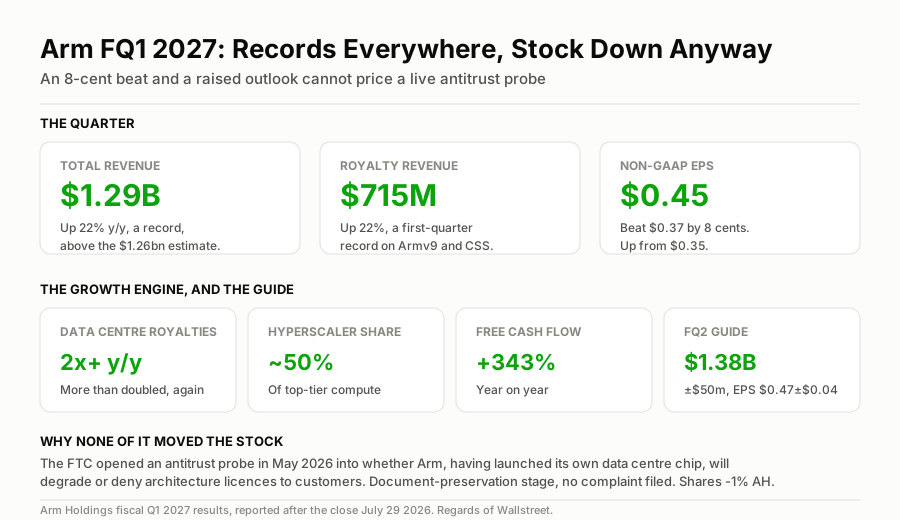
Records on every line, guidance above, and the stock went down anyway.
Why Is Arm Stock Down After a Beat?
Because the FTC opened an antitrust investigation into the thing Arm sells, and no quarterly beat can resolve it.
The Federal Trade Commission opened a formal antitrust probe into Arm in May 2026, first reported by Bloomberg on May 15, with the FTC having already ordered Arm to preserve documents before the investigation became public. The question the regulator is asking is narrow and existential: having launched its own competing data centre chip, does Arm intend to degrade or deny the CPU architecture licences that Apple, Qualcomm, Nvidia and hundreds of other customers depend on?
Sit with what that means for a valuation model.
Arm's entire business is licensing an architecture to companies it does not compete with. The moment it competes with them, every licensee has to ask whether its supplier is now its rival, and the regulator has to ask whether the licensing terms are being used as a weapon. Royalty revenue of $715 million growing 22% is a fact about the past. The FTC probe is a question about whether the licensing model survives in its current form.
The investigation is still in the document preservation stage and no formal complaint has been filed. That is genuinely early, and most probes at this stage get dropped before anything is filed. But "most" is not a number you can put in a discounted cash flow, and Arm trades at a multiple that requires years of flawless execution.
That is why a record quarter bought nothing. The market is not disputing Arm's earnings power. It is discounting the probability that the licensing model gets rewritten by someone other than Arm.
The Number the Bulls Should Point At
Data centre royalty revenue more than doubled year over year, again, and Arm-based compute is at roughly 50% share with the top hyperscalers.
That is the most underappreciated fact in this release, and it is worth more than the EPS beat.
Arm's historical problem was that it earned pennies per chip in a phone. Data centre silicon is the opposite: high value, high royalty rate per unit, and a customer set that designs its own chips and therefore needs an architecture licence rather than a finished part. Every hyperscaler building custom CPUs is an Arm royalty stream that compounds with cloud capacity.
And cloud capacity is compounding. Microsoft reported Azure growing 43% hours earlier, passed $100 billion of annual revenue, and disclosed $678 billion of contracted backlog, up 84%. Its stock rose about 8% on it. That is the demand curve underneath Arm's best segment, and we broke it down in the Microsoft Q4 breakdown.
The Armv9 architecture and Compute Subsystems are the mechanism: both carry higher royalty rates per chip than what they replace, which is why royalty revenue can grow 22% without unit volumes growing 22%. Price per unit is doing the work. That is the highest-quality kind of revenue growth there is.
Scoring Our Own Preview
Our preview yesterday called for royalty rates, v9 adoption and data-centre share to be the lines that mattered. All three delivered, and all three were the right things to watch: royalties up 22% on higher-rate v9 and CSS, data centre royalties doubling, roughly 50% hyperscaler share.
The preview also said Arm "trades at a premium that assumes years of flawless execution" and warned the after-hours tape would be thin with the real repricing happening Thursday. Both held. Arm delivered flawless execution and the premium did not care.
Where we were incomplete: the preview treated valuation as the main risk to a good print. The actual ceiling on this stock is regulatory, and the FTC probe deserved to be in that preview's risk section rather than arriving as context after the fact. Owning that.
The Bull Case and the Bear Case
Bull case. Ten consecutive earnings beats. Record revenue, record royalties, record licensing, guidance to another record, free cash flow up 343%, and the single best structural position in AI compute: an architecture that gets paid a rising rate on every custom CPU every hyperscaler builds. The stock has already shed roughly 28% in a month from a $266.33 close on July 27, which means a great deal of the multiple compression the bears wanted has already happened.
Bear case. The FTC is investigating whether Arm's licensing model is anticompetitive, and Arm made that inquiry possible by choosing to compete with its own customers. That is a self-inflicted risk with no timeline and no bounded outcome. Meanwhile the valuation still assumes perfection, semiconductors are in a bear market more than 20% off their highs, and the 30-year Treasury above 5.19% after today's Fed decision is a direct attack on exactly this kind of long-duration growth multiple. Three separate pressures, none of which a good quarter addresses.
Our read: a buy for investors with a genuine three-year horizon and the stomach for headline risk, and a bad idea for anyone who needs it to work by Christmas. The business is performing better than the share price suggests and the data centre royalty line is worth a premium. But you are underwriting a regulatory outcome you cannot handicap, so size it as though a bad FTC outcome is possible rather than unthinkable. If the probe closes without a complaint, this is a substantially higher stock. If it produces one, the earnings do not matter for a while.
The Options Angle
- Options priced a ±15% move into this print and got about 1% after hours on top of an 8% intraday fall. Anyone who bought that straddle paid for a hurricane and got weather.
- Implied volatility now collapses, which makes buying premium the worst trade available and makes selling it tempting. Resist the temptation: the FTC headline risk is unscheduled, and selling volatility against an unscheduled binary is how accounts get destroyed.
- If you want exposure, own shares rather than options. There is no expiry date that lines up with a regulatory process.
- For holders, a covered call harvests still-elevated premium, but keep the strike well out: the upside gap on a cleared FTC probe is the scenario you are being paid to wait for and the one you least want capped.
The One-Line Read
Arm delivered a record quarter, an 8-cent beat, guidance to another record and free cash flow up 343%, and the stock fell because the FTC is investigating whether the licensing model it just monetised so well is legal in its current form: buy the business if you can hold through a regulatory process with no timetable, and understand that until the probe resolves, the earnings are not what prices this stock.
Next up:Fed decision, Tuesday →
More on $ARM
Updated Every Saturday
The Week Ahead
Every earnings date, Fed event and setup for the current trading week, on one page.
Refreshed Weekly
Earnings Calendar
Who reports next, when, and what consensus and the whisper expect.
The Week-Ahead Brief
Don’t miss next week’s setups. Get the Sunday brief.
Latest issue, Sep 7“Week ahead in the stock market...”
Every Sunday: next week’s earnings dates, Fed days and the trades worth watching, from the same desk that writes the week-ahead hub. Free, built for retail investors.