August Jobs Report: Payrolls Jumped 162,000, and the 'Negative July' Got Revised Away
August payrolls rose 162,000, more than double every consensus estimate, and revisions turned July's minus 23,000 into plus 21,000. Two sectors drove most of the gain.
Show 3 earlier updates
TL;DR
- August payrolls rose 162,000, released Friday, September 4 at 8:30am ET, per the BLS, more than double the highest of three competing consensus estimates (53,000-58,000).
- The revisions matter as much as the headline. July's initial minus 23,000 became plus 21,000; June's +20,000 became +31,000. Combined, that is 55,000 jobs added back that the market spent three weeks treating as a warning sign.
- Two categories, food services and local government education, drove 101,000 of the 162,000 gain, nearly two-thirds. Manufacturing and information both shrank. Call it a strong print with a narrow base, not yet a broad rebound.
- Unemployment held at 4.1%; wage growth cooled further to 3.1% year over year, down from July's 3.2%.
- Hike odds moved but did not settle: a jump toward 60% on the beat, then a partial retreat to roughly 52-60% as the morning went on. Full odds tracking on the Fed hub, where August PPI (Sept 10) and CPI (Sept 11) are the two prints left before the September 16 vote.
More on $SPY: Stock Market Week Ahead (Sep 28-Oct 2): Micron Earnings, PCE Inflation, and the Jobs Report That Decides an October Fed Hike →
When Was the August Jobs Report?
Friday, September 4 at 8:30am ET, from the Bureau of Labor Statistics. The release covered August payrolls, the unemployment rate, participation, and average hourly earnings, plus revisions to July and June. It was the last payrolls print before the September Fed meeting, so it is what the committee votes with.
The Bar: What July Left Behind
July was the worst payrolls print of the cycle. Nonfarm payrolls fell 23,000 against a Dow Jones consensus of +83,000, the report that flipped the September conversation from hike to hold. The unemployment rate slipped to 4.1%, and the decline is not the good kind: it fell because the labour force shrank, not because hiring recovered. Average hourly earnings cooled to 3.2% year over year, the slowest since May 2021.
The revisions did as much damage as the headline. June's +57,000 became +20,000, and May's +129,000 became +63,000, a combined 103,000 jobs that were reported and then taken back. So the August release carries two questions, and the revision line answers the second one: is July's minus sign real, and was the spring ever as solid as it looked?
One negative month can be noise. Government payrolls alone accounted for 53,000 of July's decline. Two negative months, with revisions still pointing down, is a trend, and the Fed would be debating a hike into a shrinking labour market.
What It Decides for the Fed
The decision comes eleven days later, on September 16. Pricing had drifted to near one in three by mid-August, down from almost 58% after the July meeting, on the labour half of the mandate dragging it down; then Warsh's August 28 Jackson Hole speech pushed it back to about 57% in one morning, climbed further to 60-66% over the following weekend, then eased to roughly 50-55% after Governor Waller's September 3 dovish remarks. This print landed into that already-whipsawing number: a jump toward 60% within the hour, a partial retreat after. My read going in was simple: a rebound into six figures makes a hike more likely, not less, because the inflation half of the mandate never went away. The print delivered that rebound. The odds moved less than the reasoning would predict. That tells me the market is waiting on August CPI on September 11 to actually decide it, not on payrolls alone.
Warsh gave his first Jackson Hole keynote on August 28, and this was the first hard data point it got tested against.
The Board
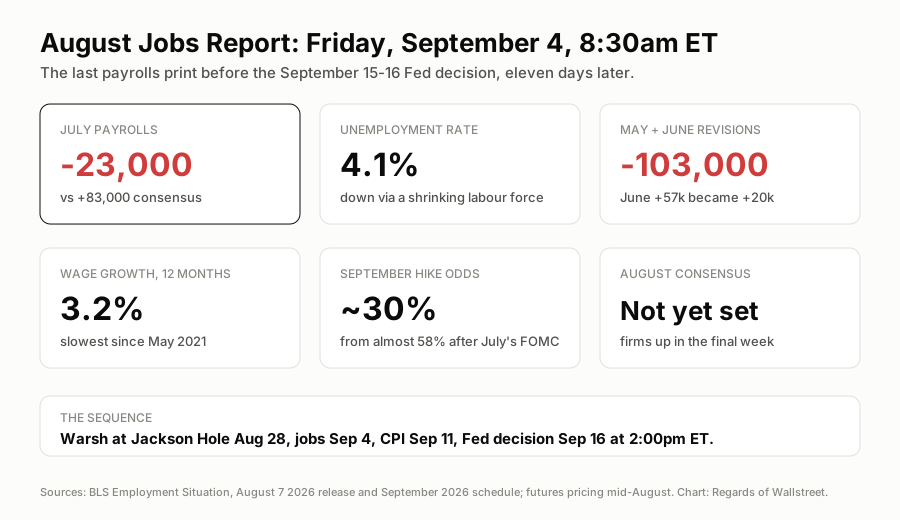
The print that turned a negative July into a positive one, and still left the Fed's vote unsettled.
The One-Line Read
August payrolls rose 162,000, turning July's minus 23,000 into plus 21,000, but two-thirds of the gain sat in two sectors, and hike odds moved only from roughly 50-55% to 52-60%. A blowout headline just barely moved the Fed's vote.
Next up:Jobs report, today at 8:30am ET →
More on $SPY
$SPY · 2026-09-27
Stock Market Week Ahead (Sep 28-Oct 2): Micron Earnings, PCE Inflation, and the Jobs Report That Decides an October Fed Hike
$SPY · 2026-09-19
Stock Market Week Ahead (Sep 21-25): Costco, AutoZone, KB Home and a 5% Ten-Year
$SPY · 2026-09-18
Options Scorecard: A Reddit Put and a Nutanix Pass, Both Right at Expiry
Updated Every Saturday
The Week Ahead
Every earnings date, Fed event and setup for the current trading week, on one page.
Refreshed Weekly
Earnings Calendar
Who reports next, when, and what consensus and the whisper expect.
The Week-Ahead Brief
Don’t miss next week’s setups. Get the Sunday brief.
Latest issue, Sep 27“Micron, PCE and the jobs report that decides October”
Every Sunday: next week’s earnings dates, Fed days and the trades worth watching, from the same desk that writes the week-ahead hub. Free, built for retail investors.