Canada's 50% Tariff Lands August 19: 5% of Imports, on a Law Never Used
Trump's 50% tariffs on Canada take effect 12:01am ET August 19 under Section 338, a 1930 law no president has used. They cover about $20bn of imports, roughly 5% of the $383bn America buys.
TL;DR
- The duties start at 12:01am ET on Wednesday, August 19, on goods entered for consumption or withdrawn from warehouse on or after that moment. The proclamations were signed July 20 with a 30-day fuse.
- USTR puts the three lists at "nearly $20 billion" of annual imports. America bought $383.0 billion of goods from Canada in 2025, so the 50% rate reaches about 5% of the flow.
- The authority is Section 338 of the Tariff Act of 1930, the Smoot-Hawley statute. No president has ever used it to impose duties. The administration reached for it after the Supreme Court struck down the IEEPA tariffs 6-3 in February.
- USMCA origin buys no exemption, which is the part that separates this from earlier rounds. Energy, potash, fish, critical minerals and anything already carrying Section 232 duties are carved out.
- Steel, aluminum, autos and softwood lumber are all outside this action and all inside the negotiation. That is why a deal is still live four days out.
More on $SPY: Stock Market Week Ahead (Sep 28-Oct 2): Micron Earnings, PCE Inflation, and the Jobs Report That Decides an October Fed Hike →
What Time Do the Canada Tariffs Take Effect?
12:01am ET on Wednesday, August 19, 2026, for goods entered for consumption or withdrawn from warehouse for consumption on or after that time. That is the operative language in the proclamations, and it means the trigger is the customs entry, not the border crossing or the purchase order. Freight already on a truck can still land on the wrong side of it.
Talks are running to the wire. Canadian Trade Minister Dominic LeBlanc has been back in Washington repeatedly this month to see US Trade Representative Jamieson Greer, who said after the latest round that Trump and Prime Minister Mark Carney "obviously they'll be given options." A Canadian source told Reuters on Thursday that Washington wants a deal too. Nothing is signed.
The Board
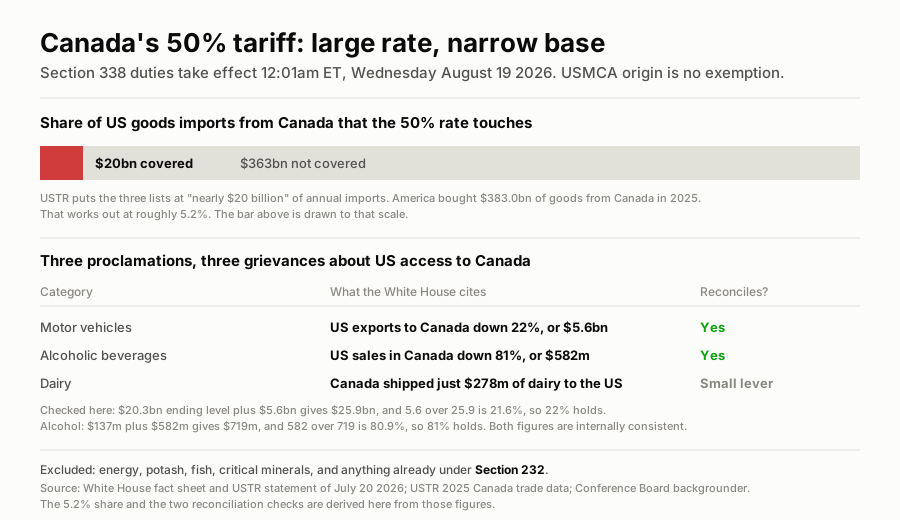
A 50% rate on about a twentieth of the trade, effective 12:01am ET Wednesday.
Twenty Billion, Out of Three Hundred Eighty-Three
The headline rate is doing a lot of work in the coverage I have read, and the base is doing almost none. USTR's own statement puts the three lists at nearly $20 billion of annual Canadian imports. USTR also publishes the denominator: the US imported $383.0 billion of goods from Canada in 2025, itself down 7.0% on 2024. Twenty into 383 is 5.2%.
The Conference Board's backgrounder puts the "total economic impact" nearer $22 billion, a different measure from import value rather than a rival figure. Either way the share lands around 5 or 6%.
That is small in aggregate and concentrated where it lands. A brewery importing Canadian beer, a distributor of Canadian whisky, an importer of plywood or hockey gear or Christmas ornaments eats a 50% duty on Wednesday. For the index it stays a rounding error, which is why the tape has barely moved on any of this.
The Statute FDR Passed On
Section 338 lets the president impose duties up to 50% on a country that discriminates against US commerce. It has sat on the books since 1930 and no administration has ever pulled the trigger. Roosevelt's people looked at it and passed. White & Case and Polsinelli both describe July's proclamations as the first use in the statute's history.
The reason it came off the shelf now is February. The Supreme Court held 6-3 on February 20 that IEEPA does not authorise the president to impose tariffs, which removed the legal basis for most of the 2025 program overnight. Section 338, Section 301 and Section 232 are what is left, and each carries procedural baggage that IEEPA did not.
Section 338's baggage is the International Trade Commission. The statute directs the ITC to ascertain whether discrimination is occurring and bring the matter to the president with recommendations. Whether that is a prerequisite or a standing duty has never been litigated, because the provision has never been used. A second open question is whether Section 301 superseded it in 1974.
My read: this is the fact pattern that draws major-questions scrutiny, and the Conference Board expects litigation, singling out the dairy proclamation's loose drafting as the softest target. An importer paying a 50% duty on Thursday has the standing and the motive to file. The precedent that case sets would govern every tariff this administration writes for the rest of the term, which earns more attention than the four days left on the clock.
Softwood Lumber Is Not in This. It Is in the Deal.
Read the exclusions before the inclusions. Energy, potash, fish and critical minerals are out, per the White House fact sheet. So is anything already under Section 232, which sweeps out steel, aluminum, automobiles and softwood lumber.
Those four are precisely what the talks have snagged on. Reporting from CBC and the Globe and Mail has US negotiators refusing any deal that drops Section 232 duties on them entirely, while Canadian concessions on auto tariffs, provincial liquor rules and dairy quotas are conditional on getting meaningful 232 relief. Canada's chief negotiator Janice Charette has warned her counterparts that letting Wednesday pass would be a cliff that could halt the talks outright.
So the Section 338 action is leverage aimed at a bigger prize, and the $20 billion is the fee for missing the deadline. Holland & Knight titled its client alert "50 Percent Opening Bid", which I think is the right way to read it.
One asymmetry is worth naming. Canada shipped roughly $278 million of dairy to the US in 2025. A 50% tariff on a $278 million flow is not a serious economic weapon, and the grievance the proclamation cites runs the other way, about American access to the Canadian market. Parts of these lists are pure message.
The Arithmetic Holds
I ran the government's own figures against each other, since a headline percentage that will not reconcile with its own dollar change is the most common tell of a bad number. Vehicles: the fact sheet cites a 22% fall, or $5.6 billion, and the Conference Board puts the ending level near $20.3 billion. Add them back and $5.6bn on $25.9bn is 21.6%. Alcohol: an 81% fall, or $582 million, against an ending $137 million, and $582m on $719m is 80.9%.
Both round to what is claimed. The grievances are stated accurately, whatever anyone makes of the remedy.
Wednesday Morning, the Retailers Answer for It
The timing is genuinely awkward for the companies. The deadline passes at 12:01am ET Wednesday. Target, Lowe's and TJX report that same morning, Home Depot the day before, and Walmart on Thursday at 7:00am ET. The July FOMC minutes land Wednesday at 2:00pm.
Every one of those calls now carries a tariff question that did not have a clean answer when the scripts were written. Walmart raised prices citing duties in the spring and cut them again in July, so its gross margin commentary is the closest thing available to a live read on who absorbs this. The rest of the week's setup is in the week ahead.
The One-Line Read
A 50% rate on 5% of the trade, resting on a statute nobody has ever used. The tariff is survivable. The precedent, once a court gets hold of it, decides what the next three years of tariffs look like.
Next up:PCE inflation, today at 8:30am ET →
More on $SPY
$SPY · 2026-09-27
Stock Market Week Ahead (Sep 28-Oct 2): Micron Earnings, PCE Inflation, and the Jobs Report That Decides an October Fed Hike
$SPY · 2026-09-19
Stock Market Week Ahead (Sep 21-25): Costco, AutoZone, KB Home and a 5% Ten-Year
$SPY · 2026-09-18
Options Scorecard: A Reddit Put and a Nutanix Pass, Both Right at Expiry
Updated Every Saturday
The Week Ahead
Every earnings date, Fed event and setup for the current trading week, on one page.
Refreshed Weekly
Earnings Calendar
Who reports next, when, and what consensus and the whisper expect.
The Week-Ahead Brief
Don’t miss next week’s setups. Get the Sunday brief.
Latest issue, Sep 27“Micron, PCE and the jobs report that decides October”
Every Sunday: next week’s earnings dates, Fed days and the trades worth watching, from the same desk that writes the week-ahead hub. Free, built for retail investors.