Why Is Strategy Selling Bitcoin? It Sold 6x More Stock, And Now MSCI Wants MSTR Out
Strategy sold 1,690 bitcoin below cost in the week to August 9, then raised $653.1m selling MSTR shares, six times more. MSCI's deletion consultation closes September 30, with results by October 16.
TL;DR
- Strategy sold 1,690 bitcoin in the week to August 9 at an average of $64,262, against an aggregate cost basis of $75,385 a coin. That is $11,123 per coin below cost, and it was the third consecutive week of selling.
- In the same week the company raised $653.1 million selling its own stock: 6,585,682 MSTR shares at roughly $99.17. The equity sale was six times the bitcoin sale. Almost every writeup led on the smaller number.
- The reason is a bill, and the company publishes it. Preferred dividends and debt interest run about $1.76 billion a year. The USD Reserve built to fund it reached $4.65 billion on August 9, up from $2.55 billion six weeks earlier: roughly 31.7 months of coverage against a policy floor of 12.
- MSCI reopened the index question on Friday. Its consultation on "non-operating companies" would make Strategy ineligible for the Global Investable Market Indexes. Feedback closes September 30, results land on or before October 16, and any change takes effect at the November 2026 index review.
- MSTR closed Friday at $93.04, down 4.18%, below the ~$99.17 the company itself sold stock at a week earlier.
More on Commodities & Crypto: Why Is Oil Up? Energy's Best Week, and My $80 Call Broke →
The Board
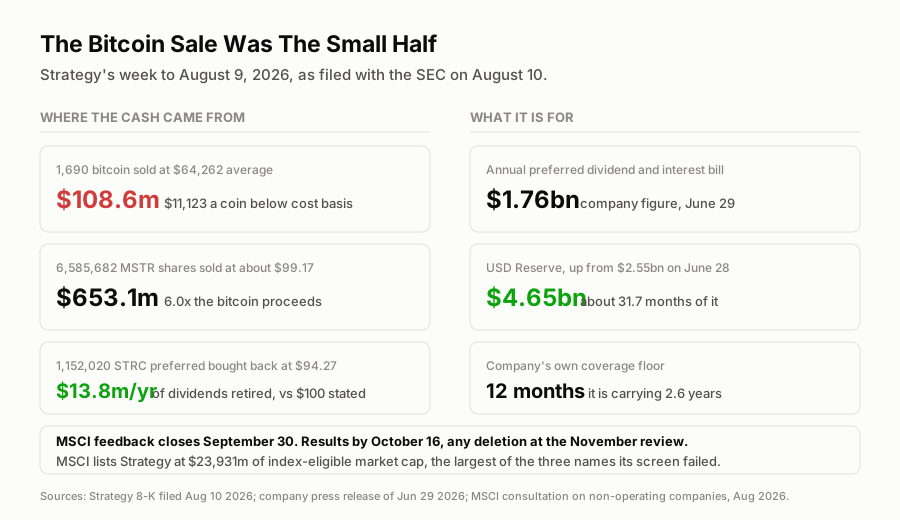
Two funding sources in one week. The one everybody covered was the smaller one.
Why Is Strategy Selling Bitcoin?
To pay a dividend bill that does not stop, and to buy back the security that creates it. Strategy's 8-K filed on August 10 discloses 1,690 bitcoin sold between August 3 and August 9 for $108.6 million, and every dollar of it going into the repurchase of 1,152,020 shares of its Variable Rate Series A Perpetual Stretch Preferred, ticker STRC. The week before, the same filing pattern showed 1,638 coins for $104.73 million, split between preferred dividends and more STRC buybacks.
None of this was improvised. On June 29 the company announced a Digital Credit Capital Framework with four moving parts: a USD Reserve policy, a $1.0 billion authorization to repurchase its preferred securities, a $1.0 billion common stock authorization, and a $1.25 billion BTC Monetization Program. The board pre-approved the selling. Management's line was that "bitcoin is capital", and the filings since have been that sentence being executed.
So the sales are not a change of mind. Michael Saylor's own framing, that he has never sold a personal coin and that Strategy is a public company rather than his wallet, is a distinction that matters less than it sounds: the company is the entity with 840,447 bitcoin, about 4.0% of the 21 million supply cap, and the company is selling.
The Bill
$1.76 billion a year, in cash, for as long as the preferred stays outstanding. That is the company's own figure from the June 29 release, and the two coverage numbers in that release check against it exactly: $2.55 billion of reserve was described as 17.4 months of it, and $2.55 billion plus the $1.25 billion monetization capacity as 25.9 months. Both divide out.
STRC is the expensive piece. It carries a $100 stated amount and a rate the board resets monthly, currently 12.00% per annum since July 1, the highest in the instrument's short history. The 10-Q for the June quarter shows $629.2 million of preferred dividends already paid in the first half of 2026, against cash and equivalents of $1.71 billion.
Here is the part I find genuinely clever, and it is the part the headlines skipped. Strategy bought those 1,152,020 STRC shares for $108.6 million, which is $94.27 a share against a $100 stated amount. Retiring them removes $13.8 million a year of dividend obligation for a one-time $108.6 million outlay. That is a 12.7% cash-on-cash return on the buyback, permanent, and it is why selling a coin at a loss can still be the right trade: a 12% perpetual liability is a harder thing to outrun than an $11,000 realised loss is to absorb.
Whether it is actually right reduces to one question. Does bitcoin compound faster than 12.7%? If yes, Strategy is burning the better asset to kill the cheaper liability. If no, this is the most sensible thing the company has done in two years. I lean toward the second, and I am not confident about it.
The Half Nobody Counted
The bitcoin sale raised $108.6 million. The at-the-market equity program raised $653.1 million in the same seven days, of which $650.0 million went straight into the USD Reserve. Shareholders funded roughly six dollars of the reserve for every dollar the bitcoin stack funded.
That reframes the story. The reserve did not climb from $2.55 billion to $4.65 billion because Strategy liquidated bitcoin; it climbed because Strategy sold a great deal of stock, at an average near $99.17, into a market that has since marked it down to $93.04. Anyone who bought that paper is about 6% underwater three sessions later.
It also explains why the company is comfortable selling coins below cost. At $4.65 billion the reserve covers about 31.7 months of the $1.76 billion bill, against a stated policy minimum of 12. This is not a company scraping together a payment. It is a company pre-funding two and a half years of dividends while it still can, and the "while it still can" is the whole point of the next section.
What MSCI Actually Proposed
On August 14 MSCI opened a consultation on the eligibility of non-operating companies for its Global Investable Market Indexes. The mechanism is a two-step screen: an operating-assets test, then an exclusion screen built on five financial ratios, with an issuer ineligible if it is flagged on four of the five. Run against May 2026 data, three names failed outright. Strategy is the large one, carried in the document at $23,931 million of index-eligible market cap, alongside Yellow Cake at $1,807 million and Metaplanet at $654 million.
The dates are the tradeable part. Feedback closes September 30, 2026. MSCI expects to publish results on or before October 16. Any resulting change would be implemented at the November 2026 index review. JPMorgan's analysts have put immediate direct outflows at roughly $2.8 billion if Strategy is deleted, which against MSCI's own $23.9 billion eligible-cap figure implies passive holders own about 12% of the float. Wider estimates circulating this week run from $8 billion to $15 billion on the assumption that other index providers follow, and those I would not lean on: they are conditional on decisions nobody has announced, and the range disagrees with itself.
Strategy pushed back the same day, posting that "digital assets are assets" and that "index providers should measure markets, not decide which assets companies are allowed to own."
One piece of history belongs here, because it cuts against the panic. MSCI ran a narrower consultation aimed specifically at digital asset treasury companies over the winter, and in January it declined to proceed, keeping Strategy in the benchmarks and saying the broader question of non-operating companies needed more research. This consultation is that research arriving. Having backed off once is not a promise to back off twice, but it does mean the base rate on these proposals is not 100%.
Where I Think This Breaks
The bitcoin selling is the least interesting risk here, and I think the market has it backwards. Selling 1,690 coins a week out of 840,447 is a rounding error against the stack, it is board-authorized, and roughly $800 million of the $1.25 billion monetization capacity is still unused. At that run rate the program funds itself into next year without touching the thesis.
The equity machine is the fragile part. Strategy's ability to raise $653 million in a week at a small premium is what actually pays the preferred, and that machine runs on index membership, passive bid and share price. Delete MSTR from the Global Investable Market Indexes in November and you do not merely trigger a one-off $2.8 billion of selling. You permanently shrink the buyer base for the ATM that services a $1.76 billion annual obligation. Then the bitcoin genuinely does have to fund the dividend, and 31.7 months of reserve starts counting down instead of up.
Two things would change my read. A weekly filing showing the ATM raising materially less than the bitcoin sales would mean the equity bid is already going, well ahead of any MSCI vote. An October 16 result that leaves Strategy in the indexes removes the only dated catalyst on this page, and the stock probably reprices on it. Everything between now and then is noise dressed as news, including most of what happens to bitcoin's own price while it grinds through the low $60,000s.
For what it is worth, this is the same structural pressure that showed up in Coinbase's second quarter: crypto-levered businesses built for the 2024 tape all have to answer what they cost to run in this one. Strategy at least publishes the arithmetic. Next Monday's 8-K, and the week's broader calendar, will show whether the mix has moved.
The One-Line Read
The bitcoin sales are a managed, pre-authorized trickle. The thing that could actually break Strategy is a November index review, and the market spent Friday pricing the wrong one.
Next up:PCE inflation, today at 8:30am ET →
More on Commodities & Crypto
Updated Every Saturday
The Week Ahead
Every earnings date, Fed event and setup for the current trading week, on one page.
Refreshed Weekly
Earnings Calendar
Who reports next, when, and what consensus and the whisper expect.
The Week-Ahead Brief
Don’t miss next week’s setups. Get the Sunday brief.
Latest issue, Sep 27“Micron, PCE and the jobs report that decides October”
Every Sunday: next week’s earnings dates, Fed days and the trades worth watching, from the same desk that writes the week-ahead hub. Free, built for retail investors.