Meta Q2 2026 Earnings Breakdown: Revenue Grew 28%, Costs Grew 55%, and Free Cash Flow Fell to $784 Million
Meta beat on revenue at $60.8B but missed EPS at $6.18 versus $7.13 expected, as operating costs rose 55% and free cash flow collapsed to $784 million. Shares fell 5% after hours.
TL;DR
- Revenue of $60.80 billion beat the $59.50 billion estimate and grew 28% year over year. The ad machine is not the problem.
- Adjusted EPS of $6.18 missed the $7.13 estimate. That is a 13% miss on the bottom line in a quarter where the top line beat by more than a billion dollars.
- The bridge between those two facts: operating costs rose 55% on AI and legal expenses, which pushed operating income down 8%.
- The number that should worry you most is not EPS. Operating cash flow was $31.86 billion. Free cash flow was $784 million. Meta converted nearly $32 billion of operating cash into under a billion of free cash.
- Full-year capex guidance is $125 to $145 billion, with the low end raised. Shares fell about 5.06% after hours to roughly $556, with the stock already sitting some 25% below its high.
More on $META: Why Is Meta (META) Stock Up Today? The Iran Trade Did It, Not Meta →
What Meta Actually Reported
| Line | Reported | Expected / Prior |
|---|---|---|
| Revenue | $60.80B, +28% | $59.50B expected |
| Adjusted EPS | $6.18 | $7.13 expected |
| Ad impressions | +14% | year over year |
| Price per ad | +12% | year over year |
| Operating cash flow | $31.86B | the ad machine working |
| Free cash flow | $784M | about 2.5% conversion |
| Operating costs | +55% | AI and legal |
| Operating income | -8% | negative operating leverage |
| FY2026 capex | $125-145B | low end raised |
Look at the two operational lines: impressions up 14% and price per ad up 12%. Both growing together is the healthiest possible shape for an advertising business. More inventory sold at higher prices. Nothing in this print says the core business is deteriorating.
The Board
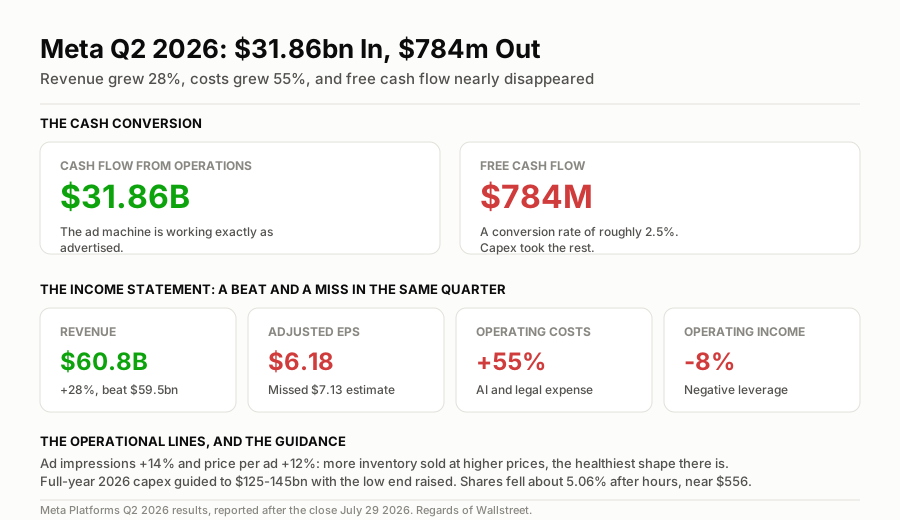
The distance between $31.86 billion of operating cash and $784 million of free cash is the entire investment case.
The Only Line That Matters
$784 million.
Meta generated $31.86 billion in cash from operations this quarter. After capital expenditure, $784 million of it was left. That is a conversion rate of roughly 2.5%.
For context on what that means: this is a company whose entire identity for a decade was a cash gusher so reliable it could fund buybacks, dividends, a metaverse bonfire and an AI buildout simultaneously without anyone checking the balance. This quarter it produced less free cash flow than a mid-cap industrial.
It is also the second megacap to hit this wall in eight days. Alphabet posted its first negative free cash flow since its 2004 IPO on $44.9 billion of quarterly capex, and that single line is what tipped the Nasdaq 100 into a correction this week. Meta did not go negative. It got close enough that the distinction is academic.
Full-year capex guidance of $125 to $145 billion, with the low end raised, tells you this is not a one-quarter shape. It is the run rate.
Why Costs Grew Twice as Fast as Revenue
Two drivers, and they deserve very different treatment.
AI expenses. This is the intentional one. Depreciation on data centres, compute, and the talent to run it. It is a choice, it is disclosed, and in principle it buys future revenue. You can argue about the return but not about the logic.
Legal expenses. This is the one nobody models and everybody should. Legal costs are pure deadweight: no capacity, no capability, no revenue on the other side. When a company flags rising legal expense as a material contributor to a 55% cost increase, it is telling you a slice of the margin compression buys literally nothing.
Put together they drove operating income down 8% on revenue up 28%. That is negative operating leverage at scale, and it is the single hardest thing for a growth multiple to survive.
Scoring Our Own Preview
Our July 16 preview made a specific claim: Meta has the most violent earnings history in megacap tech, with both -25% and +20% single-day reactions on its record, and options pricing ±7% was therefore a discount. The implied trade was buying that volatility.
Result so far: -5.06% after hours. Inside the ±7% that was priced, which means the long-volatility view is behind, not ahead.
Two caveats worth stating rather than hiding. After-hours pricing on a night with five major reports and a 2% down day behind it is thin, and Thursday's cash close is what settles this. And the thesis was correct in substance: we said the tension was that "the ad machine prints money, the AI capex burns it," and this print is that sentence with numbers attached. Getting the mechanism right and the magnitude wrong is still getting the trade wrong. Noted.
The Bull Case and the Bear Case
Bull case. The business that generates the money is accelerating, not slowing. Revenue +28%, impressions +14%, pricing +12%. Every dollar of the cost increase is discretionary or transitory: Meta can cut AI capex any quarter it chooses and the free cash flow returns immediately, because the ad machine underneath is untouched. At roughly $556, some 25% below its high, you are buying a compounding advertising monopoly at a discount created by spending management controls.
Bear case. "Management can stop spending whenever it likes" has never once been true of this management team. Meta's history is of spending through shareholder objection, and the metaverse era cost investors years. Capex guided to $125 to $145 billion with the low end going up is not a company preparing to throttle back. Meanwhile legal expense is outside management's control entirely, and negative operating leverage at 28% revenue growth means the leverage gets worse, not better, if growth decelerates even slightly. A 13% EPS miss with revenue beating is the definition of a company that has lost control of its own cost base.
Our read: this is a buy for investors who genuinely believe the ad business is worth the whole current market value on its own, treating the AI spend as an option with unknown strike. Everyone else should wait. The catalyst is not a revenue beat, Meta just delivered one and lost 5%. The catalyst is the first quarter free cash flow converts above 30% again. Until then you own a great business attached to a spending decision you do not control.
The Options Angle
- Implied volatility deflates hard from here, so buying premium after the print is the wrong side of the vol cycle.
- If you want to own the recovery without the capex risk, selling cash-secured puts below $556 pays you to set an entry and profits from exactly the vol collapse that hurts call buyers.
- For holders, a covered call is defensible but pick the strike carefully: if Meta ever does throttle capex, the re-rating is violent and upside is the thing you least want capped.
- The macro overlay outranks the stock. The 30-year Treasury above 5.19% after today's Fed decision hits long-duration growth hardest, and a company spending $135 billion for revenue arriving in 2029 is the definition of long duration.
The One-Line Read
Meta grew revenue 28% and still missed EPS by 13%, because operating costs grew 55% and free cash flow collapsed from $31.86 billion of operating cash to $784 million: the advertising business is in excellent health, the spending decision on top of it is not yours to make, and the number that fixes this stock is cash conversion rather than another revenue beat.
Next up:Fed decision, Tuesday →
More on $META
Updated Every Saturday
The Week Ahead
Every earnings date, Fed event and setup for the current trading week, on one page.
Refreshed Weekly
Earnings Calendar
Who reports next, when, and what consensus and the whisper expect.
The Week-Ahead Brief
Don’t miss next week’s setups. Get the Sunday brief.
Latest issue, Sep 7“Week ahead in the stock market...”
Every Sunday: next week’s earnings dates, Fed days and the trades worth watching, from the same desk that writes the week-ahead hub. Free, built for retail investors.