Is Meta a Buy After the Drop? 24% Off Its High, 57 Buy Ratings, and $784 Million of Free Cash Flow
Meta fell 5% after hours to about $556, now 24% below its high, with 57 buy ratings and an $826 target. Our answer, the bull case, the bear case and how to size it.
TL;DR
- Meta closed July 29 at $585.61, down 1.31%, then fell about 5.06% after hours to roughly $556 on a 13% EPS miss. It now sits about 24% below its high.
- Wall Street disagrees with the tape, loudly. 57 buy ratings, 6 holds, zero sells, and a consensus price target of $826.01.
- The bull case is one number: revenue grew 28% to $60.80 billion, with ad impressions up 14% and price per ad up 12%. The advertising machine is accelerating, not breaking.
- The bear case is one number too: $784 million of free cash flow out of $31.86 billion of operating cash flow, a conversion rate of about 2.5%, with full-year capex guided to $125 to $145 billion and the low end raised.
- Our answer: yes, but only at a size you can hold through another year of this, and only if you can say out loud that you are buying the ad business and treating the AI spend as a lottery ticket. Anyone buying because it is 24% off its high should not.
More on $META: Why Is Meta (META) Stock Up Today? The Iran Trade Did It, Not Meta →
Is Meta a Buy After the Earnings Drop?
Yes, if you are buying the advertising business and are honest that the capex is out of your control. No, if your thesis is "it fell a lot, so it is cheap."
That distinction is not pedantry. It determines your position size, and position size is the only part of this trade you actually control.
The Board
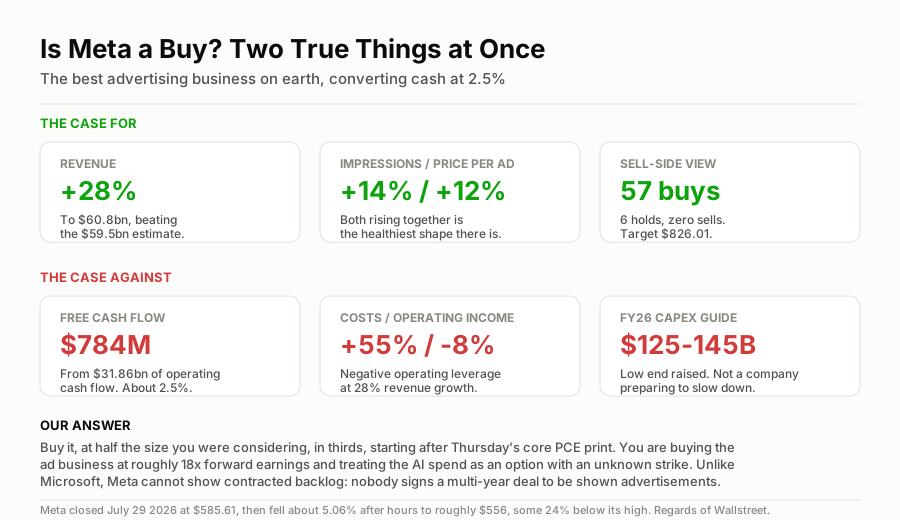
Two true things: the best ad business on earth, and 2.5% cash conversion.
The Case For
The advertising machine is getting stronger, not weaker. Revenue up 28% to $60.80 billion, beating the $59.50 billion estimate. Underneath it, impressions up 14% and price per ad up 12%. Both growing together is the healthiest possible shape for an ad business: Meta is selling more inventory and charging more for it. That does not happen to a platform losing relevance.
Every dollar of the problem is discretionary. Operating costs rose 55% on AI and legal expense. The AI portion is a choice. Meta could cut capex next quarter and free cash flow would recover almost immediately, because the business generating the cash is untouched. You are not looking at a broken company, you are looking at a healthy company making an expensive bet.
The valuation is not demanding. Meta went into this print around 18x forward earnings, with the street expecting roughly 22% annual earnings growth over three years. A high-teens multiple on a business compounding earnings in the low twenties is not a stretched number by any standard.
The analyst community is close to unanimous. 57 buys, 6 holds, no sells, target $826.01. Consensus is often worth ignoring, but a spread this wide between the target and roughly $556 means the sell side thinks the market is mispricing this by a lot.
The Case Against
Start with the number that actually broke the stock. Meta produced $31.86 billion of operating cash flow and kept $784 million of it. That is roughly 2.5% conversion. This was a company whose defining feature was a cash gusher so dependable it funded buybacks, a metaverse write-off and an AI buildout at the same time without anyone checking. This quarter it generated less free cash flow than a mid-cap industrial.
"Management can stop spending" has never once been true here. The bull case leans on Meta throttling capex when it chooses. Meta's actual history is spending through shareholder objection for years. Full-year capex is guided to $125 to $145 billion with the low end raised, which is not the disclosure of a company preparing to slow down.
Legal expense is outside anyone's control. Rising legal cost was named as a material contributor to the 55% increase. Unlike AI capex, legal spending buys no capacity, no capability and no future revenue. It is pure deadweight, and no amount of ad growth makes it go away.
Negative operating leverage at 28% growth is the real alarm. Revenue up 28% and operating income down 8% means the cost base is outrunning an accelerating top line. If revenue growth decelerates even modestly while costs keep compounding, the margin damage gets worse, not better.
The macro is actively hostile. The 30-year Treasury sits at 5.193% after yesterday's Fed decision, and long yields are the discount rate on distant cash flows. A company spending $135 billion for revenue arriving in 2029 is about as long-duration as equity gets. Core PCE prints Thursday morning and can make that worse before any of Meta's fundamentals change. See the core PCE preview.
Why Microsoft's Night Makes Meta Look Worse
This is the comparison that should shape your entry, and it happened on the same evening.
Microsoft also guided capex higher. Microsoft's stock rose about 8%. The difference was commercial RPO of $678 billion, up 84%, and up 25% excluding OpenAI: contracted, signed backlog proving the capacity being built has already been sold. Detail in the Microsoft breakdown.
Meta has no equivalent disclosure, and structurally it cannot have one. Nobody signs a multi-year contract to be shown advertisements. Meta's AI spending is a bet that better models produce better targeting produces more ad revenue, and that chain is real but unquantifiable from the outside.
So the market now has a template for rewarding AI capex, and Meta is the megacap least able to satisfy it. That is not a reason to avoid the stock. It is a reason to expect this discount to persist longer than the bulls think.
Our Answer, and How to Size It
Buy it, at half the size you were considering, in thirds, starting after Thursday's core PCE print.
The reasoning:
- The ad business alone justifies a large share of the current market value. Growing 28% with impressions and pricing both up, at roughly 18x forward earnings, is a good asset at a fair price. That is the thesis and it is sufficient.
- Treat the AI spend as an option with an unknown strike, not as an investment you have underwritten. If it works, you get paid twice. If it does not, you own an advertising monopoly that stops burning $30 billion a quarter. Neither outcome ruins you at a sensible size.
- Half size, because the one variable that matters most is the one you cannot influence or forecast. You are not being asked to judge a business, you are being asked to trust a capital allocation decision from a team with a poor record on exactly that.
- In thirds, because the catalyst is quarters away. The thing that re-rates this stock is not a revenue beat. Meta just delivered one and fell 5%. It is the first quarter free cash flow conversion goes back above 30%.
- Wait for Thursday morning. A hot core PCE would push the 30-year higher and hit this name specifically. There is no reward for buying a long-duration stock the day before a scheduled inflation print.
What would make us wrong in the bullish direction: Meta announcing a capex ceiling or a buyback scaled to the discount. Either would close the gap to $826 fast.
What would make us wrong in the bearish direction: ad revenue decelerating below 20% while capex stays at this run rate. That combination removes the floor under the whole argument.
The Options Angle
- Implied volatility collapses after the print, so buying calls now to chase the recovery is the worst version of this trade.
- Selling cash-secured puts below roughly $556 is the best structure available: it pays you to set a lower entry, it profits from the vol crush rather than fighting it, and it suits a stock you want to own more cheaply. That is the wheel doing what it is for.
- For holders, a covered call is defensible, but be careful with the strike. If Meta ever caps capex, the re-rating is violent, and that is the exact scenario you are being paid to wait for.
- At roughly $556, one contract is about $55,600 of notional, which puts cash-secured puts out of reach for many retail accounts. If that is you, buy shares in thirds instead of forcing an options structure the account cannot support.
The One-Line Read
Meta is a buy at 24% off its high because the advertising business accelerated to 28% growth with impressions and pricing both rising, and it is only a buy at half size, because $784 million of free cash flow from $31.86 billion of operating cash flow is a capital allocation decision you do not control, made by a team with a history of spending through exactly this kind of complaint.
Next up:Fed decision, Tuesday →
More on $META
$META · 2026-08-03
Why Is Meta (META) Stock Up Today? The Iran Trade Did It, Not Meta
$META · 2026-07-29
Meta Q2 2026 Earnings Breakdown: Revenue Grew 28%, Costs Grew 55%, and Free Cash Flow Fell to $784 Million
$META · 2026-07-16
Meta Earnings Preview: The Megacap Most Likely to Move 10%, in Either Direction
Updated Every Saturday
The Week Ahead
Every earnings date, Fed event and setup for the current trading week, on one page.
Refreshed Weekly
Earnings Calendar
Who reports next, when, and what consensus and the whisper expect.
The Week-Ahead Brief
Don’t miss next week’s setups. Get the Sunday brief.
Latest issue, Sep 7“Week ahead in the stock market...”
Every Sunday: next week’s earnings dates, Fed days and the trades worth watching, from the same desk that writes the week-ahead hub. Free, built for retail investors.