Palo Alto (PANW) Earnings Sept 1: 32% Revenue, 2% EPS
Palo Alto Networks reports fiscal Q4 on September 1. The guide asks for 32% revenue growth and 1-3% earnings growth in the same quarter, and CyberArk's 112 million shares explain the gap.
TL;DR
- Reported: $3.41bn of revenue (up 34%) and $1.02 of non-GAAP EPS, both above the guided $3.345bn-$3.355bn and $0.96-$0.98. GAAP EPS swung to a $0.35 loss on acquisition accounting even as non-GAAP EPS grew. PANW closed down 5.2% at $362.09 anyway.
- Palo Alto Networks reported fiscal Q4 and full-year 2026 after the close on Tuesday, September 1, with the webcast at 4:30pm ET. The quarter ended July 31.
- The Q4 guide asked for 32% revenue growth and 1% to 3% earnings growth at the same time: revenue of $3.345bn to $3.355bn against $0.96 to $0.98 of non-GAAP EPS, versus $0.95 a year ago. Both cleared.
- CyberArk closed on February 11 for $2.3bn in cash and 112 million shares. That is the wedge, and it showed up again in Q4 as a GAAP net loss. Q3 non-GAAP operating income grew 29.8% while non-GAAP EPS grew 6.3%.
- Strip the acquisitions out of Q3 and organic revenue grew about 14%, against the 31% headline. CyberArk and Chronosphere contributed $388m of the $3.0bn; management did not give the equivalent Q4 split. The fiscal 2027 guide of 23-24% revenue growth, the first with CyberArk in both the base and the comparison, is the cleaner read.
More on $PANW: Is Palo Alto Networks a Buy After the AI Hacking Scare? The Thesis Is Right, the Day Is Wrong →
When Does Palo Alto Networks Report Earnings?
Tuesday, September 1, after the US market closes, with a video webcast at 1:30pm Pacific, which is 4:30pm ET. The company confirmed both in its own advisory, covering the fiscal year ended July 31, 2026.
It is a quiet week to report into, which is unusual for Palo Alto and probably deliberate. CrowdStrike reports on August 26, five sessions earlier, so the security comp will already be on the board. Intuit goes on August 25. The rest is in the earnings calendar, and the week-ahead hub has the full week, Dell included.
UPDATE (August 26, 2026): five straight losing sessions have taken 12% off the stock heading into the print. PANW closed $339.90 on Tuesday, August 25, down 3.1%, the fifth consecutive decline, a stretch that has cut about 12% and roughly $37 billion of market value off the stock since mid-August, per multiple market-data trackers. That is a materially cheaper entry than the $384.27 close this piece opened with, down about 11.5%, with no single named catalyst behind the slide beyond broad valuation pressure on richly priced software names heading into a print that already has to explain a 30-point gap between revenue and earnings growth. The trailing P/E near 295x, cited below, has come in some with the price, though not by much on a multiple this stretched.
The Board
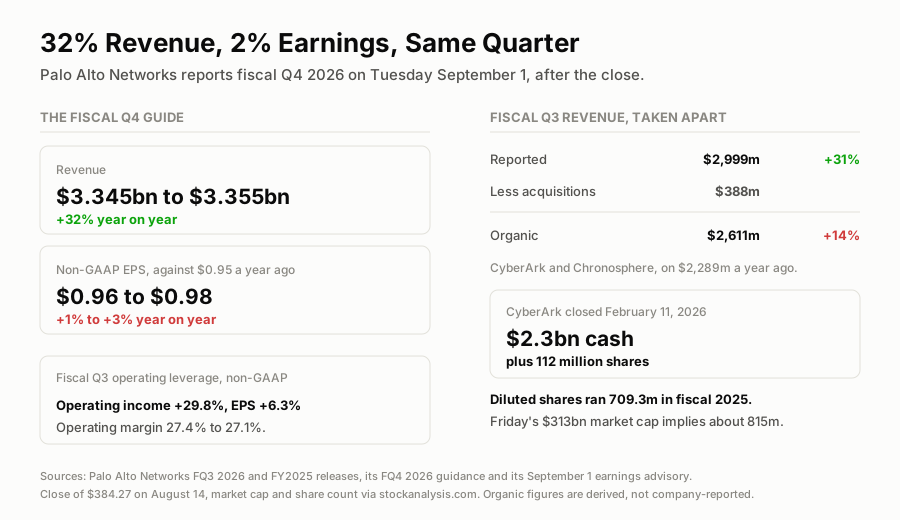
Two guided numbers for the same three months, thirty points apart.
Thirty Points Of Revenue, Two Points Of Earnings
Put the two halves of the Q4 guide next to each other and the quarter stops looking like an acceleration.
Revenue is guided to $3.345bn to $3.355bn, which the company describes as 32% growth. The year-ago quarter did $2.5bn. Non-GAAP EPS is guided to $0.96 to $0.98. The year-ago quarter did $0.95. That is 1.1% to 3.2% earnings growth on 32% revenue growth, and it is guided that way, so nothing has to go wrong for it to happen.
The same shape showed up in Q3, already reported. Non-GAAP operating income went from $627m to $814m, up 29.8%, roughly tracking the 31% revenue line. Non-GAAP EPS went from $0.80 to $0.85, up 6.3%. Operating margin held: 27.4% a year ago, 27.1% last quarter. So the wedge opens up below the operating line, and the two candidates are the 112 million shares issued for CyberArk and the financing cost of the $2.3bn cash half of the deal.
The share count is checkable from the outside. At Friday's $384.27 close the market cap was $313.18bn, which implies roughly 815m shares. Weighted average diluted shares were 709.3m in fiscal 2025. Add 112m and you land within a rounding error of where the market cap puts it today.
None of that makes the deal a mistake. It does mean the fiscal 2026 growth rate and the fiscal 2026 earnings power are describing two different companies, and the per-share line is the one shareholders own.
What $388m Does To The Growth Rate
Palo Alto disclosed the number, which is more than most acquirers do: $388m of the fiscal Q3 revenue came from CyberArk and Chronosphere.
Q3 revenue was $3.0bn against $2.289bn a year earlier. Take the $388m out and the remaining business did about $2.61bn, or roughly 14% growth. The headline was 31%. Fiscal 2025 grew 15% on its own, so on that arithmetic the underlying business is running about where it was, and the acceleration in the reported line is the acquisition arriving.
For Q4 the same subtraction gets harder, because this is the first complete quarter with CyberArk. The deal closed on February 11 and fiscal Q3 ran from February 1, so Q3 captured about ten days less than a full period. If the acquired lines simply repeat $388m, organic Q4 growth works out near 17%. To the extent a full quarter contributes more than a partial one, and it should, the organic figure comes in below that. Mid-teens is the reasonable expectation, and management confirming or refusing the split is the first thing I want off the call.
Worth noting what this does to the Rule-of-50 framing the company used all through fiscal 2025. Guided fiscal 2026 revenue growth of 24% plus a 37.5% adjusted free cash flow margin comfortably clears 50. Substitute the organic growth rate and it clears by about a point and a half.
The Number Management Wants The Call To Be About
Next-Generation Security ARR, and the case for it is decent.
NGS ARR reached $8.1bn in Q3, up 60%, with the full year guided to $8.90bn to $8.95bn. RPO grew 36% to $18.4bn, guided to $20.9bn to $21.0bn. Both are subscription measures that ignore the timing noise in reported revenue, and both are the metrics that matter if the platform consolidation strategy is working, since the whole argument is that customers buy more modules from one vendor over time.
The catch is that CyberArk's ARR is inside those numbers too, so a 60% ARR growth rate is subject to the same subtraction as the 31% revenue line. Nobody should treat NGS ARR as the organic metric simply because it is the one on the slide.
Watch the fiscal 2027 guide instead. It is the first outlook where CyberArk sits in both the base and the comparison, so the growth rate stops being flattered by the arithmetic of adding a company. Whatever number management puts on fiscal 2027 is what I will be reading on September 1.
Where The Stock Sits
PANW closed $384.27 on Friday, down 2.96% on the day. The decision piece written on August 10, after the stock jumped 4.4% on reports of AI agents conducting real hacking sprees, argued for the boring week rather than the loud one. Five sessions later the stock is lower, so waiting has cost nothing so far.
The trailing GAAP multiple is unusable here. stockanalysis.com shows 371x, which is acquisition accounting rather than a valuation. On the fiscal 2026 guide of $3.77 to $3.79 of non-GAAP EPS, the stock trades near 102x. That is a premium that only survives if fiscal 2027 shows the acquired revenue compounding rather than merely being added, and September 1 is when management has to say so.
The One-Line Read
Palo Alto guided 32% revenue growth and 2% earnings growth for the same quarter. CyberArk's 112 million shares are the difference. The fiscal 2027 guide is the first clean look at what was bought.
Next up:PCE inflation, Wednesday at 8:30am ET →
More on $PANW
Updated Every Saturday
The Week Ahead
Every earnings date, Fed event and setup for the current trading week, on one page.
Refreshed Weekly
Earnings Calendar
Who reports next, when, and what consensus and the whisper expect.
The Week-Ahead Brief
Don’t miss next week’s setups. Get the Sunday brief.
Latest issue, Sep 27“Micron, PCE and the jobs report that decides October”
Every Sunday: next week’s earnings dates, Fed days and the trades worth watching, from the same desk that writes the week-ahead hub. Free, built for retail investors.