Sherwin-Williams (SHW) Jumped 8% on a Quarter With 'No Meaningful Improvement in Demand'. Read That Again.
Sherwin-Williams rose 8.08% to $353.72 on Q2 2026 adjusted EPS of $3.70 versus $3.50 expected, with housing still weak. Why share gains beat a bad end market, and where the risk sits.
TL;DR
- Sherwin-Williams rose 8.08% to $353.72 after Q2 2026 adjusted EPS of $3.70 beat the $3.50 estimate on revenue of $6.789 billion, above the $6.61 billion consensus.
- Revenue grew 7.5% year over year, from $6.314 billion. All three reportable segments contributed.
- The company raised full-year EPS guidance to $11.80 to $12.20, and returned $1.46 billion to shareholders in the quarter via dividends and buybacks.
- Here is the part that matters: management explicitly said there was "no meaningful improvement in demand." Residential new construction stayed weak and DIY stayed muted. The beat came from share gains, pricing discipline and cost control, not from a housing recovery.
- At $353.72 the stock sits near its $379.65 52-week high, which is a strange place for a housing-levered name in a weak housing market. That is either the bull case or the entire risk, depending on what happens to volumes.
More on Earnings: Options Scorecard: The Week of August 17, Graded (25 Calls, 72% Right) →
Why Is Sherwin-Williams Stock Up Today?
Sherwin-Williams beat on both lines and raised the year in an end market that has not recovered, which is the single most valuable thing a cyclical can prove.
The numbers: adjusted EPS $3.70 against $3.50 expected. Revenue $6.789 billion against $6.61 billion expected, up 7.5% from $6.314 billion. Full-year EPS guidance lifted to $11.80 to $12.20. Shares closed up 8.08% at $353.72, approaching the $379.65 52-week high.
The Board
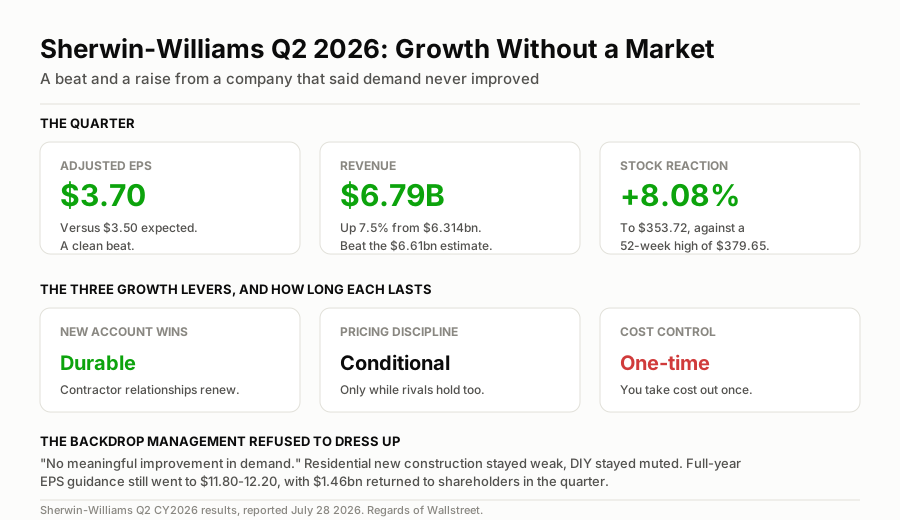
Beat, raise, and a demand backdrop management refused to dress up.
Growth Without a Market
Most beats in a cyclical come from the cycle. This one did not, and management said so out loud: no meaningful improvement in demand, with residential new construction weak and DIY muted.
So where did 7.5% revenue growth come from? Three places, and they are worth separating because they have very different shelf lives.
New account wins. This is real, durable share gain. In architectural paint, an account is a contractor relationship that renews for years. Winning them in a weak market is the hardest and most valuable kind of growth, because the competitor losing them is losing them permanently.
Pricing discipline. Also real, but conditional. Holding price while volumes are soft means you are choosing margin over share. It works until a competitor decides it would rather have the volume, and then it stops working quickly.
Operational excellence. Cost control. The most fragile of the three. You can only take cost out once.
Two of those three have a ceiling. For a stock trading near its 52-week high, that ceiling is the constraint that matters.
Why It Popped in This Particular Week
Because of what is happening two sectors over.
The Nasdaq 100 entered a correction on Wednesday, sitting 10% below its June peak of 30,660 after four straight sessions of semiconductor selling. The Dow closed Tuesday up 0.62% at 52,534.84 on the same tape. Capital is rotating out of AI-levered growth and into anything that produces predictable cash. We laid out that split in the Nasdaq 100 correction piece.
Sherwin-Williams is close to a perfect landing spot for that money. It sells a consumable into a repeat-purchase channel, it just raised guidance, and it handed back $1.46 billion in the quarter. In a week when the market is punishing companies that spend cash, a company that returns it gets rewarded twice.
That is the same mechanic that lifted Ford, Boeing and Coca-Cola this week. See why Ford is up for the clearest version of it.
The Bear Case
A paint company near a record high with weak housing is a bet on a recovery that has not started.
- Volumes are the missing ingredient. Price and share can carry a few quarters. They cannot carry a multi-year story. If new construction stays soft into 2027, the comparisons get harder exactly as the pricing lever runs out.
- Pricing discipline is a two-player game. Sherwin-Williams holding price only works while competitors do too. That is not a contract.
- The multiple already assumes the recovery. At $353.72, near a $379.65 high, you are not being paid to wait for housing. You are paying up for management execution in advance.
- Rates are the whole housing story, and rates are not moving. The Fed is widely expected to hold at 3.50% to 3.75% today, a fifth consecutive meeting unchanged. Nothing about that helps residential construction in 2026. Our read on the rate path is in forget the rate cut, watch for a hike.
Is SHW a Buy Here?
Yes, but as a quality compounder, not as a housing recovery trade. Those get confused constantly and they lose money differently.
The bull case is that this is a company demonstrating it can grow 7.5% and raise guidance with its end market working against it. That is what pricing power looks like from the inside, and it is worth a premium multiple. When housing does turn, the operating leverage on top of the share gains is substantial.
The bear case is that you are buying near a 52-week high the mechanical strength of which is two-thirds price and cost, both of which expire.
Our read: a buy for the franchise, not for the print. The way I would rather own it is a starter now with dry powder held back for the quarter when management finally admits pricing has stalled, because chasing an 8% gap is how you turn a good business into a bad entry. If you want the housing recovery specifically, you want something more levered and cheaper than this. If you want a business that compounds through a bad market, this quarter was the proof.
The Options Angle
- At $353.72, one contract is roughly $35,372 of notional. That is real money and it takes cash-secured puts off the table for most retail accounts.
- Post-earnings implied volatility is already deflating, so buying calls to chase the gap is paying full price for a move that already happened.
- If you own the shares, a covered call into the $379.65 52-week high area is a defensible way to monetise the pop without deciding to sell.
- The next real catalyst is macro, not company-specific: housing data and the rate path. There is nothing scheduled until Q3 earnings, which means premium sellers have a clean runway and premium buyers have nothing to buy.
The One-Line Read
Sherwin-Williams grew 7.5% and raised the year while telling you demand never improved, which makes it a genuine quality name doing hard things well: own it for the share gains and the buyback, price in the fact that two of its three growth levers have a ceiling, and stop calling it a housing recovery trade until housing actually recovers.
Next up:Fed decision, Tuesday →
More on Earnings
Updated Every Saturday
The Week Ahead
Every earnings date, Fed event and setup for the current trading week, on one page.
Refreshed Weekly
Earnings Calendar
Who reports next, when, and what consensus and the whisper expect.
The Week-Ahead Brief
Don’t miss next week’s setups. Get the Sunday brief.
Latest issue, Sep 7“Week ahead in the stock market...”
Every Sunday: next week’s earnings dates, Fed days and the trades worth watching, from the same desk that writes the week-ahead hub. Free, built for retail investors.