The Nasdaq 100 Just Entered a Correction: 10% Below Its Record, and the Chips Are 20% Down
The Nasdaq 100 opened July 29 down 10% from its June peak of 30,660, the official correction line. What broke, why the Dow is up while tech bleeds, and what to do about it.
TL;DR
- The Nasdaq 100 opened Wednesday July 29 down 10% from its June peak of 30,660, which puts the correction line at roughly 27,594. That is the textbook definition, crossed on the fourth straight session of semiconductor selling.
- This is not an index-wide event. The Dow closed Tuesday up 0.62% at 52,534.84 while the Nasdaq Composite fell 1.31% to 24,605.01. One tape, two completely different markets.
- Semiconductors are already past correction and into a bear market: the group is more than 20% off its highs, with the PHLX Semiconductor Index down 4.5% on Tuesday alone.
- Two catalysts did the damage: CXMT's 466% Shanghai IPO debut, which made a Chinese memory price war suddenly concrete, and Alphabet's first negative free cash flow since 2004 at -$5.9 billion on $44.9 billion of quarterly capex.
- Context that matters: the Nasdaq is still up 12% year to date, and so is the S&P 500. This is a correction inside an up year, not a crash.
More on $QQQ: Nasdaq 100 Rides Chip Stocks Higher While a War Restarts in the Background →
Is the Nasdaq in a Correction?
Yes, the Nasdaq 100 is, as of Wednesday morning July 29, 2026. The index opened 10% below its June record close of 30,660, and a 10% drawdown from a closing high is the standard definition of a correction.
The broader Nasdaq Composite is not quite there. It closed Tuesday at 24,605.01, down 1.31% on the day and down 327.07 points. The S&P 500 is roughly 6% off its high. So when someone tells you "the market is in a correction," ask which market. The answer changes the trade.
Here is the cleanest way to hold all three facts at once. The Nasdaq 100 is in a correction. Semiconductors are in a bear market. The Dow is near record territory. All of that is true on the same Wednesday morning.
The Board
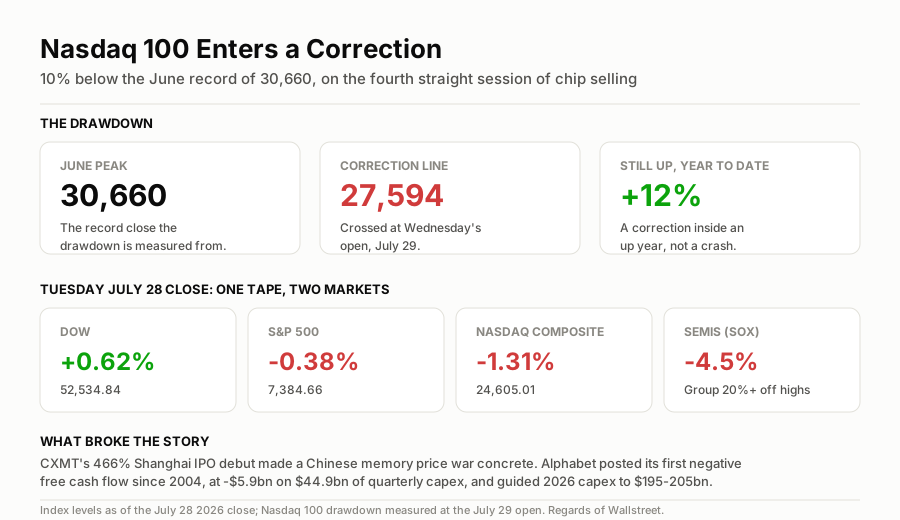
The correction is real, it is concentrated in one sector, and the year is still green.
What Actually Broke
Not the economy. Not earnings. A story.
The story that held the Nasdaq up all year was that AI capital spending is a moat: the hyperscalers spend, the chipmakers collect, and nobody else can play. Two events in eight days punched holes in both halves of it.
The moat leaked from the east. Chinese memory maker CXMT closed its Shanghai IPO up 466%, and the market read that debut correctly: capital is now flowing into Chinese memory capacity at scale. On top of it came a report that a Chinese state-backed firm has started mass-producing immersion DUV lithography machines, roughly 5 in 2026 and 20 in 2027. If you want the full version of why that name keeps appearing, we wrote the standalone explainer on CXMT.
The response was violent and it started overnight. South Korea's Kospi fell 10.8% to 6,023.66. SK Hynix fell 14.7%. Samsung fell 13.4%. We covered that session in detail in why the Korean stock market is crashing.
The spending leaked from the west. Alphabet reported negative free cash flow of $5.9 billion, its first negative quarter since the 2004 IPO, on $44.9 billion of capex in three months. Management then raised full-year capex guidance to $195 to $205 billion and warned of a further significant increase in 2027. Cloud revenue grew 82% and the backlog is $514 billion, so this is not a demand problem. It is a when do we get paid problem, and the market decided the answer is "later than we thought."
Put those together and you get the two questions now repricing every AI-adjacent name: can the sellers hold price, and can the buyers keep funding it?
Where the Damage Actually Is
The damage inside this correction is nothing like evenly spread.
- Semiconductors: more than 20% off highs, with SOX down 4.5% on Tuesday. Dell fell 8%, Intel slid 6%, and SanDisk is more than 50% below its peak.
- Memory specifically: Micron has been the epicentre, and we laid out the valuation math in MU and SNDK after the selloff.
- Everything else: the Dow rose 324.76 points on Tuesday on clean beats from Coca-Cola, UPS and PayPal. On Wednesday Ford, Sherwin-Williams and Boeing joined the list.
That is a market taking money out of one crowded trade and putting it into another, which is not the same as falling apart. We flagged the same shape earlier this week in SPY 3% off highs feels like a bear market, and the gap between how it feels and what the index did has only widened since.
The Two Events That Decide the Next Leg
Both land today, hours apart.
2:00pm ET, the Fed. Consensus is a hold at 3.50% to 3.75%, which would be the fifth straight meeting unchanged. A hold is priced. The press conference is not. Our full setup is in the FOMC July 29 preview.
After the close, Microsoft and Meta. This is the one that matters more for the Nasdaq. Alphabet already told the market what AI capex is doing to cash flow. If Microsoft and Meta confirm it with their own capex guides, the correction has a second leg and the index does not stop at 10%. If either of them shows operating leverage instead, the "AI does not pay" trade unwinds fast. The hour-by-hour timetable is in our July 29 day-of piece.
The Playbook
- Do not buy the index to buy the dip. The Nasdaq 100 is down 10% because roughly one sector is down 20%+. Buying QQQ here is a bet on semiconductors dressed up as diversification. Own the thing you actually mean to own.
- Corrections are not a signal to sell what you already hold. The index is still up 12% on the year. If your plan was a multi-year hold, a 10% drawdown was always in the distribution. Our take on this reflex is in time in market versus timing the market.
- If you want to add, stage it. Thirds, not all at once, and not before tonight's capex guides. There is a scheduled information event in a few hours. Buying ahead of it is paying for the privilege of being surprised.
- Covered calls get more attractive here, not less. Elevated volatility means better premium on shares you already own and were not planning to sell.
- The failure mode to name: every one of these tactics loses if this is the start of a genuine AI capex bust rather than a repricing. The bear case has nothing to do with chips falling another 20%. It is that hyperscaler capex guidance gets cut in 2027, which turns a sentiment correction into an earnings correction. Nothing so far says that is happening. Watch tonight's guides, not tonight's prices.
The One-Line Read
The Nasdaq 100 is in a correction because one crowded trade got repriced by a Chinese IPO and a negative cash flow line, not because the market broke: own that distinction, keep the position sizes you can hold through tonight's capex guides, and stop treating a 10% drawdown in an up 12% year as an emergency.
Next up:Fed decision, Tuesday →
More on $QQQ
Updated Every Saturday
The Week Ahead
Every earnings date, Fed event and setup for the current trading week, on one page.
Refreshed Weekly
Earnings Calendar
Who reports next, when, and what consensus and the whisper expect.
The Week-Ahead Brief
Don’t miss next week’s setups. Get the Sunday brief.
Latest issue, Sep 7“Week ahead in the stock market...”
Every Sunday: next week’s earnings dates, Fed days and the trades worth watching, from the same desk that writes the week-ahead hub. Free, built for retail investors.