Visa Earnings Preview (July 28): The Cleanest Read on the Consumer, Right After Amex Flashed a Warning
Visa reports fiscal Q3 2026 after the close Tuesday July 28. Payment volume, cross-border and the consumer slowdown Amex just flagged. Expectations, what matters, and the options play.
TL;DR
- Visa reports fiscal Q3 2026 after the close on Tuesday, July 28, with the conference call following at 5:00pm ET / 2:00pm PT.
- Last quarter set a high bar: revenue $11.23 billion, up 17%, and adjusted EPS of $3.31 against a $3.10 estimate.
- The question isn't Visa's business, it's the consumer's. Amex just slipped 2% despite beating because billed business decelerated. Visa is the confirmation or the refutation.
- Watch payment volume, cross-border volume and value-added services. Options plays below.
When Does Visa Report Earnings?
The short answer: Tuesday, July 28, after the US market closes, with the earnings call at 5:00pm ET (2:00pm PT, 10:00pm BST). This is fiscal Q3 2026, because Visa's financial year ends in September rather than December.
It lands the day before the Fed decision, which makes it the last big consumer datapoint policymakers and traders get before Wednesday.
The Board
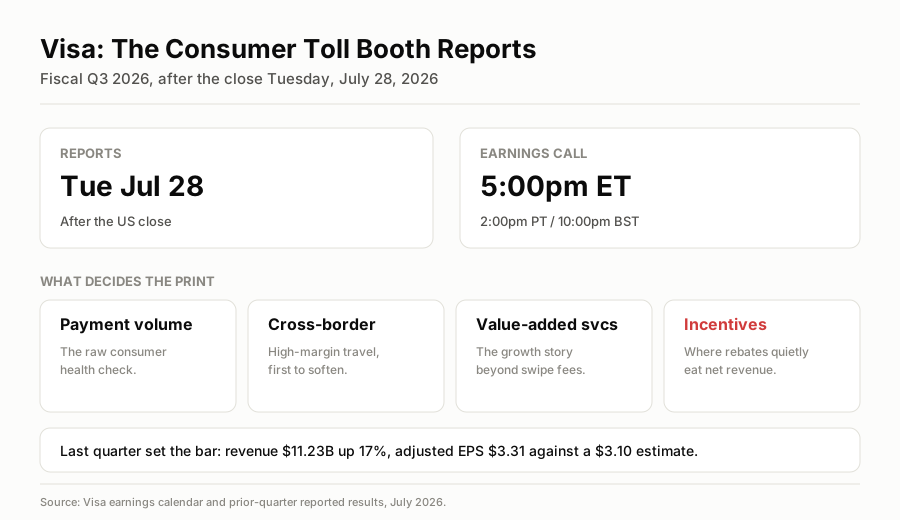
Visa is a toll booth on global spending. The toll rate is stable, so the only real variable is traffic.
What Wall Street Is Watching
- Payment volume. The raw measure of how much is being spent on Visa cards. This is the consumer health check, and it's the line that decides the reaction.
- Cross-border volume. The high-margin travel and international business, and historically the most cyclical piece. It is the first thing to soften when households pull back on discretionary spending.
- Value-added services. Visa's growth story beyond swipe fees: fraud tools, risk management, consulting, tokenization. This is what justifies the multiple, and it grew strongly last quarter.
- Incentives and rebates. The unglamorous line where Visa buys bank loyalty. Rising incentives quietly eat net revenue growth.
The Amex Read-Through That Sets the Bar
Here's the context that makes this print more interesting than usual. Amex beat on revenue and EPS last week and the stock still fell about 2%, because billed business growth decelerated to roughly 7% from 9% and the credit provision built to around $1.4 billion.
That gives you a clean hypothesis to test. If the affluent-skewed Amex consumer is slowing, does the broader Visa consumer slow too? Visa's network spans every income bracket in nearly every country, so it is the wider, less selective sample. If Visa's payment volume holds up while Amex decelerated, the slowdown is a premium-spending story rather than a consumer-wide one. If Visa decelerates too, the market has a genuine macro problem on its hands the day before the Fed speaks.
The Bull and Bear Case
The bull case. Visa is close to a toll road on global commerce: it takes a small cut of an enormous, growing volume without carrying credit risk. It doesn't lend, so it doesn't care much whether borrowers repay, which is precisely why it deserves a premium to card issuers like Amex. Value-added services keep compounding, and cash generation funds relentless buybacks.
The bear case. That premium is the problem. Visa rarely trades cheap, so a merely-fine quarter gets sold, exactly as Amex's did. Regulatory risk on interchange fees never fully goes away, stablecoin and account-to-account payment rails are a slow structural question, and if consumer spending really is rolling over, a toll road with less traffic is still a toll road with less traffic.
The Options Angle
- Visa is not a big-move name, and the options price it that way. Buying options into this print means paying event premium on a company that usually delivers a low single-digit reaction. The volatility crush afterwards is close to a certainty.
- An iron condor around the expected move fits the profile, because a mega-cap payments network with predictable economics is exactly the kind of stock that pins. Respect the tail: a genuine consumer-spending shock is the one thing that breaks it.
- If you own it, a covered call into elevated pre-earnings implied volatility is the sensible income trade on a steady compounder you have no intention of selling.
- The cross-asset read is the real edge. Visa's payment volume moves consumer discretionary names, card issuers and retail sentiment more than it moves Visa. Watch the print for what it tells you about everything else.
The One-Line Read
Visa reports Tuesday after the close as the broadest, least selective read on global consumer spending available, landing 24 hours before a Fed decision and one week after Amex's decelerating billed business spooked the tape; the company itself will almost certainly be fine, so trade the print for what payment volume says about the consumer rather than for what it says about Visa.
More on Earnings
$MRNA · 2026-07-28
Moderna Earnings Preview (July 31): Revenue Near $103 Million, and the Only Question Is the Runway
$RDDT · 2026-07-28
Reddit Earnings Preview (July 30): After the Last Faceplant, the Google Dependency Is the Whole Risk
$RBLX · 2026-07-28
Roblox Earnings Preview (July 30): Bookings, Bots and the Profitability Question That Never Goes Away
The Sunday Setup
Enjoyed this breakdown? Don’t miss the next market setup.
Get deep-dive analyses delivered to your inbox every Sunday. Free, and built for retail investors.
Comments
0 totalNo comments yet. Be the first to drop a take.