Why Is Blaize (BZAI) Stock Down? A $130M Guide Became $40M
Blaize cut full-year 2026 revenue guidance from $130m to $40-43m and fell about 35% after hours. Innventure and AmpliTech pulled their 2026 guides the same evening, for related reasons.
TL;DR
- Blaize took full-year 2026 revenue guidance to $40.0m-$43.0m from $130m, a cut of roughly 67% to 69%. Shares traded near $0.76 after hours, down about 35% from a $1.17 close.
- The new guide is mostly one contract. First-half revenue was $14.7m. The guide leaves $25.3m-$28.3m for the second half, and management said about $20.0m of that comes from a single binding 2,000-server agreement. Everything else in the business is being guided to roughly $5m-$8m.
- Gross profit fell while revenue quadrupled. Q2 revenue of $12.0m was 4.4x the $2.7m Q1 did, but gross margin collapsed to 8% from 58%, so gross profit went from about $1.6m to $0.96m. Management named materially higher memory pricing as a cause.
- Cash is $36.8m against a Q2 adjusted EBITDA loss of $20.9m. Those two numbers do not leave much room to be wrong twice.
- Blaize was not alone on Thursday evening. Innventure suspended its 2026 Accelsius targets and fell about 45%; AmpliTech withdrew its roughly $50m 2026 target and fell about 34%. All three named deployment timing.
More on AI & Semiconductors: Akamai's $11.6 Billion Anthropic Deal Pushes the AI Ledger Past $900B →
Why Is Blaize Stock Down?
Blaize cut its full-year 2026 revenue guidance by about two thirds, to $40.0m-$43.0m from the $130m it had reaffirmed as recently as its Q1 report. The quarter itself grew: revenue of $12.0m against $2.7m in Q1 and $2.0m a year ago. The guide is what moved the stock.
Management gave two reasons in the release: the pace at which opportunity converts into orders, and materially higher memory pricing. The CFO added that the revised outlook excludes opportunities still in progress, "regardless of how far along they may be."
I read that last line as the useful one. A company that has just missed its own number by two thirds has bought itself a guide it can clear. Whether that is conservatism or capitulation depends entirely on what converts in the fourth quarter, and there is no way to tell from here.
The Board
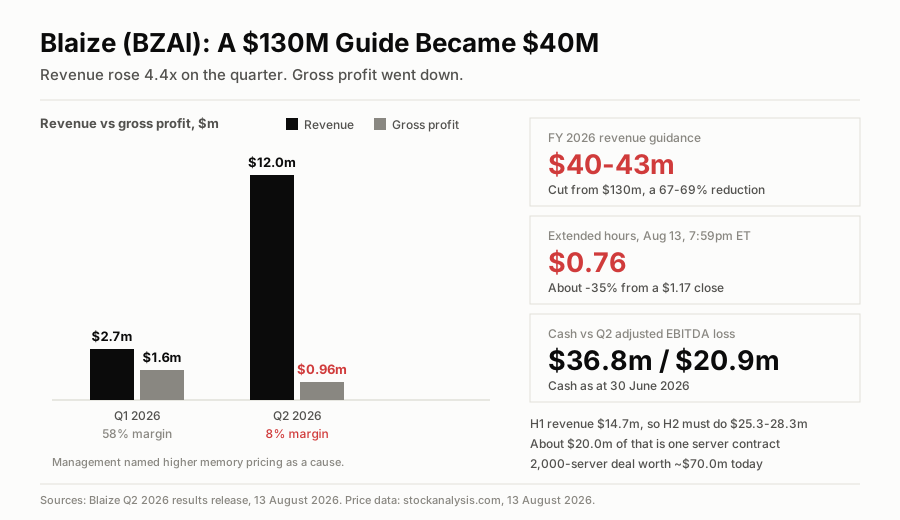
Revenue up 4.4x on the quarter. Gross profit down. That is the memory bill arriving.
The Guide Is Almost Entirely One Contract
Do the arithmetic the release does not do for you.
First half revenue: $2.7m in Q1 plus $12.0m in Q2 is $14.7m. Take that off the new full-year range and the second half has to deliver $25.3m at the low end and $28.3m at the high end.
Management disclosed a binding agreement covering 2,000 servers, worth roughly $70.0m at current memory prices, of which about $20.0m is expected to be recognised in the second half of 2026 and about $50.0m carried as 2027 backlog. Subtract that $20.0m and the rest of Blaize, every other customer and product line combined, is guided to something like $5.3m to $8.3m for the back half of the year.
That is a company whose 2026 now rests on one counterparty delivering on schedule. It also means the $70.0m headline figure moves with memory pricing, which the company said explicitly, so the contract's value is quoted against a cost curve rather than fixed.
Where the Margin Went
Gross margin of 8% on $12.0m of revenue is $0.96m of gross profit. In Q1, a 58% margin on $2.7m produced about $1.6m. Revenue rose 4.4x and gross profit went down.
Memory is the reason management gave, and it lands on a thesis this site has been tracking since July: DRAM up 89% in a quarter puts the cost on somebody's income statement, and the somebody is whoever assembles the box. Cisco, with memory at 15-20% of its bill of materials, lost 210 basis points of gross margin last week even after raising prices successfully. Blaize sells servers. Its exposure is not 15%.
The difference is pricing power. Cisco raised prices and still gave up margin. A company doing $12m a quarter, selling into customers who control the deployment schedule, does not get to raise prices at all. It eats the memory bill or it does not ship. Micron and the memory names have been the other side of this trade all summer.
The Same Evening, Two More Guides Came Down
Three small caps selling into the AI buildout pulled or cut 2026 guidance within about ninety minutes of each other on Thursday.
Innventure (INV) suspended its 2026 revenue and cash flow expectations for Accelsius, its two-phase liquid cooling business, and fell about 45% after hours to $1.99. Q2 revenue was $953,000. The company had previously talked about Accelsius exiting 2026 at roughly a $100m revenue run rate. Management named the constraint precisely: power availability, GPU access and site allocation, all of them hitting smaller early adopters hardest.
AmpliTech (AMPG) withdrew its roughly $50m 2026 revenue target after Q2 revenue of $8.07m came in against a consensus near $13m. The stock closed the regular session at $6.02, down 6.08%, then traded near $3.94 after hours. Management said it could not "reaffirm a specific full-year revenue number today until we have better visibility into the timing of these volume shipments," blamed an international 5G program that moved its schedule, and said no orders had been cancelled. AmpliTech's gross margin actually improved sharply, to 27.9% from 7.8% a year ago.
Innventure's phrasing is the one I keep coming back to. The scarce inputs in the AI buildout, power and GPUs and site allocation, are being handed to the largest buyers first. These three companies sell to everyone else. Our AI deal ledger tracks where the binding commitments actually landed, and it is not with the small early adopters.
TSS Inc (TSSI) is the counterexample worth holding next to them. It missed too: Q2 revenue of $35.1m was down 20% year over year against an estimate near $48.0m, on procurement revenue that fell 45% to $18.2m. The stock fell about 24%. But TSS maintained its full-year adjusted EBITDA outlook at the upper end of $20m-$22m, because systems integration revenue rose 46% and facilities management rose 84%, and gross profit of $8.0m rose year over year on 20% less revenue. Same buildout, same timing slippage, different rung of the ladder.
The Options Angle
I could not source a live options chain for BZAI at the time of writing, and for a stock that just printed $0.76 in extended trading that matters less than usual: there is very little premium to work with and the spreads on a sub-dollar name eat the trade.
The specific thing to watch instead is the listing rule. Nasdaq requires a $1.00 minimum bid price, and a deficiency notice follows 30 consecutive business days of closing bids below it, with 180 days to regain compliance. BZAI closed the regular session at $1.17, so that clock has not started. It starts if Friday's close is the first of thirty. That is a mechanical risk sitting on top of the fundamental one, and it is the reason I would not treat this as a cheap lottery ticket on a bounce.
Trade log
| # | Stance | Structure | Strikes and expiry | Cost or credit | Spot at writing | Implied move | Breakeven |
|---|---|---|---|---|---|---|---|
| 1 | Pass | Any long premium | n/a | Live chain not sourced | $0.76 extended hours, Aug 13, 7:59pm ET | Not sourced | n/a |
The pass is a call, so score it. If BZAI doubles off $0.76 into the Q3 print, this row is a loss.
The One-Line Read
Blaize guided 2026 down by two thirds and left itself one contract to hit the number. The memory bill that made Micron's year is now showing up as the cost line on everyone who builds the boxes.
Next up:PCE inflation, Wednesday at 8:30am ET →
More on AI & Semiconductors
Updated Every Saturday
The Week Ahead
Every earnings date, Fed event and setup for the current trading week, on one page.
Refreshed Weekly
Earnings Calendar
Who reports next, when, and what consensus and the whisper expect.
The Week-Ahead Brief
Don’t miss next week’s setups. Get the Sunday brief.
Today's issue“Micron, PCE and the jobs report that decides October”
Every Sunday: next week’s earnings dates, Fed days and the trades worth watching, from the same desk that writes the week-ahead hub. Free, built for retail investors.