DRAM Is Up 89% in a Quarter. Which Stocks Get Hit Next by Memory Costs?
LPDDR5X prices rose 89% in Q2 2026. Qualcomm and Microsoft have already put memory costs on their statements. Who reports it next, who passes it on, and who is immune.
TL;DR
- This stopped being a story about memory makers. LPDDR5X prices rose 89% in Q2 2026 alone, and DRAM is up roughly 50% year to date. Somebody buys all that memory, and now they are telling you what it costs.
- Qualcomm was first to put it on the income statement, guiding fiscal Q4 EPS light and naming rising wafer, memory, advanced packaging, assembly and test costs. Microsoft disclosed roughly $25 billion of its calendar-2026 capex is component inflation buying no extra capacity.
- The cause is structural, not a shortage panic. HBM will consume 23% of total DRAM wafer output in 2026, up from about 19%, as Samsung, SK Hynix and Micron shift capacity to higher-margin AI memory and away from conventional DRAM.
- The pass-through has hit a wall. Price rises are cooling because manufacturers cannot get consumers to absorb any more, which means the cost now lands on margins instead of on customers.
- Intel points to 2028 before normalisation and Silicon Motion warns the DRAM, NAND and HBM squeeze persists into 2028. SK Hynix has suggested it may run past 2030. This is a multi-year margin variable, not a quarter.
More on $MU: Mag 7 Slides, Memory Rips: The AI Trade Splits in Two →
The Setup: Memory Is the Cost Now
For a month the memory story was about sellers. CXMT's 466% Shanghai IPO debut, whether Micron and SK Hynix can hold price, the Korean crash that took SK Hynix down 14.7% in a session. We covered all of it, most recently in the CXMT explainer.
This week it flipped. Memory pricing became a cost line on the buyers, and that is a much larger set of companies than the handful who make the stuff.
The mechanism is worth understanding because it means this does not self-correct quickly. AI data centre demand pulls manufacturers toward high-bandwidth memory, which carries much better margins than commodity DRAM. So Samsung, SK Hynix and Micron reallocate wafer capacity to HBM. HBM takes 23% of total DRAM wafer output in 2026, up from roughly 19%. Every wafer that goes to HBM does not make the DRAM in a laptop or a phone.
That is not a shortage caused by a fire at a fab. It is a deliberate reallocation toward the customer paying more, and it persists as long as AI demand does. If you want the technical version, we wrote what HBM actually is.
The Board
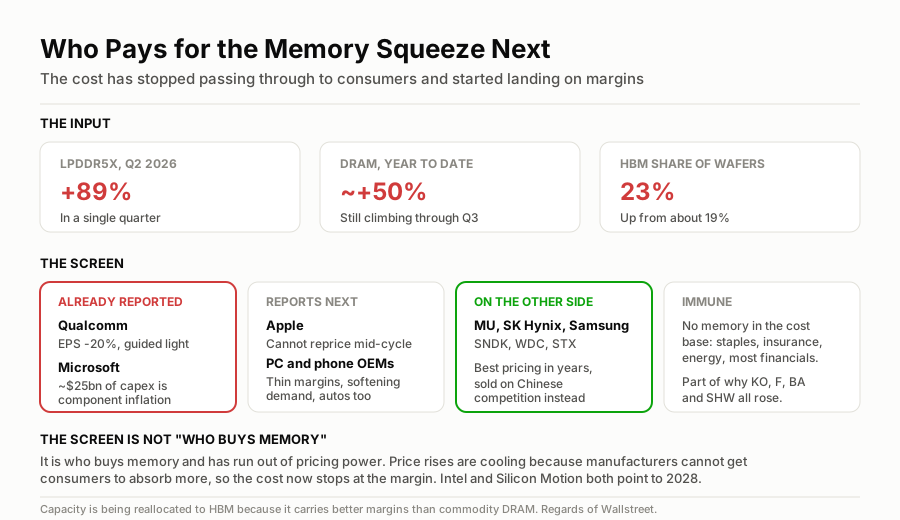
Every wafer diverted to HBM is a wafer not making the memory in a phone.
Tier One: Already On the Statements
These have confirmed it. No forecasting required.
Qualcomm. The cleanest case. Revenue came in near the high end of guidance and non-GAAP EPS still fell 20% to $2.21, then fiscal Q4 was guided light at $2.05 to $2.25. Management named wafer fabrication, memory, advanced packaging, assembly and test costs and said it is raising product prices in response. Full detail in the Qualcomm breakdown.
Microsoft. Different shape, same cause. Roughly $25 billion of calendar-2026 capital spending is attributable purely to higher component pricing. That is a quarter of the increase buying no additional capacity at all. See the Microsoft breakdown.
Cisco, added August 12. The most instructive of the three, because it had the lever the others lack and pulled it. 5 points of an 18% growth quarter came from price increases on memory-heavy gear, 4 to 5 more points are baked into fiscal 2027, and gross margin fell 210 basis points to 66.3% in spite of it. Memory is only 15-20% of its bill of materials. See the update at the top of this page.
The distinction matters. For Qualcomm this is a gross margin problem. For Microsoft it is a capex problem that becomes a depreciation problem later. For Cisco it is a timing problem: the price rise works, and it lands two quarters after the cost. Same input, three different places on the statements.
Tier Two: Reports Next, Has Not Said Yet
This is where the analysis is, because these companies have the same exposure and have not yet had to quantify it.
Apple is the largest single question. It buys memory at enormous scale for every device, and unlike Qualcomm it does not reprice hardware mid-cycle. A cost shock with no pricing lever lands in exactly one place: gross margin, guided at 47.5% to 48.5%. Apple reports Thursday, and the September-quarter margin guide is the number to watch rather than EPS. Our setup is in the Apple preview.
PC makers. TrendForce expects higher memory costs to feed into retail pricing and to weigh on PC shipments for the rest of the year. That is the worst combination available: cost up, volume down. PC OEMs run thin margins and have little room to absorb.
Smartphone vendors. Many are expected to raise handset prices to offset persistently high LPDRAM costs, while becoming more cautious on production plans as consumer demand softens. Raising prices into softening demand is how a cost problem becomes a volume problem.
Server and hardware assemblers. Anyone building boxes with memory in them. Note the counter-example though: Celestica grew revenue 62% and expanded margin to 8.2%, which is evidence that some assemblers have genuine pricing power or bought inventory ahead of the rise. Whether that holds is the thing to test, and we said so in the Celestica breakdown.
Gaming hardware has already been forced to raise prices partly on memory and storage costs; the pass-through is well past enterprise and into consumer shelves.
Autos, less obviously. Modern vehicles carry substantial memory, and auto contracts are long and hard to reprice mid-programme.
Tier Three: The Beneficiaries
Say the obvious half out loud, because a cost squeeze for buyers is revenue for sellers.
Micron, SK Hynix, Samsung, SanDisk, Western Digital and Seagate are on the receiving end of a 50% DRAM price increase. The memory complex has been sold hard on Chinese competition fears rather than on pricing weakness, which is a distinction worth holding. Our valuation work is in MU and SNDK after the selloff and the cycle framework in the memory supercycle thesis check.
The tension: they are simultaneously enjoying the best pricing in years and being repriced for a Chinese price war that has not arrived yet. Both facts are real.
Tier Four: Genuinely Immune
Useful to name, because in a market repricing input costs these become defensive by construction.
Companies with no memory in the cost base: consumer staples, insurance, most financials, energy, industrials making things without chips, healthcare services. That is a large part of why the rotation this week has favoured them. Coca-Cola hit a record, Ford and Boeing rose, and Sherwin-Williams gained 8% on a quarter with weak end demand. None of them buy DRAM.
The Detail Most People Are Missing
The pass-through has stalled, and that is bearish for margins rather than bullish for consumers.
Memory price increases are now cooling. The reason is not new supply. It is that consumer electronics manufacturers are unwilling and unable to absorb higher memory costs after months of increases, and consumers have hit an affordability limit. PC and smartphone makers have already raised prices across the board.
Follow the logic. If memory prices stay elevated and manufacturers can no longer raise end prices, the cost stops moving down the chain and stops at the manufacturer's margin. That is the transition happening right now, and it is why Qualcomm's guide was about profit rather than revenue.
So the screen is not "who buys memory." It is "who buys memory and has run out of pricing power." Apple has brand pricing power but a fixed product cycle. PC OEMs have neither. Qualcomm is raising prices and still guided EPS down, a measure of how far behind the pass-through is running.
How Long This Lasts
Longer than the market is modelling, on the operators' own testimony.
- Intel has pointed to 2028 before conditions normalise.
- Silicon Motion warns the squeeze across DRAM, NAND and HBM persists into 2028.
- SK Hynix has suggested the shortage may last past 2030.
- AI demand keeps DRAM and NAND prices climbing through Q3 2026 even as consumer price rises cool.
Those are sell-side-adjacent statements from companies with incentives, so discount them somewhat. But three independent participants pointing at 2028 is a signal, and it reframes this from a cyclical blip into a multi-year cost regime.
The Playbook
- Add "memory exposure" to your checklist for every hardware name this earnings season. Ask two questions: how much memory is in the cost base, and can they raise prices? The second matters more.
- Watch gross margin guidance, not EPS. EPS gets managed. Gross margin is where an input cost shows up first and hides worst.
- Beware the beat that comes with a soft margin guide. That combination has been punished repeatedly this month, most sharply when Vertiv beat on EPS and fell 13%.
- The memory makers are the other side of this trade, and they are cheap for a different reason. They are being sold on Chinese competition, not on pricing. If you think the squeeze runs to 2028, the sellers are mispriced and the buyers are not yet marked down enough.
- The counter-case, stated fairly: CXMT and Chinese capacity coming online in 2027 could break DRAM pricing hard, which would make every Tier Two name a buy and every Tier Three name a value trap. That is the genuine two-sided risk, and it is why we will not tell you the memory complex is a straightforward long.
The One-Line Read
DRAM is up about 50% this year and LPDDR5X rose 89% in a single quarter because HBM is eating 23% of wafer output, and the cost has now stopped passing through to consumers and started landing on margins: Qualcomm and Microsoft have already reported it, Apple, the PC makers and the handset vendors report it next, and the operators themselves are pointing at 2028 before it normalises.
Next up:MU reports Wed, Sep 30 after the close →
More on $MU
Updated Every Saturday
The Week Ahead
Every earnings date, Fed event and setup for the current trading week, on one page.
Refreshed Weekly
Earnings Calendar
Who reports next, when, and what consensus and the whisper expect.
The Week-Ahead Brief
Don’t miss next week’s setups. Get the Sunday brief.
Latest issue, Sep 7“Week ahead in the stock market...”
Every Sunday: next week’s earnings dates, Fed days and the trades worth watching, from the same desk that writes the week-ahead hub. Free, built for retail investors.