Why Is Huize Holding (HUIZ) Stock Up Today? A $15 Million Insurer Just Grew Profit 11-Fold
Huize Holding's H1 2026 profit rose 11-fold to RMB25.3 million on record RMB4.2 billion of premiums, yet the Nasdaq-listed Chinese insurer carries a market cap near $15 million.
TL;DR
- Huize Holding (NASDAQ: HUIZ) reported first-half 2026 results before Thursday's open: revenue of RMB719.8 million ($106.1 million), up 5.8% year over year, and net profit attributable to shareholders of RMB25.3 million, up roughly 11-fold from RMB2.3 million in the same half of 2025.
- Gross written premiums hit a record RMB4,196.4 million, up 29.8%, and first-year premiums, the forward-looking growth line, jumped 48.7% to RMB2,763.0 million.
- The stock had already run 20.66% higher on Wednesday, closing at $1.46 from a $1.21 prior close, ahead of the release. Thursday's premarket reaction to the results themselves had not settled into a reliable print by the time this piece went out: average daily volume in this name is close to nothing, so a handful of trades can move the quoted price by double digits in either direction.
- At Wednesday's close the whole company was worth about $14.75 million, against $106 million of revenue booked in six months. That gap, not the earnings beat, is the real story.
- No options market exists on HUIZ. There is no chain to trade this through; the only way to express a view is the stock itself, at whatever spread the market maker is quoting.
More on Earnings: Stock Market Week Ahead (Sep 21-25): Costco, AutoZone, KB Home and a 5% Ten-Year →
Why Is Huize Holding Stock Up Today?
Huize turned a business that has spent years bouncing between small profits and small losses into one growing a lot faster and keeping more of what it takes in. Revenue rose only modestly, 5.8%, but net profit jumped 11-fold year over year and the company's non-GAAP measure flipped from a RMB3.3 million loss to a RMB3.1 million profit. Premiums placed through the platform hit a record. For a stock that traded at $1.21 on Tuesday, that combination is enough to move the price hard even before anyone works out whether the improvement is durable.
What Huize Actually Reported
Huize is a Shenzhen-based online insurance marketplace, one of China's first licensed e-insurers, distributing life, health, critical-illness and property products from third-party carriers rather than underwriting the risk itself. The half-year numbers, from the company's GlobeNewswire release and confirmed by wire pickup, break down like this:
- Revenue: RMB719.8 million ($106.1 million), up 5.8% year over year.
- Gross written premiums (GWP): RMB4,196.4 million ($618.5 million), up 29.8%, an all-time high for the platform.
- First-year premiums (FYP): RMB2,763.0 million, up 48.7%, now 65.8% of total GWP. This is the line that predicts next year's renewal book, and it grew faster than everything else.
- Renewal premiums: RMB1,433.4 million, up 4.2%.
- Net profit attributable to shareholders: RMB25.3 million ($3.7 million), against RMB2.3 million in H1 2025.
- Non-GAAP net profit: RMB3.1 million, against a RMB3.3 million non-GAAP loss a year earlier.
- Expense-to-income ratio: 24.2%, improved 1.8 percentage points, which management credited to AI tools folded into underwriting and customer service.
- Cash and equivalents: RMB241.4 million ($35.6 million).
- 13.1 million cumulative clients served, up 789,000 new clients in the half.
Read the profit number in dollar terms and it stays modest: $3.7 million of net income for six months of work. This is not a blowout quarter by any absolute measure. It is a meaningful improvement for a company that has been running near breakeven, which is a different and smaller claim.
The Board
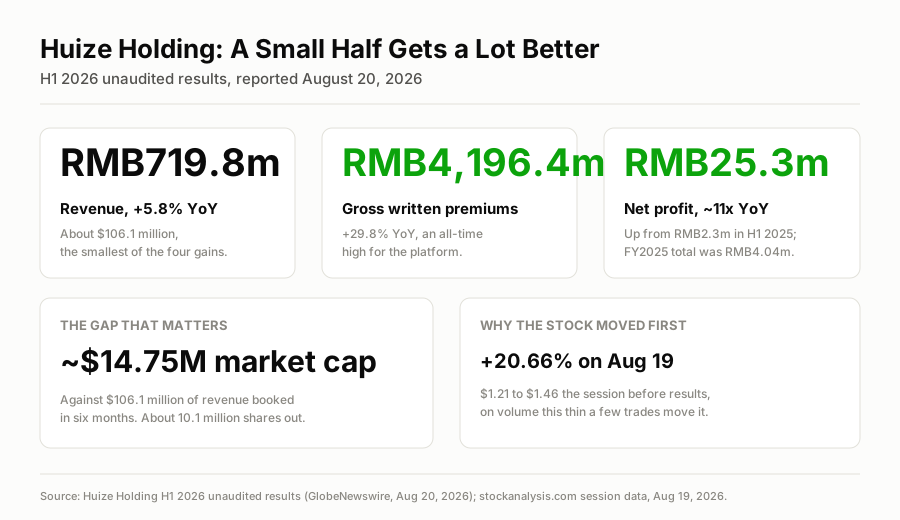
A company booking $106 million of half-year revenue, priced by the market at about $15 million.
The Turnaround, in Context
Huize's recent history explains why an 11-fold profit jump reads as news rather than noise. Full-year 2025 net profit was just RMB4.04 million on revenue of RMB1,582.2 million, itself a thin margin. Inside that year, the swings were sharp: a RMB8.6 million net loss in the first quarter of 2025, followed by a RMB10.9 million profit in the second quarter, a reversal from a RMB23.3 million loss in the same quarter of 2024. Add the two 2025 quarters together and the roughly RMB2.3 million first-half profit matches the comparison figure in Thursday's release, which is the kind of internal arithmetic check that either holds or the numbers are wrong. It holds.
So the pattern is a company that lost money, then earned a little, then lost a little, and has now posted a first half worth more than six times all of 2025's profit. One good half does not erase three years of choppy results, but it is the cleanest quarter this platform has produced since it went public.
Why a $106 Million Revenue Company Trades at $15 Million
Huize listed on Nasdaq in February 2020 at $10.50 a share and fell on its own debut day. It has been sliding, with rallies, ever since; Wednesday's $1.46 close sits about 86% below that IPO price. Three things explain the gap between the business and the stock price.
It is a China-based ADR built on a VIE. Huize operates its Chinese insurance license through a variable-interest-entity structure rather than direct foreign ownership, the same arrangement Alibaba, Baidu and most other Nasdaq-listed Chinese companies use. US investors own a claim on contracts, not a direct equity stake in the licensed business, and Beijing's regulatory stance toward the structure has shifted before without much warning.
It carries the whole sector's discount. Every Chinese ADR has traded at a lower multiple than a comparable US business since 2021, for reasons ranging from Holding Foreign Companies Accountable Act audit-inspection risk to capital-controls uncertainty to plain unfamiliarity. Huize's larger China peers reporting this same week carry that discount too, just from a much bigger base.
It is genuinely illiquid. A $14.75 million market cap and roughly 10.1 million shares outstanding means most days trade a few thousand shares. That thinness is exactly what let Wednesday's 20.66% move happen on ordinary-sized buying, and it is why this piece is not pinning an exact number on Thursday's premarket reaction: at this volume, the quoted price and the price a real order clears at can differ by a lot.
The Bear Case
- The absolute profit is still small. $3.7 million of net income does not change the fact that this is a marginal, low-margin brokerage business competing against larger platforms and the insurers' own direct channels.
- No analyst coverage exists to check management's framing. There is no sell-side model to compare the AI-efficiency story against, which means the market is pricing this on the press release alone.
- VIE and delisting risk sit permanently in the background. Nothing in Thursday's release changes that structural fact, and it is the reason the stock trades at a fraction of revenue rather than a normal insurance-broker multiple.
- Illiquidity cuts both ways. The same thin float that let the stock triple-digit-percent-move on light volume in past squeezes can also strand a position on the way down.
The Bull Case
- Growth is real and it is in the forward-looking line. FYP growing 48.7% while renewal premiums grew only 4.2% says new business is what is driving this, not just renewing an existing book.
- Margins are improving structurally. A 1.8-point cut in the expense-to-income ratio, attributed to AI tooling rather than one-time cost cuts, is the kind of change that compounds if it holds for another two quarters.
- The valuation gap is large enough to matter. A $15 million market cap against $106 million of half-year revenue and a swing to non-GAAP profitability is a multiple that would be unusual for a growing, profitable business anywhere outside the China-ADR discount bucket.
- 13.1 million cumulative clients is a real distribution asset in a market this company has operated in since 2006, longer than most of its listed competitors.
The Practical Constraint
There is no listed options chain on HUIZ. Checked against Nasdaq's own option-chain page, none exists. That rules out covered calls, hedges, or any structured way to express a smaller, defined-risk view here: the stock itself, at whatever the market maker is quoting on a given minute, is the only instrument available. Combined with the thin float, that makes this a name where position size has to be set by how much of the spread you are willing to give up, not by how much conviction you have.
The One-Line Read
Huize turned a choppy, marginal business meaningfully more profitable and grew its forward book at a record pace, but the stock still prices the whole company at roughly one-seventh of six months' revenue, so the market is charging for VIE risk, zero analyst coverage and near-zero liquidity more than it is questioning the earnings, and I would want to see a second clean quarter before trusting the reprice.
Next up:ISM Services PMI, tomorrow at 10:00am ET →
More on Earnings
Updated Every Saturday
The Week Ahead
Every earnings date, Fed event and setup for the current trading week, on one page.
Refreshed Weekly
Earnings Calendar
Who reports next, when, and what consensus and the whisper expect.
The Week-Ahead Brief
Don’t miss next week’s setups. Get the Sunday brief.
Latest issue, Sep 27“Micron, PCE and the jobs report that decides October”
Every Sunday: next week’s earnings dates, Fed days and the trades worth watching, from the same desk that writes the week-ahead hub. Free, built for retail investors.