Why Is Omeros (OMER) Stock Up? 73 of 175 Centers Have Ordered
Omeros jumped after YARTEMLEA net revenue rose 188% to $28.5 million in Q2. But $11.4M of the $13.2M net income is a derivative mark, and the CMS J-code only started July 1.
TL;DR
- Omeros traded at $17.81, up 29.9%, at 2:51pm ET Thursday, with the market still open, so this is a mid-session quote rather than a close. Results landed at 4:02pm ET Wednesday and the stock had already put on 20% in after-hours trade to $16.46.
- Net product revenue rose 188% to $28.5 million from $9.9 million in Q1. Every dollar is YARTEMLEA, the only drug approved for TA-TMA.
- $11.4 million of the $13.2 million of net income is a non-cash mark on the 2029 convertible notes. Adjusted net income was $1.8 million, or $0.02 a share, against a -$0.27 consensus.
- 73 of roughly 175 US transplant centres had ordered by June 30, up 143% in three months.
- The permanent CMS J-code took effect July 1 and an inpatient add-on payment of up to $287,000 per course starts October 1. Q2 contains neither.
More on Earnings: Stock Market Week Ahead (Sep 21-25): Costco, AutoZone, KB Home and a 5% Ten-Year →
Why Is Omeros Stock Up Today?
Omeros reported its first profitable quarter and YARTEMLEA sales nearly tripled in three months. Gross product revenue hit $32.2 million against $11.1 million in Q1, a 190% jump, and net revenue came in at $28.5 million after gross-to-net adjustments of 11.5% for chargebacks and distribution fees. The company also generated $4.1 million of positive operating cash flow.
Context for how unusual that is: the FDA approved narsoplimab on Christmas Eve last year, and per FiercePharma it was Omeros's first approval in the company's 31 years. Commercial distribution started January 2. TA-TMA is a frequently fatal complication of stem-cell transplantation, and YARTEMLEA is the first and only therapy indicated for it.
The Board
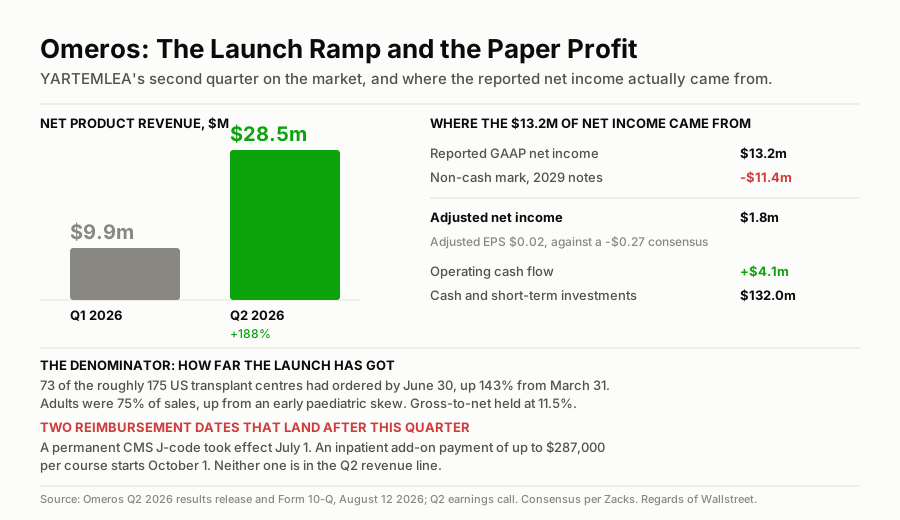
Two quarters of a launch, and a profit line that mostly is not the drug.
The Profit Is Mostly An Accounting Mark
Reported net income was $13.2 million, or $0.18 a share basic and $0.15 diluted. Inside it sits roughly $11.4 million of non-cash gains from revaluing an embedded derivative, which the 10-Q describes as the conversion and interest make-whole features on the 2029 notes. Back that out and adjusted net income is $1.8 million. 13.2 less 11.4 is 1.8, so the two figures do reconcile.
I would not lean on the $0.18. A derivative mark moves with Omeros's own share price, so a stock that rips higher mechanically produces a larger gain on that line, and it reverses just as easily. There was also a $1.9 million loss on the early repurchase of convertible notes in the period.
The operating picture underneath is cleaner than the headline suggests, though. R&D of $13.8 million and SG&A of $13.9 million total $27.7 million against $28.5 million of net revenue. Two quarters after a first launch, that is roughly breakeven on operations, which is not where most commercial-stage biotechs sit.
73 Accounts, 175 Centers
This is the number I would build a view on. Management put 73 unique accounts ordering as of June 30, a 143% increase since March 31, with the sales force working all 175 US transplant centres. So about 42% of the addressable centres have placed an order at all, let alone reordered.
Management declined to give patient counts, citing HIPAA, and said it tracks vial shipments into centres rather than usage. That is a real gap in what anyone can model. What it can say: adults are now 75% of sales, up from an early paediatric concentration, and adults are the larger pool.
Two Dates That Are Not In This Quarter
The $28.5 million was earned before either reimbursement tailwind arrived. A permanent J-code became effective July 1, which is what moves a buy-and-bill biologic from case-by-case wrangling to a billable code. Then a New Technology Add-on Payment of up to $287,000 per inpatient course starts October 1, which changes the economics for the hospital deciding whether to treat.
Neither is a guarantee of volume. Both remove friction that existed for all of Q2. Omeros gave no revenue guidance, and management reiterated a target of company-wide cash flow positivity by mid-2027.
Is OMER A Buy Here?
Not at $17.81. At $1.29 billion of market cap on 72.4 million shares, against Q2 net revenue annualised at $114 million, the stock trades near 11.3x a run-rate that is two quarters old. It is also sitting on a 52-week range of $3.94 to $18.14, so buyers today are paying within 2% of the high after a move of more than four times off the low.
The bull case has teeth. Sole approved therapy in the indication, 58% of centres still to convert, two reimbursement catalysts landing in the next two quarters, $132.0 million of cash and short-term investments, and a balance sheet getting simpler: the 2029 notes fell from $70.8 million at quarter-end to $54.8 million after July repurchases. The $240 million Novo Nordisk took off the table for zaltenibart in December, part of a deal worth up to $2.1 billion with milestones, paid for that optionality.
Against it: the profit that generated today's move is largely a mark, off-label eculizumab remains first-line for high-risk TA-TMA and ravulizumab has phase 3 data behind it, and Europe is still at re-examination. A launch trading at 11x sales has priced the J-code and the NTAP already. My preference is to see the October quarter, the first with both reimbursement changes running, and pay up for evidence of reorders rather than for a ramp off a small base. Healthcare weight is a big part of why the Russell 2000 hit a record this week, and small-cap biotech is where that bid is most crowded.
No options play logged. I could not source a live OMER chain this afternoon, and I am not writing a structure into a 30% intraday move on estimated pricing.
For the pattern of a reported number that flatters the business, see EnerSys, where $1.88 of a $3.66 quarter was not operating. For binary FDA outcomes, Replimune's 127% day and Capricor's deramiocel review, now heading past its August 22 date are the live examples on this site.
The One-Line Read
The drug is working and the launch is early: 42% of centres, before the J-code. The profit is an accounting mark. I would buy the first quarter that proves reorders, not the quarter that proves a code exists.
Next up:PCE inflation, Wednesday at 8:30am ET →
More on Earnings
Updated Every Saturday
The Week Ahead
Every earnings date, Fed event and setup for the current trading week, on one page.
Refreshed Weekly
Earnings Calendar
Who reports next, when, and what consensus and the whisper expect.
The Week-Ahead Brief
Don’t miss next week’s setups. Get the Sunday brief.
Latest issue, Sep 27“Micron, PCE and the jobs report that decides October”
Every Sunday: next week’s earnings dates, Fed days and the trades worth watching, from the same desk that writes the week-ahead hub. Free, built for retail investors.