Why Is Red Robin (RRGB) Stock Up? A $96 Million Sale the Guidance Ignores
Red Robin jumped 26% after Q2 revenue of $277.6m and deals to sell 116 restaurants for $96.0m gross, against a $186m market cap. The reaffirmed EBITDA guide excludes those deals.
TL;DR
- Red Robin (NASDAQ: RRGB) traded at $10.25 by early afternoon on August 13, up 25.6% from the $8.16 close, after reporting fiscal Q2 the previous evening. That is an intraday quote, not a close.
- Q2 revenue was $277.6 million, down $6.1 million year over year on closures. Net income was $0.4 million, or $0.02 per diluted share. Adjusted EBITDA fell 16% to $18.9 million.
- The move is about the balance sheet. Three refranchising deals cover 116 company-owned restaurants for $96.0 million of gross proceeds, against $167.2 million of debt and a market capitalisation near $186 million.
- Comparable restaurant revenue rose 1.3% on traffic of -0.2% and check of +1.5%. Restaurant-level margin was 14.7%, which the CEO called the best second-quarter margin in three years.
- The reaffirmed $70-73 million EBITDA guide does not include the sales. The company says so explicitly. So the guide describes a business roughly a third larger than the one that will exist by the fourth quarter.
More on Earnings: Stock Market Week Ahead (Sep 21-25): Costco, AutoZone, KB Home and a 5% Ten-Year →
Why Is Red Robin (RRGB) Stock Up Today?
Red Robin agreed to sell 116 of its restaurants for $96.0 million in gross proceeds, and it carries $167.2 million of debt. That ratio is the entire move. The operating quarter was fine and would not have produced a 26% day on its own.
The company reported after the close on August 12 for the 12 weeks ended July 12. Revenue of $277.6 million was down $6.1 million on the year, which management attributes to restaurants it has already closed. Net income was $0.4 million. On 18.727 million weighted average shares that is $0.02 per diluted share, and I would not build much on it either way.
One warning on the aggregators here. Several are running a $283.7 million revenue figure and a $0.26 EPS beat for this quarter. Neither matches the company's own release, so I have used the release throughout.
The Board
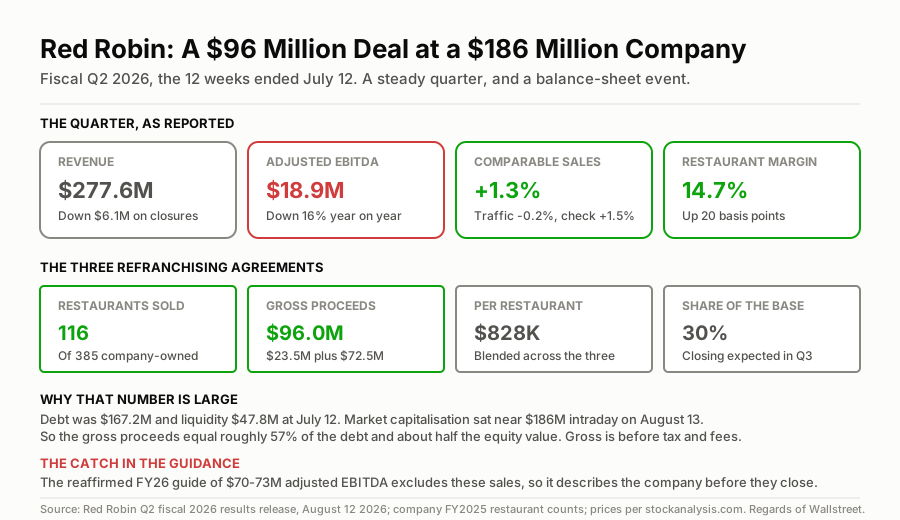
A $96 million deal at a company worth $186 million. That is why the burger chain moved 26%.
116 Restaurants Out of How Many?
Three hundred and eighty-five. That is the denominator, and almost nobody printed it.
Red Robin ended fiscal 2025 with 475 restaurants: 385 company-operated and 90 run by franchisees. The 116 units now under agreement are about 30% of the company-operated base. Close all three deals and the split flips toward franchising hard, to roughly 269 company-operated against 206 franchised.
The pricing is consistent across the three agreements, which is a decent sign nobody is dumping. 30 restaurants in Washington and Idaho went to Evergreen Dining for $23.5 million, or about $783,000 each. The other 86 went for $72.5 million, about $843,000 each. Blended, $96.0 million across 116 restaurants is roughly $828,000 per unit, and $23.5m plus $72.5m does come to $96.0m exactly.
Management expects all three to close in the third quarter, subject to customary conditions. They have not closed yet.
The Guide Describes a Company That Won't Exist
Here is the sentence in the release that matters most, and it is easy to skim past:
"This guidance does not contemplate any impacts from the announced refranchising transactions due to uncertainty with the timing of the completion of the transactions."
So the reaffirmed fiscal 2026 numbers, comparable revenue growth of 0.5% to 1.5%, restaurant-level operating profit around 13.0%, adjusted EBITDA of $70-73 million and capex of $25-30 million, all describe Red Robin with its 385 restaurants intact. If the deals close in Q3 as planned, they do not describe the fourth quarter.
That cuts both ways and I want to be careful about it. Selling 30% of your restaurants removes their revenue and their restaurant-level profit, and replaces it with a franchise royalty that is a fraction of the size. Adjusted EBITDA after the deals should be materially below $70-73 million. It also removes the capex those restaurants demanded and, if the proceeds go where management says, most of the interest bill.
What we do not have is the post-deal number. The company has promised updates on completion. Until then, anyone valuing this stock off a $70-73 million EBITDA guide and a shrinking debt load is double-counting the sale: taking the cash in and leaving the earnings in place.
What the Cash Actually Buys
Run the balance sheet as reported on July 12: $167.2 million of debt, $47.8 million of liquidity including $22.8 million of cash. Against that, $96.0 million gross is transformative arithmetic. Gross, though, is not net. Taxes, fees and any lease obligations travelling with the restaurants come out first, and the release does not quantify them.
At $10.25 the equity is worth about $186 million on 18.14 million shares, or nearer $194 million on the 18.888 million shares the release says are issued. Add the debt, take out the cash, and enterprise value lands near $330 million, about 4.6 times the midpoint of the current EBITDA guide. That multiple is only meaningful if you believe the guide, and the guide is the thing that is about to change.
The stock's 52-week range tells you what has already been repriced: $2.46 to $10.95. Today's print is roughly four times the low. This is not a stock the market has been ignoring for a month.
The Operations, Briefly
Traffic was -0.2%. Not growth, but the company says it beat the industry by 40 basis points, and the release claims "the strongest second quarter traffic and restaurant-level operating profit margins in three years". Average check rose 1.5%, which got comparable revenue to +1.3%.
Restaurant-level margin of 14.7% was up 20 basis points. Adjusted EBITDA of $18.9 million was down 16%, and that gap between improving margins and falling EBITDA is the closure programme working through the numbers.
The input side is helping at the margin. July producer prices for final demand foods fell 0.9% on the month, which is the line a burger chain feels before it feels anything else in that report.
My read: this is a slow operational stabilisation attached to a fast balance-sheet event, and the market priced the second one today. Compare it with Leslie's, which went the other way this morning on a going-concern warning: both are small-cap consumer names carrying more debt than equity, and the difference between them is whether an asset sale arrived in time. Small caps as a class are having a session of their own, which I have written up in the Russell 2000's record and what is actually driving it.
I am not logging an options play. RRGB's chains are thin, and after a 26% day the pricing I could find was not something I would publish an entry against.
The One-Line Read
Red Robin sold a third of its restaurants for half its market value, and the guidance it reaffirmed still counts them. The re-rating is real; the multiple everyone is quoting is stale.
Next up:PCE inflation, Wednesday at 8:30am ET →
More on Earnings
Updated Every Saturday
The Week Ahead
Every earnings date, Fed event and setup for the current trading week, on one page.
Refreshed Weekly
Earnings Calendar
Who reports next, when, and what consensus and the whisper expect.
The Week-Ahead Brief
Don’t miss next week’s setups. Get the Sunday brief.
Latest issue, Sep 20“The week after the hike: two housing reads and Costco earnings...”
Every Sunday: next week’s earnings dates, Fed days and the trades worth watching, from the same desk that writes the week-ahead hub. Free, built for retail investors.