Why Is Riot Platforms (RIOT) Stock Up Today? The Anthropic Deal, and the Fade
Riot Platforms jumped as much as 25% on a $9.1 billion, 20-year Anthropic data center lease, then closed Tuesday up just 4.33% at $20.24. What the fade means for RIOT stock.
TL;DR
- Riot Platforms (RIOT) signed a 20-year, 191-megawatt data center lease worth $9.1 billion with what Bloomberg reported, and Riot itself would only call "one of the world's leading frontier AI labs," to be Anthropic.
- The news broke after Monday's close, when RIOT had already fallen 5.46% to $19.40. Shares then surged more than 25% in after-hours trading, to $24.30, and were quoted as high as 20-25% above Monday's close in Tuesday's pre-market.
- By Tuesday's 4pm close, most of that gap had closed itself. RIOT finished the regular session at $20.24, up 4.33% on the day, a fraction of the overnight pop.
- The deal is real and it is large: two five-year extension options could push the total contract value to $16.1 billion, and it lands alongside an existing 50-megawatt AMD lease, taking Riot's contracted AI capacity to 241 megawatts and roughly $9.8 billion of long-term revenue.
- Riot also reported Q2 revenue of $174.2 million (up 14% year over year) and a $237.2 million net loss, most of it non-cash: a $75 million bitcoin mark-to-market hit, $98 million of depreciation, and a $28 million impairment tied to repurposing capacity for data centers.
More on AI & Semiconductors: Akamai's $11.6 Billion Anthropic Deal Pushes the AI Ledger Past $900B →
The Board
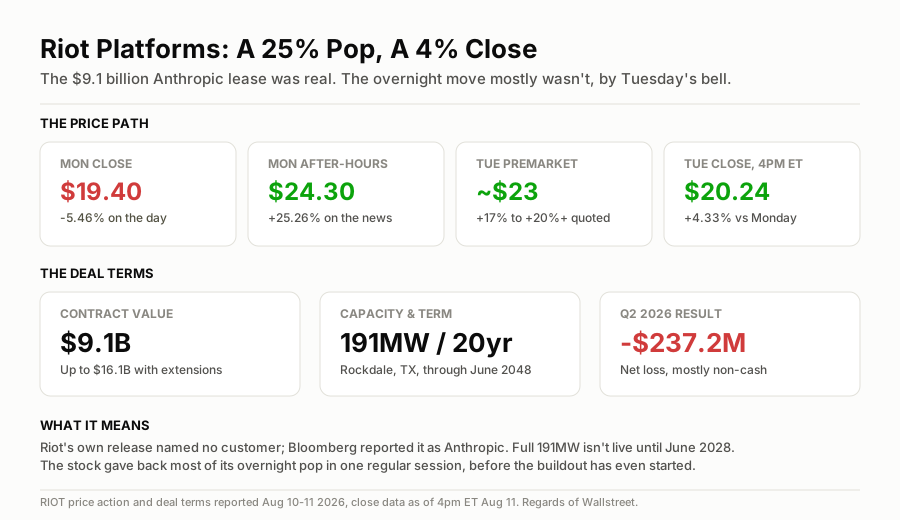
A 25% overnight pop. A 4% close. The deal didn't get smaller, the premium did.
Why Is Riot Platforms Stock Up Today?
Riot Platforms signed a 20-year, $9.1 billion data center lease for 191 megawatts of capacity at its Rockdale, Texas campus, and the market spent Tuesday deciding how much that news was actually worth.
Riot's own statement didn't name the customer, saying only that it had struck the deal with "one of the world's leading frontier AI labs." Bloomberg reported the counterparty is Anthropic, the AI lab behind Claude, and the rest of the financial press ran with that attribution. Nothing in Riot's public filings confirms it directly as of this writing.
The lease runs through June 2048. Capacity comes online in stages: 96 megawatts by December 2027, the full 191 megawatts by June 2028. Two five-year extension options could stretch the total value to $16.1 billion, according to reporting on the deal terms.
The Number That Actually Moved: From +25% to +4.33%
Most of the coverage Tuesday morning quoted the bigger number, so here is the whole sequence.
Monday, August 10: RIOT closed at $19.40, down 5.46% on a broadly weak day for risk assets, before the deal was disclosed after the bell.
Monday after-hours: shares jumped 25.26%, to $24.30, once the lease was announced.
Tuesday pre-market and early trading: RIOT was quoted anywhere from 9% to 20%+ above Monday's close, with multiple outlets flagging gains in the high teens during the premarket session.
Tuesday's close, 4:00pm ET: $20.24, up 4.33% from Monday. That's roughly a sixth of the after-hours pop, and it happened on a day the S&P and Nasdaq were both soft ahead of Wednesday's inflation data, per Tuesday's broader market coverage.
None of that makes the deal less real. It means the stock had already priced in a large chunk of the news by the time the opening bell rang, and the rest got sold into through the day, which is the normal life cycle of an overnight gap on a single-source report. If you only saw a premarket headline with "20%" or "25%" in it, you saw a snapshot, not the outcome.
The Business Underneath the Ticker
Riot Platforms started as a bitcoin miner. It is trying to become a data center landlord to the AI industry, and the numbers show a company mid-pivot rather than one that has already arrived.
Q2 2026 revenue was $174.2 million, up 14% year over year. Bitcoin mining still supplied the bulk of it at $113.7 million. Data center revenue was $23.2 million, up modestly from $21.6 million in Q1. Engineering revenue, tied to building out the leased capacity, was $37.3 million, more than triple the $10.6 million from a year earlier.
The net loss was $237.2 million. More than $240 million of that was non-cash: a $75 million mark-to-market loss on Riot's bitcoin holdings, $98 million of depreciation and amortization, and a $28 million impairment from repurposing Rockdale capacity toward data centers instead of mining. Strip those out and the operating picture looks considerably less alarming than the headline loss, but a loss that size still belongs in any read of the stock.
The Anthropic lease sits alongside an AMD data center deal, which grew to 50 megawatts this quarter, 25 of it already delivered on schedule. Combined, Riot says the two agreements represent 241 megawatts of contracted capacity and roughly $9.8 billion of long-term revenue, all signed within about six months. That's the bull case in one sentence: a bitcoin miner that already owns power and land is turning both into two decade-long leases with well-funded AI counterparties, one of them apparently a frontier lab burning cash to secure compute.
It's the same trade CoreWeave and Super Micro are running on the other side of the AI capex boom, and it's worth reading alongside our CoreWeave Q2 earnings breakdown and the SMCI-CoreWeave doubleheader verdict from the same week, since all three stocks are being repriced on the same underlying bet: that hyperscaler and AI-lab demand for power and floor space outruns the industry's ability to build it. Anthropic's willingness to lock in 20 years of capacity outside its usual cloud partners also lines up with how it has been buying compute elsewhere; our Alphabet Q2 review covers Anthropic's other big cloud commitment, with Google, from the same quarter.
Is RIOT a Buy?
I'd separate the deal from the stock's reaction to it, because they point in different directions.
The deal itself is good news, not manufactured hype. A 20-year lease with a well-capitalized AI lab converts a volatile bitcoin-mining business into something closer to an annuity, assuming the counterparty pays for two decades, which is a real assumption and not a formality. $9.1 billion of contracted revenue, potentially $16.1 billion with extensions, is a genuine re-rating catalyst for a company that carried an $8-9 billion market cap into the announcement.
The stock's first reaction overstated it. A 25% after-hours pop on a single-sourced, not-yet-company-confirmed customer name was always going to give some of that back once the broader market opened and traders could actually size the position. It did, closing up 4.33% instead. That's not a red flag on the deal; it's what happens when premarket enthusiasm meets a full trading session.
The risk that doesn't go away with a good lease: Riot is still posting nine-figure quarterly losses, still holds a large, volatile bitcoin position that swings the P&L independent of the data center story, and is still executing a multi-year buildout on a deal whose full 191-megawatt capacity doesn't arrive until June 2028. A lot has to go right, on schedule, for the $9.1 billion to show up as cash rather than as a press release.
If the pivot from miner to data center operator is the thesis, this deal is meaningful evidence for it. If the thesis is "buy the pop," Tuesday's chart already argued against that: the market gave back roughly 80% of the initial move in one session.
The Options Angle
I don't have a live, sourced options quote for RIOT at today's close, and I'm not going to invent one. What's known and scoreable is the setup, not a specific premium.
- RIOT is a name where implied volatility runs high even without a catalyst, being both bitcoin-linked and now AI-infrastructure-linked, two of the most volatility-hungry stories on the market at once. A deal announcement like this typically pushes near-term IV higher still, which makes buying premium into the news expensive by the time a retail trader can act on it.
- The Tuesday chart is itself the argument against chasing calls here: the stock already gave back most of its overnight move by lunchtime. Buying calls after a 20%+ premarket print, only to watch the stock settle up 4%, is a classic way to pay a volatility premium for a move that already happened.
- Pass on new premium (calls or puts) in the days immediately following this news. The information is public, the initial repricing has already happened and mostly reversed, and the next real catalyst is execution: the first 96 megawatts going live by December 2027, more than a year out. There's no clean, near-dated event to trade against right now.
- Anyone with an existing long position who wants to reduce cost basis without adding exposure could look at a covered call against shares they already hold, collecting premium against the elevated IV rather than paying it.
Trade log
| # | Stance | Structure | Strikes and expiry | Cost or credit | Spot at writing | Implied move | Breakeven |
|---|---|---|---|---|---|---|---|
| 1 | Pass | Long calls, any near-dated expiry | N/A | Elevated IV; no sourced quote | $20.24 (Aug 11 close) | Not sourced | N/A, no clean catalyst before Dec 2027 milestone |
The One-Line Read
Riot Platforms signed a real, large deal, a $9.1 billion, 20-year lease that could be worth $16.1 billion with extensions, and the stock's first reaction to it, a 25% after-hours pop, was bigger than the market ultimately agreed with, since RIOT closed Tuesday up just 4.33% once the whole session had a chance to price it.
Next up:PCE inflation, Wednesday at 8:30am ET →
More on AI & Semiconductors
Updated Every Saturday
The Week Ahead
Every earnings date, Fed event and setup for the current trading week, on one page.
Refreshed Weekly
Earnings Calendar
Who reports next, when, and what consensus and the whisper expect.
The Week-Ahead Brief
Don’t miss next week’s setups. Get the Sunday brief.
Latest issue, Sep 20“The week after the hike: two housing reads and Costco earnings...”
Every Sunday: next week’s earnings dates, Fed days and the trades worth watching, from the same desk that writes the week-ahead hub. Free, built for retail investors.