Why Is SanDisk (SNDK) Stock Down After Earnings? It Beat Its Own Guide and Fell Anyway
SanDisk beat on revenue, EPS and gross margin, then guided fiscal Q1 to $10.3-10.8 billion against $11.16 billion consensus. Why a record quarter got sold, and what it means for memory stocks.
Why Is SanDisk Stock Down After Earnings?
The quarter beat and the guide missed. SanDisk reported the best quarter in its history on Wednesday August 5, clearing the top of its own guidance on revenue, earnings and gross margin. Then it guided fiscal Q1 2027 revenue to $10.3-10.8 billion against a consensus near $11.16 billion, and the shares fell in extended trading.
That is the specific reason, and it is not the same as "the market sold a good print because it was crowded". Something concrete came in light: the forward number. The guide's midpoint sits about 5.5% below consensus, and the after-hours decline has run in roughly the same range, which is about as tidy as this ever gets.
Correction, and it is ours. An earlier version of this piece said "nothing in the numbers disappointed, the expectations did", written before the guidance was available. That was wrong, or at best half of it. The trailing quarter disappointed nobody; the forward quarter came in below the Street. The paragraphs below have been rewritten and the original claim is recorded here rather than deleted.
More on $SNDK: SanDisk Investor Day: The 80% Margin Is the Floor Case →
What SanDisk Actually Reported
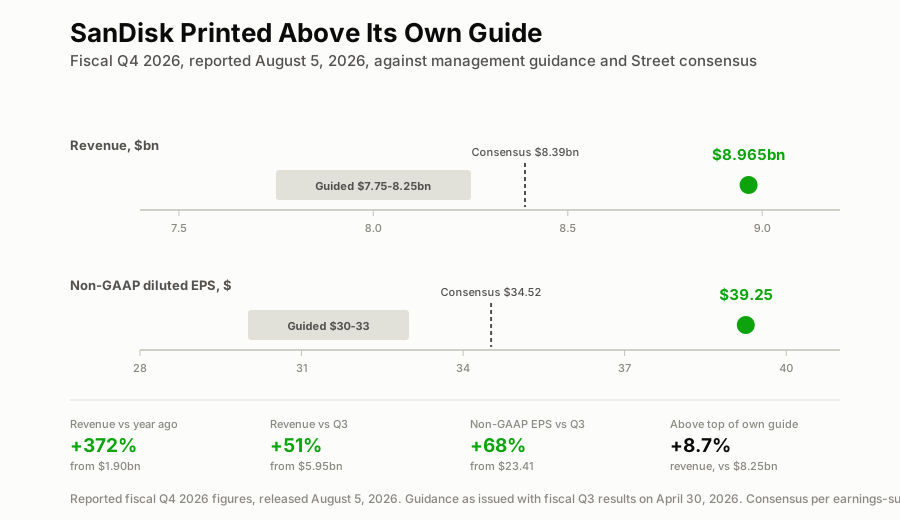
The grey bands are what management promised in April. The dashed lines are what the Street marked it up to. The green dots are what happened.
| Reported | Guided (April) | Consensus | |
|---|---|---|---|
| Revenue | $8.965bn | $7.75-8.25bn | $8.39bn |
| Non-GAAP EPS | $39.25 | $30-33 | $34.52 |
| Non-GAAP gross margin | 84.6% | 79-81% | n/a |
Revenue was up 372% on the $1.90 billion of the year-ago quarter and up 51% sequentially on Q3's $5.95 billion. Non-GAAP EPS of $39.25 compares with $0.29 a year ago and $23.41 in Q3. GAAP diluted EPS was higher still at $43.97, on GAAP net income of $6.90 billion, up 91% sequentially. Against the Street it was a 7% revenue beat and a 14% EPS beat. Against the company's own ceiling it was 8.7% better on revenue and 18.9% better on EPS.
The margin is the part that deserves more attention than it will get. Non-GAAP gross margin came in at 84.6%, against a guided 79-81% and 78.4% in Q3. A NAND business running a mid-eighties gross margin is a long way from the commodity cyclical this industry has always been, and it is the single most direct evidence that the shortage is being captured by the seller.
Note the order of events, because it is the most interesting thing in the release. Management guided to $7.75-8.25 billion in April. Analysts then marked consensus to $8.39 billion, which is above the company's own ceiling, on the theory that NAND pricing was running faster than the guide. The company then beat the marked-up number too.
It cleared every published version of the bar, not just the convenient one. Zacks had $8.3 billion and $34.24; the figure most widely quoted on the day was $8.39 billion and $34.52; Visible Alpha was the most aggressive at $8.71 billion and $35.45, already above the guidance ceiling. Revenue of $8.965 billion beat all three.
So Why Did It Fall?
Four things, in descending order of how much I think they matter.
1. The guide came in below consensus, and that is the actual answer.
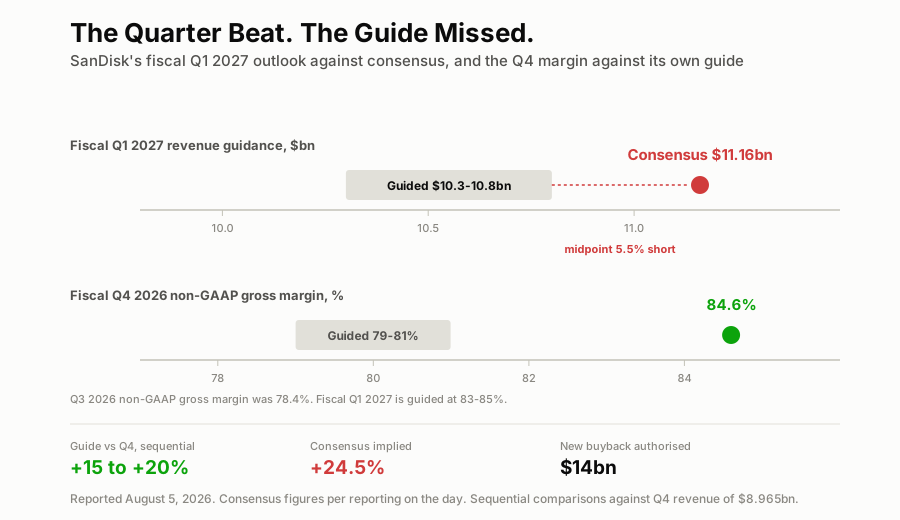
The grey bands are what the company said. The red dot is what the Street wanted. One row is a beat and the other is the reason the stock fell.
Fiscal Q1 2027 revenue is guided to $10.3-10.8 billion against consensus near $11.16 billion, with adjusted EPS of $44-46 against about $45.58 expected. Adjusted gross margin is guided at 83-85%.
Now hold two facts side by side, because the selloff sits in the gap between them. That guide is +15% to +20% sequential growth on top of a quarter that already grew 51%. And it is still a miss, because consensus had come to require +24.5% sequential. The bar was not "keep growing fast". The bar was "keep accelerating", and almost nothing can clear that for long.
2. The stock front-ran the print and then flinched. SNDK rose 6.0% on Monday August 3 to $1,288.03 and 10.84% on Tuesday August 4 to $1,427.62, roughly 25% in five sessions. Then Wednesday sold off ahead of the release, down about 3.2% at the open and closing at $1,350.50, off about 5.4% (one source puts the session at 5.50%). The last day before the numbers was already a distribution day.
3. The reaction function in this tape punishes crowded winners regardless. Options had priced an earnings move of anywhere between 12% and 25% depending on source and expiry, which is the market saying it had no idea which direction. Broadcom guided AI revenue up 200% and was sold anyway on a version of this mechanic.
4. SanDisk did this last quarter too. In April it beat Q3 consensus by roughly 60% on EPS ($23.41 against $14.62 expected) on revenue of $5.95 billion against a $4.72 billion forecast, then guided the following quarter miles above the Street. Sherwood News reported the shares fell about 6% after hours regardless. Twice in a row is a feature of the shareholder base, not an accident.
What is not on this list: any evidence of the shortage ending, or of margins cracking. The company simultaneously authorised an additional $14 billion of buyback, taking the remaining authorisation to about $15.5 billion, which is not the capital-allocation behaviour of a management team that thinks the cycle is turning next quarter. Which brings us to the part that actually matters.
What It Means for Memory Stocks
The read-through is real but narrower than the headline suggests. Reporting on the quarter puts the revenue increase at roughly two-thirds pricing and one-third higher volumes, so this is mostly, though not purely, a price story. (An earlier version of this piece called it "not a volume story" full stop. The split above is the more accurate version.) Industry data had NAND contract prices up 70-75% quarter over quarter, and a gross margin of 84.6% against a guided 79-81% is the income statement confirming that the seller, rather than the customer, is collecting it. For Micron, Kioxia, Western Digital and Seagate, all selling into the same tightness, that is the useful signal.
The size of the forecast error is the cycle tell. A company missing its own twelve-week-old ceiling by 8.7% to the upside is not usually a company at a cycle top. Tops forecast accurately, because prices have stopped moving. Mid-upcycles under-forecast, because each contract reset lands above the last. That is my interpretation rather than a reported fact, and it is the single reason I would not read tonight's share-price reaction as a verdict on the cycle.
But this is a NAND print, and the complex is four different balances. SanDisk has zero CXMT exposure, because China's new entrant attacks commodity DRAM, a different technology with a different supply outlook. Nothing reported tonight tells you anything about whether CXMT floods DRAM in 2027. Our standing thesis narrowed the memory call to HBM and NAND and cut the commodity-DRAM leg loose. Tonight supports that narrowing.
And it retires one bear argument. SNDK fell 47% in July, its worst month since the February 2025 spinoff, with more than $150 billion of market value erased, and contemporaneous reporting tied that to Korean regulators tightening single-stock leveraged ETF rules and forcing passive deleveraging rather than to anything in the business. The business has now reported above its own guide. July was a positioning event, not a fundamental one. That does not make the drawdown painless, and it does not mean it is over.
The Bear Case That Survives Tonight
Three things the print did not refute. A gross margin guided at 79-81% is an invitation, and the industry's historical answer to invitations is capacity. Hyperscaler order books can be digested rather than repeated, which is a demand-timing risk no supply analysis catches. And a stock that gave back roughly a tenth of its value across the two days containing its best-ever quarter is telling you something about who owns it, which is a real risk even when the fundamentals are clean.
Grading Our Own Trigger, Which Was Too Easy
This piece originally set a falsifiable test: a fiscal Q1 guide below about $9 billion would say the sequential pricing ramp is flattening. The guide came in at $10.3-10.8 billion. So by the test as written, the ramp is intact and the shortage extends, comfortably.
And that test was close to useless, which is worth saying out loud. A $9 billion bar was roughly flat sequential. It would only have tripped if the ramp had stopped dead. The market was working to a completely different number, $11.16 billion, and by that standard the same guide is a disappointment. I graded a pass on a guide the market graded a fail, because I set the bar where it could not teach me anything.
The test as it should have been written, for next time: the number that mattered was not the guide's absolute level but its position relative to consensus, and consensus was demanding acceleration off a quarter that had already grown 51%. The lesson carries directly into the August 13 Investor Day, where the fiscal 2027 framing gets set and where the same trap is waiting.
The Options Angle
- The magnitude was knowable, the direction was not, and that is exactly when I do not pick a side. With implied quoted from 12% to 25% and a stock that had run 25% into the print, the constructive stance before the release was to own the move or own nothing. That is logged as a pass in the preview hub and it is scored there.
- The confirmation structure is unchanged and still conditional. Two-month calls bought after the guide is public, if and only if the guide extends the shortage into fiscal 2027. The whole point of waiting is that the guide is the information, and tonight's price move is not.
- Buying tonight's after-hours dip is a different trade from buying the thesis, and it is the one I am passing on. Extended-hours prices in a name with a 12-25% implied move are not a reliable base, and this stock has repeatedly closed a long way from where it traded at 4:30pm.
- The trigger has now fired, sort of, and it is graded above. The guide cleared my $9 billion bar with room to spare and still missed the Street. The replacement test I will be scored on: fiscal Q1 revenue guided to accelerate again, or margins guided below 80%, at the August 13 Investor Day. Either would break the argument above, and both are checkable on the day.
Trade log
| # | Stance | Structure | Strikes and expiry | Cost or credit | Spot at writing | Implied move | Breakeven |
|---|---|---|---|---|---|---|---|
| 1 | Pass | Buying the extended-hours dip | Any, immediately post-print | Not taken | $1,350.50, Aug 5 regular close; extended-hours reports ran 4% to 5% below that, so roughly $1,283-1,296 | 12-25%, source-dependent | Unscored. Grades against the Aug 6 close, which does not exist yet |
| 2 | Conditional | Two-month confirmation calls | Oct expiry, struck on the Aug 6 open | Live chain not sourced at time of writing | To be struck Aug 6 | n/a, event has passed by entry | Scored from the Aug 6 opening price if the guide triggers it |
| 3 | Pass | Selling premium into the post-print collapse in implied | Aug or Sep expiry | Not taken | $1,350.50, Aug 5 close | n/a | Scored on the whole position if assigned |
Row 1 is the live call this piece is making and it is deliberately the boring one. Row 2 stays conditional until the guide is on paper. Row 3 is logged because "sell the vol crush" is the reflex trade after every print, and July's calibration lesson was that realised moves in memory kept beating implied, which is precisely when that reflex is most expensive.
The One-Line Read
SanDisk beat its own ceiling on revenue, earnings and margin, then guided the next quarter to 15-20% sequential growth and got sold for it anyway, because consensus had come to require 24.5%: the shortage is still the story, and the bar is now the risk.
Next up:PCE inflation, Wed, Sep 30 at 8:30am ET →
More on $SNDK
Updated Every Saturday
The Week Ahead
Every earnings date, Fed event and setup for the current trading week, on one page.
Refreshed Weekly
Earnings Calendar
Who reports next, when, and what consensus and the whisper expect.
The Week-Ahead Brief
Don’t miss next week’s setups. Get the Sunday brief.
Latest issue, Sep 7“Week ahead in the stock market...”
Every Sunday: next week’s earnings dates, Fed days and the trades worth watching, from the same desk that writes the week-ahead hub. Free, built for retail investors.