Why Is Micron (MU) Stock Down Today? Korea Gave Back a Third of Its Record Day Overnight
Micron fell about 3% premarket on August 3 2026 to roughly $801 after Seoul's KOSPI dropped 5.12% and SK Hynix fell 7.92%. The overnight catalyst, the Apple problem nobody has priced, and the trade.
TL;DR
- Micron traded about 3% lower premarket, near $801, against a Friday close of $823.03. That is a premarket snapshot taken before the open, not a session result.
- The catalyst is Seoul, not America. The KOSPI closed down 5.12%, off 338 points, at 6,257.45. Samsung fell 8.19% to ₩241,000 and SK Hynix fell 7.92% to ₩1,582,000.
- Read that as a give-back, not a crash. Friday the KOSPI gained 1,001.74 points. Today it handed back 338 of them, about a third of the biggest day in its history.
- The rest of the market is fine. Nasdaq futures were up 0.36% and S&P 500 futures up 0.50% while memory was red. This is one sector being repriced, again.
- The genuinely new information is not Korean. Apple said it is "evaluating all options" on memory suppliers, and CoreWeave is exploring put options to hedge against its own supply contracts. Two of the biggest buyers in the market are positioning for lower memory prices.
- MU sits 12.1% below its 20-day moving average of $911.69 and 17.0% below its 50-day of $964.85. The trade this week is not in Micron. It is in the name with a date on it, and that is below.
More on $MU: Mag 7 Slides, Memory Rips: The AI Trade Splits in Two →
Why Is Micron Stock Down Today?
South Korea took profits on the largest single-day gain in its stock market's history, and Micron is the closest American proxy for what Korean investors own.
Nothing happened to Micron. No downgrade, no guidance change, no company news. What happened is that SK Hynix and Samsung fell about 8% each in Seoul overnight, and every US memory name gaps in sympathy when they do. It has happened five times in three weeks.
Look at what the rest of the tape was doing. Index futures were green. If this were an AI-demand scare or a rates shock, futures would not be up half a percent while Micron is down three. It is a sector unwind with a Korean postcode.
The Board
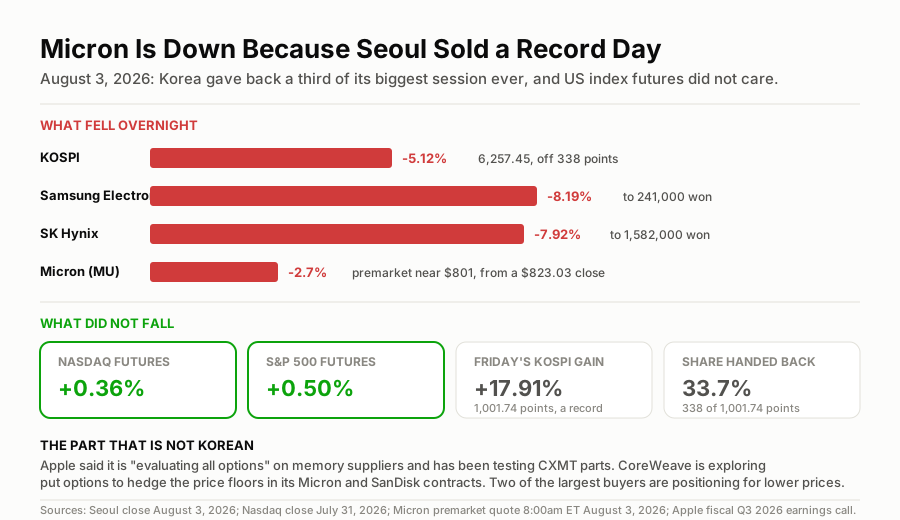
Four red bars and two green tiles. The gap between them is what marks this as a sector unwind.
What Actually Happened Overnight
Friday was the biggest day the KOSPI has ever had. It closed up 17.91% at 6,595.45, and we wrote up exactly why: SK Hynix locked limit-up at ₩1,718,000, Samsung went back above a $1 trillion market capitalisation, and foreign investors net bought more than ₩5 trillion before 10:06am.
Monday was the bill for it.
| Name | August 3 in Seoul | Level |
|---|---|---|
| KOSPI | -5.12%, off 338 points | 6,257.45 |
| Samsung Electronics | -8.19%, off ₩21,500 | ₩241,000 |
| SK Hynix | -7.92%, off ₩136,000 | ₩1,582,000 |
Do the arithmetic before you panic about it. The index gained 1,001.74 points on Friday and gave back 338, which is 33.7% of the move. SK Hynix gained ₩396,000 on Friday and gave back ₩136,000, which is 34.3%. Two different instruments retraced the same third of the same day. That is orderly profit-taking with a mechanical feel, not a fresh piece of bad news hitting the tape.
Samsung is still comfortably above where it started Friday morning. So is the index.
The Reuters Headline Doing the Rounds, and What It Actually Says
There is a second story circulating this morning, and it is being quoted far more aggressively than it deserves. Reuters reported today that CXMT is considering a second memory plant in Beijing and is in talks over funding it. That has been passed around as proof that Chinese capacity is what is dumping the sector.
Read the actual report before you price it.
- It is a second plant in Beijing, in the Yizhuang district, where CXMT already operates a fab of roughly 100,000 wafers per month. It is not CXMT's second fab.
- It is under consideration, not committed. Reuters says the talks are at an early stage and that the size and structure of any package could change.
- Its capacity, cost and timeline are all unknown, and Reuters says so explicitly.
- It is not included in the 600,000 wafers per month figure everyone is quoting. That number comes from the Shanghai and Hefei fabs, which were already reported and already in the price.
- The only money in the story is at least ¥60 million, about $8.9 million, sought from the development zone's governing body.
That last number is the one that settles it. A 12-inch DRAM fab costs billions of dollars. $8.9 million is roughly one tenth of one percent of the $8.55 billion CXMT just raised at IPO. It is a local-government anchor package at the opening of a negotiation, not a funded factory. Treating it as new capacity is exactly the numerator-without-a-denominator error that makes these headlines tradeable in the wrong direction.
The underlying trend is real and we are not dismissing it: CXMT's committed Shanghai and Hefei build-out genuinely does more than double its capacity toward 600,000 wafers per month, and independent research has it finishing 2026 near 350,000 wafer starts per month against Micron's roughly 385,000. That build-out is the real competitive threat to Micron, and it was just as much of a threat last week, which is why we wrote the CXMT explainer when the IPO first broke the sector.
But this morning's report is not evidence of it. And the tape agrees: if a Chinese DRAM-capacity headline benchmarked explicitly against Micron were driving this session, Micron should be the worst-hit name on the board. It is the least-hit, down about 3% while SK Hynix fell 7.92% and Samsung 8.19%. Samsung, which has foundry, phones and displays diluting its memory exposure, fell more than the near-pure-play memory name. That is the signature of a positioning unwind, not a fundamental repricing.
The Part That Is Not Korea: Apple Went Shopping
Here is the thing that did not happen overnight and matters far more than the overnight.
On July 30, on his final earnings call as chief executive, Tim Cook described memory pricing as a "hundred-year flood" and said Apple expects to pay even more for memory in September. Then he said the sentence the memory complex should be reading twice. Asked about the DRAM market being controlled by three suppliers, Cook said more suppliers would help on the supply side and that "we're evaluating all options."
Apple has reportedly been testing CXMT DRAM for devices sold in China, while lobbying Washington for clearance to use those parts more broadly. CXMT is the Chinese DRAM maker that debuted in Shanghai up 466% on an $8.55 billion IPO, and it is now roughly the fourth-largest DRAM producer on earth. We wrote the standalone explainer on what CXMT actually is when it first broke the sector.
Put those together. The single largest non-cloud buyer of memory in the world has publicly confirmed it is shopping for a fourth supplier, and the fourth supplier just raised $8.55 billion. That is a different argument from anything Korea did last night, and it does not go away when Seoul stops selling.
The counterweight, which Cook also supplied: more suppliers would not necessarily let Apple reverse its price increases.
And a precision point we have been getting slightly wrong on this site, so we are fixing it here. The house line has been that CXMT cannot make high-bandwidth memory. That is too strong. CXMT has HBM3 samples out, reportedly with Huawei for AI accelerator evaluation, and is targeting mass production. What is true is the gap, and the gap is what protects the margin pool: CXMT runs fewer than 2% of its roughly 265,000 monthly wafer starts on HBM, about 5,000 wafers, at low yield, and sits three to four years behind while Samsung and SK Hynix race toward HBM4 at 16-layer stacking. Export controls bite at the tooling layer rather than forbidding production outright, which is precisely why that gap is measured in years and not quarters.
"Three to four years behind at 2% of its own capacity" is a more useful sentence than "cannot," and unlike "cannot," it is still true.
CoreWeave Is Buying Insurance Against Its Own Suppliers
The second demand-side signal is stranger and, if you hold memory, more uncomfortable.
CoreWeave has been exploring financial derivatives, including put options, to hedge against a fall in memory and storage chip prices. CoreWeave signed long-term supply deals with Micron and SanDisk to lock in scarce memory. Many of those contracts carry price floors, which protect the supplier and leave CoreWeave paying above market if prices fall.
Read what that means. A major AI cloud buyer has signed the contracts the bulls point to as proof of the supercycle, and is now looking at how to profit if the prices in those contracts turn out to be too high. The buyer is hedging the seller's thesis.
That proves nothing about where prices go. It proves somebody with better supply-chain visibility than you thinks the risk is worth paying for.
The Fed Is the Quiet One
One more overhang, and it is the reason Friday's US session was ugly even while Korea was setting records.
On July 29 the FOMC held the funds rate at 3.5% to 3.75% on a 9-3 vote, with Lorie Logan, Beth Hammack and Neel Kashkari dissenting in favour of a quarter-point hike. Late last week the three of them elaborated on why they wanted to move. Micron fell 5.9% on Friday to close at $823.03, finishing the week down 10.6%.
A rate hike is a multiple story rather than a memory one, and it lands hardest on the highest-multiple cyclical on the board. Micron is up 227% year to date. That is the part of the position rates can take back.
What Did Not Change
Everything above is about the multiple. None of it is about the earnings, and the earnings are still going the other way.
- DRAM contract prices are projected up 13% to 18% quarter over quarter in Q3 2026, with NAND up 10% to 15%. Prices are still rising, just less violently.
- UBS lifted its DDR contract pricing forecast to +32% quarter over quarter for Q3, up from +17%, and its Q4 forecast to +18% from +12%. That is a forecast going up in the middle of a 26% drawdown.
- Samsung told the market on July 30 that it expects the shortage to deepen and extend well into 2028, alongside a quarter with revenue up 130%.
- Micron reports on September 22, with consensus at $31.24 of earnings per share against $3.03 a year ago, on revenue of $50.72 billion against $11.31 billion. Consensus is a Buy with an average target of $1,548.86.
The gap between a stock down 26% from its high and a revenue line up more than fourfold is the entire argument in this sector. We laid out the structural version in the memory supercycle thesis check, and the levels version in whether the memory dump continues or bounces.
The Options Angle
Micron has no dated catalyst until September 22. Everything between now and then is Korean beta with a Fed overlay, which makes MU a poor vehicle for an options position right now: you are paying for volatility in a name whose next real information event is seven weeks out.
The date this week belongs to somebody else. SanDisk reports fiscal Q4 and full-year results on Wednesday, August 5, at 1:30pm PT (4:30pm ET), with an Investor Day following on August 13. SNDK closed Friday at $1,214.83.
Anchor the bar on the company's own numbers rather than the street's, because the two do not agree. SanDisk guided fiscal Q4 revenue to $7.75 billion to $8.25 billion and adjusted earnings per share to $30 to $33. Published consensus sits at the top of that range or slightly above it, around $33 to $35 on roughly $8.2 billion to $8.4 billion, against 29 cents and $1.90 billion a year ago. Read what that means: the street is already modelling a beat of the guide, so the bar Wednesday is the whisper, not the guidance. That is exactly the setup that sold Broadcom after a 200% AI guide and sold Netflix after an EPS beat.
Now the calibration point, because the house got this wrong in July and the rule is that we say so. Through July, realised moves in this complex ran far above implied: SanDisk +26.29% in a single session on July 30, Micron +16% intraday the same day, then -5.9% on Friday. Our reflex of "implied volatility looks expensive, do not buy it" cost readers the SanDisk rally outright. A wide expected move is not on its own a reason to avoid buying volatility in a sector that has been printing 6% to 26% daily.
So the conclusion is uncomfortable. Into a print like this, in a tape like this, be a buyer of the move rather than a seller of it, and let the size do the risk management.
Trade log
| # | Stance | Structure | Strikes and expiry | Cost or credit | Spot at writing | Implied move | Breakeven |
|---|---|---|---|---|---|---|---|
| 1 | Pass | Long MU puts on the gap | Aug 7 weekly, at the money | Live chain not sourced at time of writing. MU August implied volatility was last quoted near 102% | $801, premarket 8:00am ET, Aug 3 | Not sourced | Needs a third straight down day beyond what is already gapped in |
| 2 | Pass | Selling MU premium (covered call or cash-secured put) | Any August expiry | Live chain not sourced | $801, premarket 8:00am ET, Aug 3 | Not sourced | Fails on any repeat of a 16% or 26% session |
| 3 | Pass at 25%, take under 18% | SNDK long strangle into the Aug 5 print | Aug 7 weekly, first strikes either side of spot | Chain not directly sourced. Check your own broker and let the number decide | $1,214.83, close Jul 31 | Reported at 17.5% (Benzinga) and ~25% (TipRanks). Unresolved | Needs SNDK to move more than the implied you actually pay |
| 4 | Long, delayed | SNDK confirmation calls, bought Thursday morning | Two months out, after the guide is public | Pay up a few percent to remove the coin flip | $1,214.83, close Jul 31 | n/a, the event has passed by entry | Scored from Thursday's opening price, not Friday's close |
Row 1 and row 2 are passes and get scored as passes. If Micron drops another 8% this week, row 1 is a losing call and it will appear in the next scorecard.
Row 3 is the one to read carefully, because the implied move is genuinely contested. Benzinga's early-August volatility screen headlines SanDisk at up to 17.5%. TipRanks has published twice saying options price roughly 25%. We could not resolve those against a live chain, so the rule is the trade: under 18% it is worth owning, at 25% it is not, because 25% prices the single largest day this complex has produced all year and asks you to beat it. Against that, SNDK has exceeded its implied move in four of its last five reports, which is the strongest argument for the low-end read.
Row 4 is the play we would actually put size behind, and it is deliberately late. Buying two-month calls on Thursday morning, after the guide is public, costs a few percent more and removes the direction coin-flip entirely. Post-earnings drift in names with confirmed pricing power has run bullish all season once the whisper flush clears.
Sizing, because this is the part that actually matters: one SNDK contract is roughly $121,000 of notional at Friday's close. Fractional options do not exist. For most retail accounts that removes cash-secured puts and covered calls from the menu entirely and makes a strangle a meaningful chunk of an account, not a nibble.
The One-Line Read
Micron is down this morning because Korea sold a record day and America owns the same trade, but the thing worth watching is not the KOSPI print: it is that Apple and CoreWeave, two of the largest buyers of memory on earth, spent last week publicly preparing for lower prices, and the sector has not finished arguing about what that is worth.
Next up:MU reports Wed, Sep 30 after the close →
More on $MU
Updated Every Saturday
The Week Ahead
Every earnings date, Fed event and setup for the current trading week, on one page.
Refreshed Weekly
Earnings Calendar
Who reports next, when, and what consensus and the whisper expect.
The Week-Ahead Brief
Don’t miss next week’s setups. Get the Sunday brief.
Latest issue, Sep 7“Week ahead in the stock market...”
Every Sunday: next week’s earnings dates, Fed days and the trades worth watching, from the same desk that writes the week-ahead hub. Free, built for retail investors.