Coinbase Q2 2026 Breakdown: Record Market Share, an 18.5% Revenue Decline, and a Circle Contract That Renews in Weeks
Coinbase posted revenue of $1.22bn, down 18.5%, with adjusted EBITDA of $207.8m against $301.7m expected. Shares fell 5%. Market share hit a record 10.3%. The Circle risk nobody is pricing.
TL;DR
- Revenue of $1.22 billion, down 18.5% year over year, against a consensus near $1.29 billion. Transaction revenue was $599 million against $628 million expected.
- The profit lines were worse than the revenue line. GAAP EPS of -$1.36 against -$0.42 expected, and adjusted EBITDA of $207.8 million against $301.7 million, a 31% miss.
- And yet Coinbase is winning. Crypto trading volume market share hit a record 10.3%, a third consecutive quarter of gains, and 88% of net revenue now comes from non-Bitcoin spot trading.
- Prediction markets contracts and revenue grew 106% quarter over quarter, which is the second time this week a retail broker has shown that line as its fastest-growing business.
- Shares fell about 5% after hours, into a stock already near 52-week lows. The thing to actually worry about is not this quarter: it is the Circle commercial agreement for USDC income, which renews in August.
More on Earnings: Options Scorecard: The Week of August 17, Graded (25 Calls, 72% Right) →
What Coinbase Actually Reported
| Line | Q2 2026 | Expected |
|---|---|---|
| Revenue | $1.22B, down 18.5% | ~$1.29B |
| Transaction revenue | $599M | $628M |
| GAAP EPS | -$1.36 | -$0.42 |
| Adjusted EBITDA | $207.8M | $301.7M, a 31% miss |
| Trading volume market share | 10.3%, a record | third straight quarterly gain |
| Average USDC held | $20B, an all-time high | over 30% of USDC in circulation |
| Prediction markets | +106% quarter over quarter |
Subscription and services, the segment that is supposed to provide stability, also came in short of the roughly $601 million analysts modelled inside management's $565 to $645 million guided range.
The Board
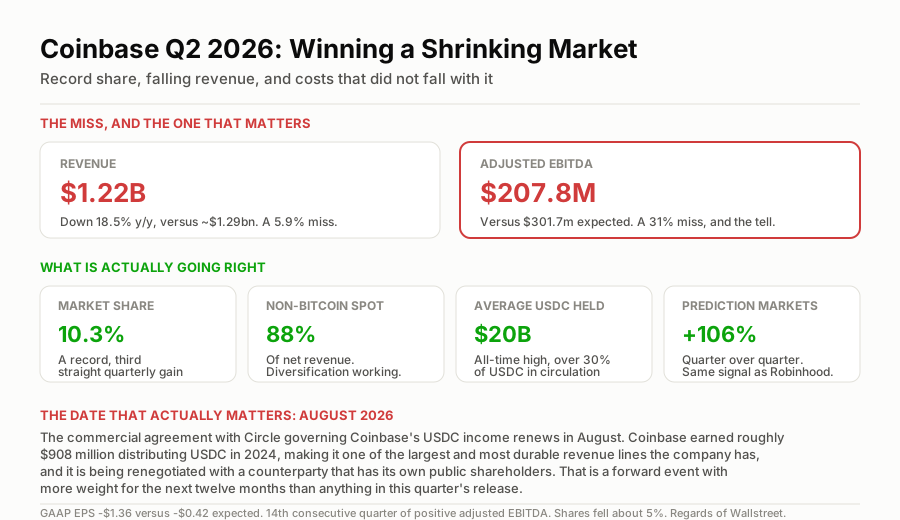
Winning share of a shrinking market, with costs that did not shrink with it.
The Miss That Matters Is the EBITDA One
Revenue missed by about 5.9%. Adjusted EBITDA missed by 31%. That gap is the whole report.
A revenue shortfall in a crypto exchange during a quiet quarter is not news. Volumes fall, take rates compress, and revenue follows. Everyone models that. What the EBITDA miss tells you is that costs did not fall with revenue, and a business whose costs are fixed while its revenue is cyclical has an operating leverage problem that works violently in both directions.
Put concretely: revenue fell 18.5%, and profitability fell far more than proportionally. That is the definition of negative operating leverage, and it is the same disease we identified at Meta this week, just with a much smaller company and a much more cyclical top line.
The mitigating fact, and it is real: this was still the 14th consecutive quarter of positive adjusted EBITDA. Coinbase has been profitable on that measure through an entire cycle, which the 2022-era version of this company could not claim.
The Bull Case Is Genuinely Good, and It Is About Share
Read past the headline and there is a real story here.
Market share hit a record 10.3%, the third consecutive quarter of gains, and it did so while the market shrank. Taking share in a falling market is harder and more valuable than taking share in a rising one, because you are winning customers at the moment competitors are cutting costs and pulling back.
88% of net revenue now comes from non-Bitcoin spot trading. That is the diversification thesis working. Coinbase spent years as a leveraged bet on Bitcoin's price; it is now substantially a bet on crypto market structure, derivatives and services.
Average USDC held on Coinbase reached an all-time high of $20 billion, more than 30% of all USDC in circulation. That is a genuine franchise, and it is the highest-quality revenue Coinbase has: interest income on stablecoin balances is recurring, does not require anyone to trade, and grows with adoption rather than with speculation.
Which brings us to the problem.
The Circle Renewal Puts $908 Million a Year in Play
The commercial agreement with Circle that governs Coinbase's USDC income is scheduled for renewal in August 2026. That is weeks away.
Understand the scale of what is being renegotiated. Coinbase earned roughly $908 million distributing USDC in 2024. That is not a side business, it is one of the largest and most profitable revenue lines the company has, and it is the exact line investors have been told to value most highly because it is recurring rather than transactional.
Now hold that next to the quarter you just read. Transaction revenue is falling. Subscription and services missed. The stock sits near 52-week lows. And the single most durable revenue stream is up for renewal in a negotiation where Circle, a now-public company with its own shareholders, has every incentive to keep more of the economics.
Nobody is pricing this properly. The market spent today's after-hours session reacting to a quarter that is already history. The August renewal is a forward event with the capacity to reset a substantial share of Coinbase's most valuable revenue, in either direction. A favourable renewal is a re-rating. An unfavourable one changes the investment case.
That is the date to have in your calendar, not the next earnings print.
The Cross-Read: Two Brokers, Same Two Signals
This is the part you only see if you read both reports this week, and it is worth more than either on its own.
Coinbase: prediction markets contracts and revenue grew 106% quarter over quarter.
Robinhood, reporting the day before: crypto revenue fell 38% to $100 million, while prediction markets grew more than 10x to $156 million. Detail in the Robinhood breakdown.
Two different companies, two different business models, the same two signals in the same quarter: crypto trading revenue down, prediction markets up sharply. When two independent operators report the identical pattern, it is a trend rather than a company-specific quirk.
The read is that retail speculative appetite has not disappeared, it has migrated. The same customer who was trading tokens is now trading event contracts, and both platforms are following the money. If you have not looked at how those contracts work, we wrote the full explainer on prediction markets, including the tax treatment and the CFTC rulemaking that could reshape the whole category.
For Coinbase specifically this is a partial hedge. Prediction markets grow when crypto volumes are quiet, which is exactly when Coinbase needs them. It is nowhere near large enough yet to offset an 18.5% revenue decline, but the direction is right.
The Bull Case and the Bear Case
Bull case. Record 10.3% market share taken in a down market, 88% of revenue diversified away from Bitcoin spot, a $20 billion USDC franchise at an all-time high, prediction markets compounding at 106% a quarter, and 14 straight quarters of positive adjusted EBITDA through a full cycle. The stock is near 52-week lows, which means a great deal of the cyclical bad news is in the price. If crypto volumes normalise at all, the operating leverage that hurt this quarter works in reverse.
Bear case. Revenue fell 18.5% and EBITDA fell far more, so the cost base is not built for a quiet market. Every stabilising segment disappointed, including subscription and services. And the most durable revenue line is subject to a contract renewal in August that the company does not unilaterally control. A cyclical business with a fixed cost base and a renegotiation risk on its best revenue stream is not a stock to size aggressively into a crypto downturn.
Our read: a hold, and a genuinely interesting one for anyone with a multi-year horizon and patience for the cycle. The share gains are real and they compound: exchanges that take share in bad markets keep it in good ones. But we would not add before the Circle renewal is settled, because that single event carries more weight for the next twelve months of revenue than anything in this release did. Watch the announcement, then decide.
The Options Angle
- Implied volatility deflates after the print, so buying calls on a recovery now means paying event premium for news already in the tape.
- The August Circle renewal is an unscheduled binary that is not cleanly tradeable. That argues strongly against selling naked premium across it: you would be collecting a few dollars against an event with no announced date and a wide outcome range.
- Cash-secured puts below the current level are the reasonable structure if you want to own it cheaper, but size them knowing you may be assigned right before a renewal headline.
- For holders, a covered call harvests still-elevated volatility, and given we would not add ahead of the renewal, capping some upside for income is a coherent expression of that same caution.
The One-Line Read
Coinbase took record market share of 10.3% in a shrinking market and grew prediction markets 106% while revenue fell 18.5% and adjusted EBITDA missed by 31%, which is a company executing well against a cycle it cannot control: the quarter is already priced, and the event that actually decides the next year is the Circle agreement renewing in August, on a USDC business that generated roughly $908 million in 2024.
Next up:Fed decision, tomorrow →
More on Earnings
Updated Every Saturday
The Week Ahead
Every earnings date, Fed event and setup for the current trading week, on one page.
Refreshed Weekly
Earnings Calendar
Who reports next, when, and what consensus and the whisper expect.
The Week-Ahead Brief
Don’t miss next week’s setups. Get the Sunday brief.
Latest issue, Sep 7“Week ahead in the stock market...”
Every Sunday: next week’s earnings dates, Fed days and the trades worth watching, from the same desk that writes the week-ahead hub. Free, built for retail investors.