Why Is Tenon Medical (TNON) Stock Down 38% After a Patent Sent It Up 109%?
Tenon Medical jumped 109% to $11.41 on a USPTO patent allowance, then gave back 38% the next session to close at $7.07, on a stock that just did a 1-for-35 reverse split to avoid delisting.
TL;DR
- Tenon Medical (NASDAQ: TNON) closed at $11.41 on Wednesday, August 19, up 109.4% from Tuesday's $5.45, after the USPTO issued a notice of allowance on a patent covering its sacroiliac joint implant.
- The stock gave almost all of it back the next session: Thursday, August 20 it closed at $7.07, down 38.0% from Wednesday's close, after touching an intraday high near $8.19.
- This is a $4.7 million company. It just completed a 1-for-35 reverse stock split, effective August 10, to get its share price back above Nasdaq's $1.00 minimum bid price before an August 24 compliance deadline.
- Underneath the swings, the business is genuinely improving: Q2 2026 revenue was $1.3 million, up 127% year over year, with gross margin up 21 points to 64%. It is also burning cash fast, with $1.7 million left as of June 30.
- No listed options chain exists on TNON. The only way to take a position is the stock itself, into a name that moved 109% one day and gave back 38% the next.
More on Single Stocks: Options Scorecard: A Reddit Put and a Nutanix Pass, Both Right at Expiry →
Why Is Tenon Medical Stock Down Today?
Tenon Medical's stock fell 38.0% on Thursday, closing at $7.07 after closing at $11.41 the day before. The move down is not really about Thursday. It is the second half of a round trip that started Wednesday, when the U.S. Patent and Trademark Office issued a notice of allowance on a patent titled "Systems, Apparatus and Methods for Stabilizing Sacroiliac Joints," and shares more than doubled on light volume in a stock with only about 667,000 shares outstanding. Thursday's session gave most of that back.
The Two Sessions, Reconciled
Snapshot prices for a stock this thin get reported at wildly different points during the same session, so here are the two closes that actually settled, both cross-checked against multiple sources:
- Tuesday, August 18 close: $5.45.
- Wednesday, August 19 close: $11.41, up 109.4%, after touching an intraday high some outlets put as high as $13.85 and others closer to $11.68 at different points in the session. Those are premarket and midday snapshots, not the close, which is why the TL;DR and this piece use $11.41.
- Thursday, August 20 close: $7.07, down 38.0% from Wednesday, on a $6.35 to $8.19 intraday range.
- Friday, August 21 premarket: roughly $7.08 to $7.13, essentially flat.
The arithmetic holds together: $11.41 times (1 minus 0.380) is $7.07, and $5.45 times 2.094 is $11.41. Both moves check out against each other, which is the first thing worth confirming on a stock this volatile before trusting either number.
The Board
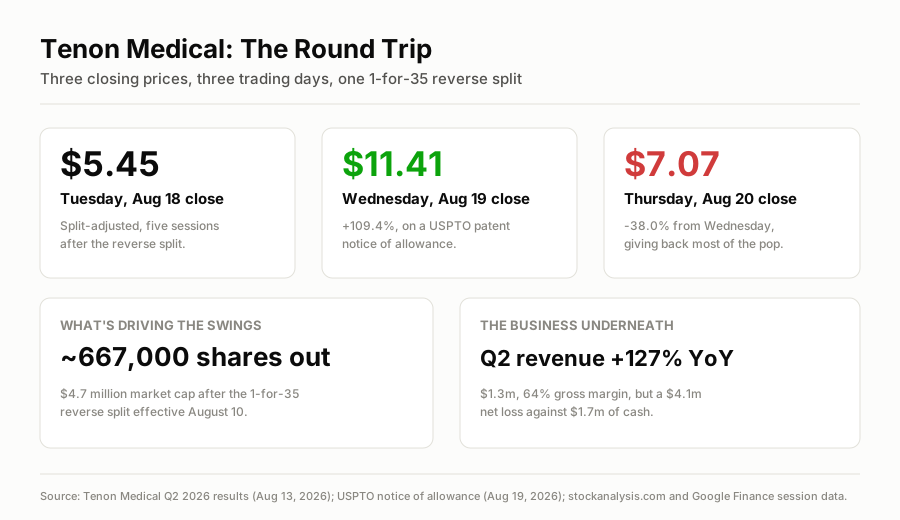
Up 109%, then down 38%: the same stock, two sessions apart.
Why a Patent Notice Moved the Stock This Much
A notice of allowance means the USPTO has decided to grant the patent once Tenon pays the issue fee. It is not a product approval and it does not, by itself, change what the company can sell or how much it can charge. What it does is strengthen the intellectual-property fence around Tenon's Catamaran SI Joint Fusion System, the single-implant device the company uses to treat sacroiliac joint disorders, at a moment when the company is trying to convince the market its growth is durable rather than a rounding error.
For a company with a $4.7 million market cap and roughly 667,000 shares outstanding after the reverse split, that is enough. A few thousand shares of buying can move the quoted price by double digits in either direction, and Wednesday's rally happened on exactly that kind of volume. Thursday's reversal did too.
The Reverse Split Sitting Underneath All of This
None of Wednesday's or Thursday's moves happened in isolation. Tenon announced a 1-for-35 reverse stock split on August 6, shareholders having approved it at the July 23 annual meeting, and it went effective at 12:01am ET on August 10. The reason was Nasdaq's $1.00 minimum bid price rule: Tenon had already gone through one compliance cycle this year, regaining compliance on July 20, then falling back under $1 again and facing an August 24 deadline to fix it or risk delisting.
A reverse split does not change the value of anyone's holding. It multiplies the price by 35 and divides the share count by the same number. What it does change is how violently the stock can move on a given amount of dollar volume, because the same buying pressure now moves a $7 stock by a much larger percentage than it moved a $0.20 stock. That mechanical fact is a large part of why a single patent notice, or a single earnings report, can now swing this name by triple digits in a day.
Three days after the split closed, on August 17, Tenon also disclosed a $100 million shelf registration alongside a $4.4 million at-the-market equity program with A.G.P./Alliance Global Partners. That is the company's answer to the cash problem below. It is also an overhang: shares sold through an ATM program go straight into the market at the prevailing price, and that is one plausible reason Wednesday's spike did not hold into Thursday.
The Business Underneath the Ticker
Strip out the split and the patent news, and Tenon's actual quarter was a real improvement for a company that has spent years barely moving:
- Q2 2026 revenue: $1.3 million, up 127% from $0.6 million in Q2 2025.
- Q2 gross profit: $0.8 million, up 232%, on a gross margin of 64%, a 21-point improvement from 43% a year earlier.
- Six-month revenue: $2.7 million, up 106% from $1.3 million in the first half of 2025.
- Net loss: $4.1 million for the quarter, versus a $2.8 million loss in Q2 2025. The loss widened even as revenue and margin improved, which is the tension at the center of this stock.
- Cash: $1.7 million as of June 30, 2026, down from $3.8 million at the end of 2025.
- An FDA 510(k) clearance for an updated version of the Catamaran system, granted in early July, and what the company described as a record month of case volume in July.
Read those together and the picture is a small medical device company whose commercial rollout is finally working, on a cost base that is still burning cash faster than the revenue is growing. That is exactly the kind of company a reverse split and a shelf registration are built for: buy time and raise capital while the underlying numbers catch up.
The Bear Case
- The company had $1.7 million in cash on June 30 and lost $4.1 million in the same quarter. Without the ATM program actively selling stock, the math does not work for more than a couple of quarters.
- The stock just proved it can lose 38% in a single session on no company-specific bad news, purely as the flip side of Wednesday's patent-driven pop. That is a volatility profile, not a valuation one.
- A notice of allowance is not a granted patent, and it changes nothing about near-term revenue. The market's reaction was almost entirely about scarcity of float, not new information about the business.
- The Nasdaq deadline is real. The reverse split addressed the immediate $1.00 bid-price problem, but a company that needed a 1-for-35 split to get there has already told the market plainly how thin the demand for its shares has become.
The Bull Case
- Revenue growth is not a one-quarter fluke. 127% year-over-year growth alongside a 21-point margin expansion, in the same quarter, is the kind of pairing that shows up when a product finally gets commercial traction rather than when a company changes how it counts something.
- The FDA clearance and the patent allowance both point at the same commercial bet: SI joint fusion is a real and growing procedure category, and Tenon is trying to lock in both the regulatory and intellectual-property ground it needs to compete against larger device makers.
- A $4.7 million market cap against $2.7 million of six-month revenue is not expensive if the growth rate holds and the company can bridge its cash gap without diluting shareholders into oblivion.
The Practical Constraint
There is no listed options chain on TNON. That was true before the reverse split and it is still true after it: a stock this thin and this newly recapitalized has not attracted market-maker interest in an options market. The only way to express a view here, in either direction, is the common stock itself, at whatever the bid-ask spread happens to be on a given minute. Combined with the share count, that makes this a name where the spread, not the thesis, decides how much of any move actually reaches an investor's account. The same constraint showed up on Huize Holding's post-earnings spike two days earlier, and it is a recurring feature of stocks this small, alongside the kind of thin-float mechanics that drove T3 Defense's float squeeze and RVII's post-spinoff swings.
Trade log
| # | Stance | Structure | Strikes and expiry | Cost or credit | Spot at writing | Implied move | Conviction | Breakeven |
|---|---|---|---|---|---|---|---|---|
| 1 | Pass | Any options structure | N/A, no listed chain | N/A | $7.07 (Aug 20 close) | Not sourceable | 4/10 | N/A |
| 2 | Pass | Common stock, chasing the reversal either direction | N/A | N/A | $7.07 (Aug 20 close) | N/A | 5/10 | N/A |
Neither row is a recommendation to trade this name. The first pass exists because no options market can be sourced on TNON at all. The second is a pass on chasing either the Wednesday spike or the Thursday reversal with fresh money: a stock that has already round-tripped 109% up and 38% down in two sessions, sitting on $1.7 million of cash against a $4.1 million quarterly loss, is a coin flip dressed up as a chart pattern until the next data point (a case-volume update, or news on the ATM program's pace) actually arrives.
The One-Line Read
Tenon's underlying business had a genuinely good quarter, but the stock's 109% spike and 38% giveback were mostly about a 667,000-share float and a fresh reverse split doing what reverse splits do, and I would want to see the ATM program's actual pace before trusting either print.
Next up:Fed minutes, tomorrow at 2:00pm ET →
More on Single Stocks
Updated Every Saturday
The Week Ahead
Every earnings date, Fed event and setup for the current trading week, on one page.
Refreshed Weekly
Earnings Calendar
Who reports next, when, and what consensus and the whisper expect.
The Week-Ahead Brief
Don’t miss next week’s setups. Get the Sunday brief.
Latest issue, Sep 27“Micron, PCE and the jobs report that decides October”
Every Sunday: next week’s earnings dates, Fed days and the trades worth watching, from the same desk that writes the week-ahead hub. Free, built for retail investors.