Is the AI Chip Trade Back? MU, SNDK and the Memory Names Ripped Again Today. V-Shape or Bull Trap?
Memory stocks surged again July 21: SanDisk +8%, Western Digital +9%, Micron +7%, with banks buying the dip. Is the AI chip trade back, or a bull trap?
TL;DR
- Memory ripped for a second straight day: SanDisk +8% (to
$1,504), Western Digital +9% ($531), Micron +7% (~$923), building on a July 20 session already up 4-6%. - The banks are openly buying the dip: Morgan Stanley models memory prices rising at least 25% from Q2 to Q3 and said it's "buying the dip"; BofA lifted its Micron target to $1,550; UBS is at a Street-high $1,625.
- The hole is real: the PHLX chip index fell ~20% over the prior month. A two-day bounce off a 20% drawdown is not yet a V; it's a bounce with good sponsorship.
- Our call: the fundamentals under memory (sold-out HBM, extended DRAM shortage) never broke, so this is a rebound with receipts, not just a reflex. But it's still a bounce inside a violent tape, and the falsification tests below decide whether it becomes a V.
More on $SMH: Why AI Stocks Dumped Today: Three Hammers, One Session →
The Board
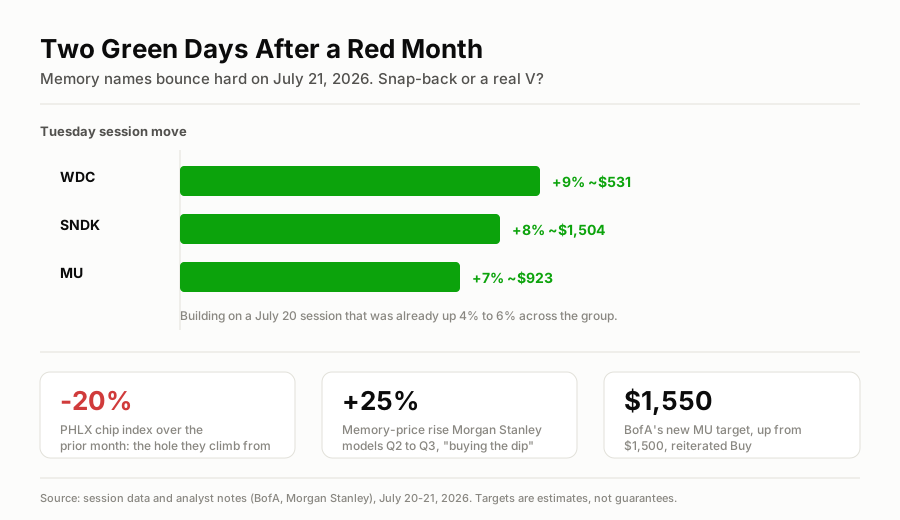
Two green days. The question is whether they're the bottom of a V or the top of a bounce.
What Actually Happened Today
The whole memory complex went vertical. SanDisk jumped as much as 10% before settling up around 8%, Western Digital climbed 9%, and Micron added 7%, following a July 20 session where the same names were already up 4% to 6%. Two days, one direction, hard.
And it had sponsorship, not just short-covering. Morgan Stanley put out a note forecasting memory prices rise at least 25% from Q2 to Q3 and said out loud that it's "buying the dip." Bank of America's Vivek Arya bumped his Micron target to $1,550 and reiterated Buy. Stack that on the UBS $1,625 call we broke down in the Micron 10% jump piece, and you have three big desks pounding the table in the same week. When the sell-side turns buyers into a falling knife, the knife tends to stop falling for a while.
Why This Is a Rebound With Receipts
Here's the part that separates this from a random dead-cat bounce: the fundamentals never actually broke. The selloff that took the chip index down ~20% on the month was about valuation, positioning, and one genuine China scare, not about demand collapsing.
Look at what's still true underneath the red candles:
- HBM is sold out for all of 2026 and booked into 2028, with Micron filling only 50-65% of key customer demand. You don't get a demand cliff and a two-year sold-out order book in the same breath.
- The shortage got longer, not shorter. UBS pushed its DRAM-undersupply call out to at least Q2 2028, and Morgan Stanley is modeling higher memory prices into Q3.
- Micron's last quarter was a record, with revenue quadrupling year over year on the memory crunch, the print we covered in the sell-the-news crater.
That's the difference between this dip and a real cycle top. At a genuine top, pricing rolls over and inventories balloon. Here, the pricing is still rising and the product is sold out. The memory supercycle thesis check laid out the falsification tests, and none of them have tripped.
Why It Might Still Be a Bull Trap
Now the cold water, because a two-day bounce is exactly what bear markets serve up to trap the hopeful.
The math of a 20% drawdown is brutal. Down 20% needs +25% just to get flat, so today's +7% to +9% is a dent, not a recovery. Sharp counter-trend rallies are a defining feature of downtrends, not evidence they're over. We flagged this exact question in can memory stocks bounce or keep dumping, and nothing since has changed the answer: you can't confirm a V from inside day two.
The China threat didn't disappear. CXMT's funded push into commodity DRAM, the fundamental behind Micron breaking $900, is still scheduled supply. It doesn't touch HBM, but it caps the commodity-memory half of the story, and it's still coming.
The broader AI trade is the real overhang. If sentiment on AI spend genuinely unwinds, the theme we picked apart in why AI stocks dumped and the KOSPI circuit-breaker memory dump, then sold-out HBM books won't save the tape. Every AI-adjacent ticker goes down together in a real unwind, receipts or not. And with megacap tech earnings landing this week, the whole group is one soft guide away from re-testing the lows.
The Falsification Tests: What Turns a Bounce Into a V
Stop guessing at candles and watch these instead:
- The megacap capex prints. If the hyperscalers reaffirm or raise AI spending this earnings season, the demand pillar under memory holds and the V gets real. A single capex cut is the fastest way to invalidate the whole bounce.
- Follow-through, not just a two-day pop. A V needs the group to reclaim and hold prior support on volume, not fade the rally by Thursday. Watch whether MU holds above its recent lows and whether SNDK and WDC keep leading.
- SK Hynix and the memory peers. The read-through from SK Hynix's record on the Nasdaq is the cleanest confirmation that memory pricing is still tightening industry-wide, not just in one company's guidance.
- NAND, not just DRAM. SanDisk leading (the $1,900 NAND-shortage rollercoaster) tells you the strength is broadening across memory types, which is what a durable recovery looks like versus a narrow HBM-only bid.
The Options Angle
- Chasing day two with naked calls is how you donate premium. You'd be paying peak fear-to-greed implied volatility right as it deflates. If you want long exposure, call spreads cap the IV-crush bleed; the calls and puts guide has the mechanics.
- Sell fear on the survivors, carefully. Selling cash-secured puts on the sold-out HBM names into weakness pays you to wait for the demand thesis, but only on the names where the fundamental is intact, and only if you'd actually want the shares lower.
- Into the megacap capex prints, structure over direction. If you expect fireworks but won't call the sign, that's straddle territory on the chip ETFs or the leaders. Check the priced-in move before you pay for it.
- Don't short it just because "it bounced too fast." Three big desks are buying, the order book is sold out, and squeezes off oversold lows are vicious. The bear case here is a macro/capex event, and you can't schedule those, so express it with defined risk, not naked shorts.
The One-Line Read
The AI chip trade isn't confirmed "back," but this is a rebound with receipts: the HBM book is still sold out, the shortage got longer, and three big desks are buying the dip, so it's far more than a reflex bounce, yet a two-day pop off a 20% drawdown is not a V until the megacap capex prints hold and the group follows through, so trade it long with defined risk and let this week's earnings, not today's green candles, tell you whether the bottom is in.
Next up:PPI, today at 8:30am ET →
More on $SMH
Updated Every Saturday
The Week Ahead
Every earnings date, Fed event and setup for the current trading week, on one page.
Refreshed Weekly
Earnings Calendar
Who reports next, when, and what consensus and the whisper expect.
The Week-Ahead Brief
Don’t miss next week’s setups. Get the Sunday brief.
Latest issue, Sep 7“Week ahead in the stock market...”
Every Sunday: next week’s earnings dates, Fed days and the trades worth watching, from the same desk that writes the week-ahead hub. Free, built for retail investors.